Thank you for visiting SNEWPapers!
Sign up free
Corpus Christi Caller And Daily Herald
Corpus Christi, Nueces County, Texas
What is this article about?
In Corpus Christi, Texas, Mayor Roy Miller and Joe Hirsch plan a meeting for farmers, merchants, and others to discuss reducing cotton acreage and increasing food production due to WWI surplus and high food prices. Includes Dept. of Agriculture letter urging diversification and a nostalgic anecdote on self-sufficient farming.
Clipping
OCR Quality
Full Text
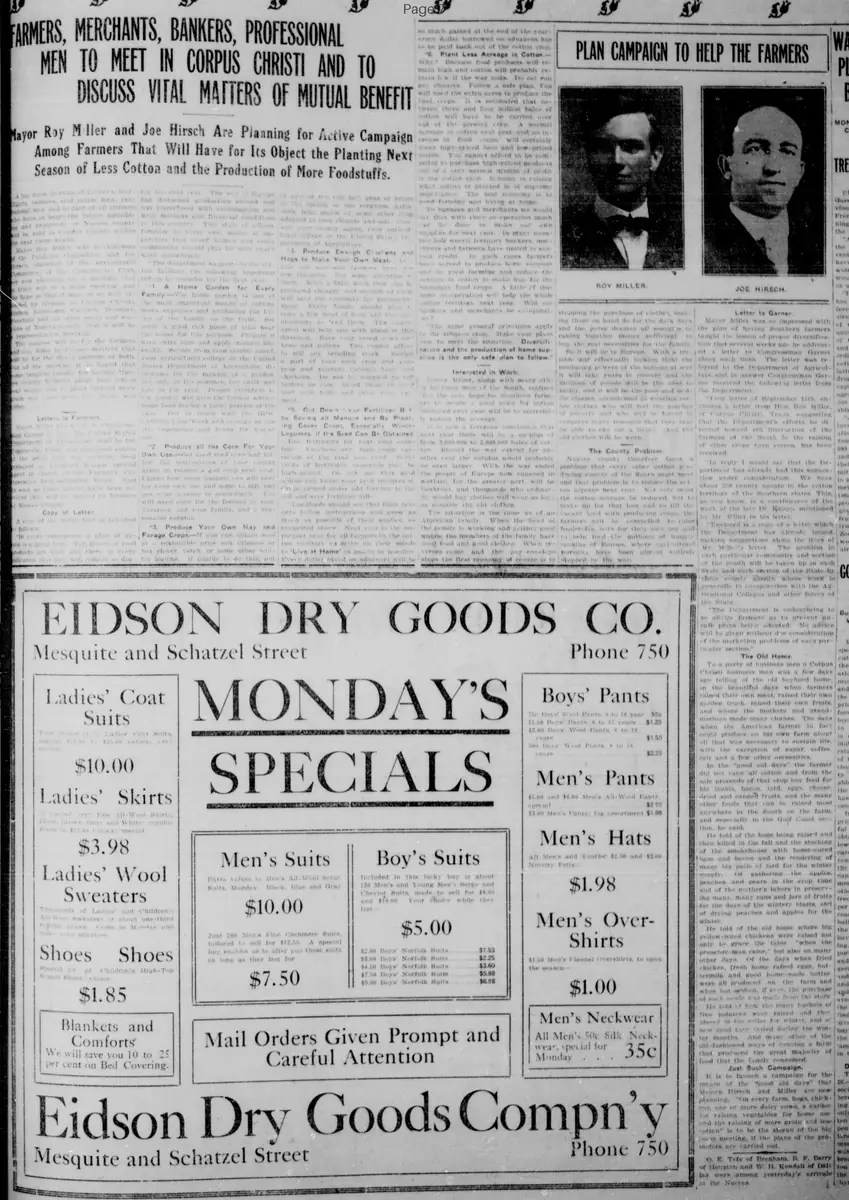
Mayor Roy Miller and Joe Hirsch Are Planning for Active Campaign Among Farmers That Will Have for Its Object the Planting Next Season of Less Cotton and the Production of More Foodstuffs.
A meeting of professional men and all citizens who have at heart the future upbuilding of the city will be held in Corpus Christi within the next three weeks. Mayor Roy Miller, who is chairman of the agricultural committee of the chamber of commerce, and Joe Hirsch, chairman of the committee on agriculture, have planned a meeting that in their opinion will be of great benefit to the city.
It is hoped that it will be attended by every citizen of Corpus Christi. H. B. Robertson, Allen Hunter, S. N. Sunshine and all other sorts and conditions of men, as well as John Doe of Nueces county, feel that it will be of great benefit to the farmers, representatives, merchants, bankers and everybody to discuss matters that will be for the direct interest of both, but of the meeting it is hoped that due tangible results for easing the cotton situation and all cotton planting at least a one-point idea among all.
Letters to Farmers
Mr. M. Farmer,
The Department of Agriculture mails to merchants, bankers and cotton men in the state the following letter:
If the situation be reported half as strong as it is, the department is prepared to do everything in its power to help the farmers in this crisis. The imperative need of planting work does not end with this.
It is estimated that between three and four million bales of cotton will have to be carried over out of the present crop. A normal acreage in cotton next year, and no increase in food crops, will certainly mean high-priced food and low-priced cotton. You cannot afford to be compelled to purchase high-priced foodstuffs out of a very narrow margin of profit in the cotton crop. It means in raising what cotton is planted in September.
The best economy is in home farming and living at home.
To bankers and merchants we would ask their cooperation to match ours to make our own supplies for next year. In many cases in this territory bankers, merchants and farmers have united to sustain credit. In such cases farmers have agreed to plant home supplies and so cut farm expenses and reduce the acreage in cotton to make way for the necessary food crops. A little of that same cooperation will help the whole situation next year.
Bankers and merchants can cooperate in the same general principles apply to the tobacco crop. Make your plans to meet the situation.
Diversification and the production of home supplies is the only safe plan to follow. Plant Less Acreage in Cotton - Why? Because food products will remain high and cotton will probably remain as it is. The war induces that, and chances follow a safe plan. You will need the extra acres to produce the food crops.
It is estimated that between three and four million bales of cotton will have to be carried over out of the present crop. A normal acreage in cotton next year, and no increase in food crops, will certainly mean high-priced food and low-priced cotton. You cannot afford to be compelled to purchase high-priced foodstuffs out of a very narrow margin of profit in the cotton crop. It means in raising what cotton is planted in September.
The best economy is in home farming and living at home. To bankers and merchants we would ask their cooperation to match ours to make our own supplies for next year. In many cases in this territory bankers, merchants and farmers have united to sustain credit. In such cases farmers have agreed to plant home supplies and so cut farm expenses and reduce the acreage in cotton to make way for the necessary food crops. A little of that same cooperation will help the whole situation next year.
Bankers and merchants can cooperate in the same general principles apply to the tobacco crop. Make your plans to meet the situation. Diversification and the production of home supplies is the only safe plan to follow. PLAN CAMPAIGN TO HELP THE FARMERS
Roy Miller, along with many other business men in the South, realizes the only hope for Southern farm owners to secure a good price for cotton next year will be to materially reduce the acreage. It is now a foregone conclusion that next season there will be a surplus of from 2,000,000 to 3,000,000 bales of cotton. Should the war extend for another year the surplus would probably be even larger. With the war ended the people of Europe, now engaged in warfare, for the greater part will be bankrupt, and thousands who ordinarily buy clothes will wear as long as possible the old clothes.
The situation is the same as of an African family. When the head of the family is working and getting good wages the members of the family have good food and good clothes. When reverses come and the pay envelope is small, the first things to be stopped is the purchase of clothes, and those on hand do for the dark days, and the father devotes his earnings to buying the meat necessary for the family.
So it will be in Europe. With a terrible war effectually locking tight the producing in war of the nations at war it will take years to recover and the millions of people will be the open market, and it will be the fad as it is in India to wear cotton clothes. Who will be the producers of rust and also want to fatten to conserve every means that this means to be able to cut out a little and the old clothes will be worn.
Nueces county therefore faces a problem that every other cotton producing county of the South must meet and that problem is to reduce the cotton acreage next year. Not only must the cotton acreage be reduced but to make up for that loss and to fill the larder full with producing crops the farmers will be compelled to raise foodstuffs both for their own use and to help feed the millions of hungry mouths of Europe where all usual purchases have been almost entirely cut off.
Mayor Miller was so impressed with the plan of having Southern farmers taught the lesson of proper diversification that several weeks ago he addressed a letter to Congressman Garner along such lines. The letter was referred to the Department of Agriculture and in answer Congressman Garner received the following letter from the department under date of September 18th in closing a letter from Hon. Roy Miller of Corpus Christi, Tex., suggesting that the department's efforts be directed toward the instruction of the farmers of the South in the raising of other crops than cotton, has been received.
In reply I would say that the department has already had this matter under consideration. We have about 80 county agents in the cotton territory of the Southern states. This, as I know, is a continuation of the work of the late Dr. Knapp mentioned by Mr. Miller in his letter. Enclosed is a copy of a letter which the department has already issued making suggestions along the lines of Mr. Miller's letter. The problem in each particular community and section of the South will be taken up in detail and each state plan of the state be county work is generally in cooperation with the agricultural colleges and other forces of the state.
The department is endeavoring to so advise farmers as to interest an adoption of safe plans. No advice will be given without due consideration of the marketing problems of each particular section. Mayor Miller was so impressed with the plan of having Southern farmers taught the lesson of proper diversification that several weeks ago he addressed a letter to Congressman Garner along such lines. The letter was referred to the Department of Agriculture and in answer Congressman Garner received the following letter from the department.
The Old Home
To a party of business men a Corpus Christi business man was a few days ago telling of the old boyhood home, in the beautiful days when farmers raised their own meat, raised their own garden truck, raised their own fruits, and where the mothers and grandmothers made many clothes. The days when the American farmer in fact could produce on his own farm about all that was necessary to sustain life with the exception of sugar, coffee, salt and a few other necessities.
In the "good old days" the farmer did not raise all cotton and from the sale proceeds of that crop buy feed for his teams, bacon, lard, eggs, cheese, dried and canned fruits, and the many other foods that can be raised most anywhere in the South on the farm, and especially in the Gulf Coast section, he said.
He told of the hogs being raised and then killed in the fall and the stocking of the smokehouse with hickory-cured ham and bacon and the rendering of many big pails of lard for the winter supply, of gathering the apples, peaches, and pears in the crop time and of the mother's labors in preserving many, many cans and jars of fruits for the days of the wintery blasts and of drying peaches and apples for the winter.
He told of the old home where big yellow-legged chickens were raised not only to grace the table "when the preacher-man came," but also on many other days. Of the day when fried chicken, fresh home-raised eggs, buttermilk and good home-made butter were all produced on the farm and when but seldom, if ever, the purchase of such meals was made through the store.
He told of the many bushels of fine potatoes were raised and then banked in the cellar for winter, and how good they tasted during the winter months. And many other of the old-fashioned ways of running a farm that produced the great majority of food that the family consumed.
Just Such Campaign.
It is to launch a campaign for the return of the "good old days" that Hirsch, Miller and others are now planning. "On every farm, hogs, chickens, one or more dairy cows, a garden for raising vegetables for home use and the raising of more grain and less cotton" is to be the slogan of the big mass meeting, if the plans of the promoters are carried out.
O. E. Teft of Brenham, B. F. Berry of Houston and W. H. Kendall of Dallas were among yesterday's arrivals at the Nueces.
What sub-type of article is it?
What themes does it cover?
What keywords are associated?
What entities or persons were involved?
Where did it happen?
Story Details
Key Persons
Location
Corpus Christi, Texas; Nueces County
Event Date
Within The Next Three Weeks; September 18th
Story Details
Planning of a meeting in Corpus Christi to promote agricultural diversification by reducing cotton planting and increasing food crops due to WWI-induced surplus and high food prices; includes Department of Agriculture letter urging cooperation among farmers, bankers, and merchants; nostalgic anecdote on self-sufficient farming practices.