Thank you for visiting SNEWPapers!
Sign up free
Literary
August 26, 1789
Gazette Of The United States
New York, New York County, New York
What is this article about?
Dr. Mitchell addresses Miss S in an epistolary essay on the philosophy of housekeeping, detailing the science of bread-making from wheat analysis to avoiding faults in flour milling and baking, emphasizing wheat's superiority for nutritious, economical family food.
Clipping
OCR Quality
85%
Good
Full Text
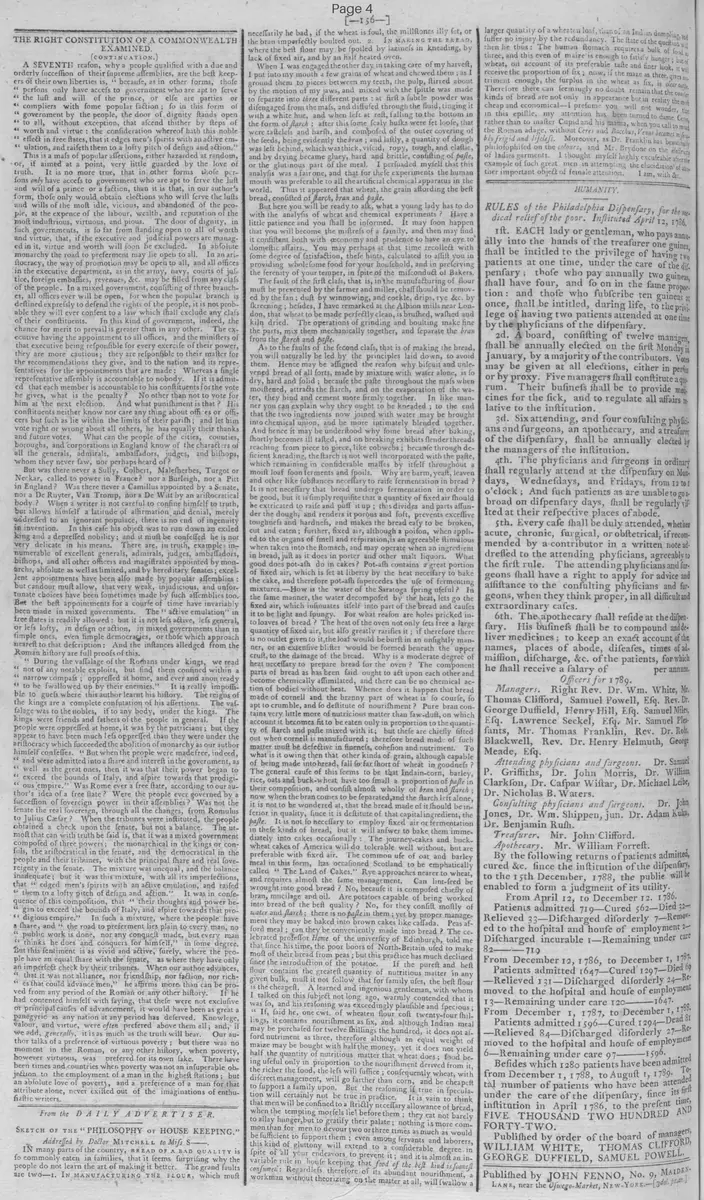
From the DAILY ADVERTISER.
SKETCH OF THE "PHILOSOPHY OF HOUSE KEEPING."
Addressed by Doctor MITCHELL to Miss S
IN many parts of the country, BREAD OF A BAD QUALITY is so commonly eaten in families, that it seems surprising why the people do not learn the art of making it better. The grand faults are two—1. IN MANUFACTURING THE FLOUR, which must necessarily be bad, if the wheat is foul, the millstones ill set, or the bran imperfectly bolted out. 2. IN MAKING THE BREAD, where the best flour may be spoiled by laziness in kneading, by lack of fixed air, and by a half heated oven.
When I was engaged the other day in taking care of my harvest, I put into my mouth a few grains of wheat and chewed them; as I ground them to pieces between my teeth, the pulp, stirred about by the motion of my jaws, and mixed with the spittle was made to separate into three different parts: at first a subtle powder was disengaged from the mass, and diffused through the fluid, tinging it with a white hue, and when left at rest, falling to the bottom in the form of starch: after this some clay husks were set loose, that were tasteless and harsh, and composed of the outer covering of the seeds, being evidently the bran; and lastly, a quantity of dough was left behind, which was thick, viscid, ropy, tough, and elastic, and by drying became gluey, hard and brittle, consisting of paste, or the glutinous part of the meal. I persuaded myself that this analysis was a fair one, and that for these experiments the human mouth was preferable to all the artificial chemical apparatus in the world. Thus it appeared that wheat, the grain affording the best bread, consisted of starch, bran and paste.
But here you will be ready to ask, what a young lady has to do with the analysis of wheat and chemical experiments? Have a little patience and you shall be informed. It may soon happen that you will become the mistress of a family, and then may find it consistent both with economy and prudence to have an eye to domestic affairs. You may perhaps at that time recollect with some degree of satisfaction, these hints, calculated to assist you in providing wholesome food for your household, and in preserving the serenity of your temper, in spite of the misconduct of Bakers.
The fault of the first class, that is, in the manufacturing of flour must be prevented by the farmer and miller, chaff should be removed by the fan; dust by winnowing, and cockle, trips, rye &c. by screening; besides, I have remarked at the Albion mills near London, that wheat to be made perfectly clean, is brushed, washed and kiln dried. The operations of grinding and bolting make fine the parts, mix them mechanically together, and separate the bran from the starch and paste.
As to the faults of the second class, that is of making the bread, you will naturally be led by the principles laid down, to avoid them. Hence may be assigned the reason why biscuit and unleavened bread of all sorts, made by mixture with water alone, is so dry, hard and solid; because the paste throughout the mass when moistened, attracts the starch, and on the evaporation of the water, they bind and cement more firmly together. In like manner you can explain why they ought to be kneaded; to the end that the two ingredients now joined with water may be brought into chemical union, and be more intimately blended together. And hence it may be understood why some bread after baking, shortly becomes ill tasted, and on breaking exhibits slender threads reaching from piece to piece, like cobwebs; because through deficient kneading, the starch is not well incorporated with the paste, which remaining in considerable masses by itself throughout a moist loaf soon ferments and spoils. Why are barm, yeast, leaven and other like substances necessary to raise fermentation in bread? It is not necessary that bread undergo fermentation in order to be good, but it is simply requisite that a quantity of fixed air should be extricated to raise and puff it up; this divides and parts asunder the dough, and renders it porous and soft, prevents excessive toughness and hardness, and makes the bread easy to be broken, cut and eaten; further, fixed air, although a poison, when applied to the organs of smell and respiration, is an agreeable stimulus when taken into the stomach, and may operate when an ingredient in bread, just as it does in porter and other malt liquors. What good does pot-ash do in cakes? Pot-ash contains a great portion of fixed air, which is set at liberty by the heat necessary to bake the cake, and therefore pot-ash supersedes the use of fermenting mixtures.—How is the water of the Saratoga spring useful? In the same manner, the water decomposed by the heat, lets go the fixed air, which insinuates itself into part of the bread and causes it to be light and spongy. For what reason are holes pricked into loaves of bread? The heat of the oven not only sets free a large quantity of fixed air, but also greatly rarifies it; if therefore there is no outlet given to it, the loaf would be burst in an unsightly manner, or an extensive blister would be formed beneath the upper crust, to the damage of the bread. Why is a moderate degree of heat necessary to prepare bread for the oven? The component parts of bread as has been said ought to act upon each other and become chemically assimilated, and there can be no chemical action of bodies without heat. Whence does it happen that bread made of cornmeal and the branny part of wheat is so coarse, so apt to crumble, and so destitute of nourishment? Pure bran contains very little more of nutritious matter than saw-dust, on which account it becomes fit to be eaten only in proportion to the quantity of starch and paste mixed with it; but these are chiefly sifted out when cornmeal is manufactured; therefore bread made of such matter must be defective in fineness, cohesion and nutriment. To what is it owing then that other kinds of grain, although capable of being made into bread, fall so far short of wheat in goodness? The general cause of this seems to be that Indian-corn, barley, rice, oats and buck-wheat have too small a proportion of paste in their composition, and consist almost wholly of bran and starch; now when the bran comes to be separated, and the starch left alone, it is not to be wondered at, that the bread made of it should be inferior in quality, since it is destitute of that capital ingredient, the paste. It is not so necessary to employ fixed air or fermentation in these kinds of bread, but it will answer to bake them immediately into cakes occasionally: The journey-cakes and buckwheat cakes of America will do tolerable well without, but are preferable with fixed air. The common use of oat and barley meal in this form, has occasioned Scotland to be emphatically called "The Land of Cakes." Rye approaches nearer to wheat, and requires almost the same management. Can linseed be wrought into good bread? No, because it is composed chiefly of bran, mucilage and oil. Are potatoes capable of being worked into bread of the best quality? No, for they consist mostly of water and starch; there is no paste in them; yet by proper management they may be baked into brown cakes like cassada. Peas afford meal; can they be conveniently made into bread? The celebrated professor Home of the university of Edinburgh, told me that since his time, the poor boors of North-Britain used to make most of their bread from peas; but this practice has much declined since the introduction of the potato.
If the purest and best flour contains the greatest quantity of nutritious matter in any given bulk, must it not follow that for family uses, the best flour is the cheapest. A learned and ingenious gentleman, with whom I talked on this subject not long ago, warmly contended that it was so, and his reasoning was exceedingly plausible and specious; "If, said he, one cwt. of wheaten flour cost twenty-four shillings, it contains nourishment as six, and although Indian meal may be purchased for twelve shillings the hundred, it does not afford nutriment as three, therefore although an equal weight of maize may be bought with half the money, yet it does not yield half the quantity of nutritious matter that wheat does; food being useful only in proportion to the nourishment derived from it, the richer the food, the less will suffice; consequently wheat, with discreet management, will go farther than corn, and be cheapest to support a family upon." But the reasoning if true in speculation will certainly not be true in practice. It is vain to think that men will be confined to a strictly necessary allowance of bread, when the tempting morsels lie before them; they eat not barely to allay hunger, but to gratify their palate; nothing is more common than for men to devour two or three times as much as would be sufficient to support them; even among servants and laborers, this kind of gluttony will extend to a considerable degree in spite of all your endeavors to prevent it; and it is almost an invariable rule in house keeping that food of the best kind is soonest consumed: Regardless therefore of its abundant nourishment, a workman without theorizing on the matter at all, will swallow a larger quantity of a wheaten loaf, than of an Indian dumpling, and suffer no injury by the redundancy. The state of things will then be thus: The human stomach requires a bulk of food, and this even of maize is enough to satisfy hunger, but of wheat on account of its preferable taste and finer look it will receive no more than the enough proportion, the surplus now if wheat as six maize as three is clear gives a glut. Therefore kinds of bread there are cannot seemingly appearance no doubt but in reality the most cheap and economical—I presume you will not wonder that in this epistle my attention has been turned to dame Ceres rather than to master Cupid and his mama, when you call to mind the Roman adage, without Ceres and Bacchus, Venus becomes miserably frigid and lifeless. Moreover, as Dr. Franklin has beautifully philosophied on the colours and Mr. Brydone on the electricity of ladies garments. I thought myself highly excusable after the example of such great men in attempting the elucidation of another important object of female attention.
I am, with &c.
SKETCH OF THE "PHILOSOPHY OF HOUSE KEEPING."
Addressed by Doctor MITCHELL to Miss S
IN many parts of the country, BREAD OF A BAD QUALITY is so commonly eaten in families, that it seems surprising why the people do not learn the art of making it better. The grand faults are two—1. IN MANUFACTURING THE FLOUR, which must necessarily be bad, if the wheat is foul, the millstones ill set, or the bran imperfectly bolted out. 2. IN MAKING THE BREAD, where the best flour may be spoiled by laziness in kneading, by lack of fixed air, and by a half heated oven.
When I was engaged the other day in taking care of my harvest, I put into my mouth a few grains of wheat and chewed them; as I ground them to pieces between my teeth, the pulp, stirred about by the motion of my jaws, and mixed with the spittle was made to separate into three different parts: at first a subtle powder was disengaged from the mass, and diffused through the fluid, tinging it with a white hue, and when left at rest, falling to the bottom in the form of starch: after this some clay husks were set loose, that were tasteless and harsh, and composed of the outer covering of the seeds, being evidently the bran; and lastly, a quantity of dough was left behind, which was thick, viscid, ropy, tough, and elastic, and by drying became gluey, hard and brittle, consisting of paste, or the glutinous part of the meal. I persuaded myself that this analysis was a fair one, and that for these experiments the human mouth was preferable to all the artificial chemical apparatus in the world. Thus it appeared that wheat, the grain affording the best bread, consisted of starch, bran and paste.
But here you will be ready to ask, what a young lady has to do with the analysis of wheat and chemical experiments? Have a little patience and you shall be informed. It may soon happen that you will become the mistress of a family, and then may find it consistent both with economy and prudence to have an eye to domestic affairs. You may perhaps at that time recollect with some degree of satisfaction, these hints, calculated to assist you in providing wholesome food for your household, and in preserving the serenity of your temper, in spite of the misconduct of Bakers.
The fault of the first class, that is, in the manufacturing of flour must be prevented by the farmer and miller, chaff should be removed by the fan; dust by winnowing, and cockle, trips, rye &c. by screening; besides, I have remarked at the Albion mills near London, that wheat to be made perfectly clean, is brushed, washed and kiln dried. The operations of grinding and bolting make fine the parts, mix them mechanically together, and separate the bran from the starch and paste.
As to the faults of the second class, that is of making the bread, you will naturally be led by the principles laid down, to avoid them. Hence may be assigned the reason why biscuit and unleavened bread of all sorts, made by mixture with water alone, is so dry, hard and solid; because the paste throughout the mass when moistened, attracts the starch, and on the evaporation of the water, they bind and cement more firmly together. In like manner you can explain why they ought to be kneaded; to the end that the two ingredients now joined with water may be brought into chemical union, and be more intimately blended together. And hence it may be understood why some bread after baking, shortly becomes ill tasted, and on breaking exhibits slender threads reaching from piece to piece, like cobwebs; because through deficient kneading, the starch is not well incorporated with the paste, which remaining in considerable masses by itself throughout a moist loaf soon ferments and spoils. Why are barm, yeast, leaven and other like substances necessary to raise fermentation in bread? It is not necessary that bread undergo fermentation in order to be good, but it is simply requisite that a quantity of fixed air should be extricated to raise and puff it up; this divides and parts asunder the dough, and renders it porous and soft, prevents excessive toughness and hardness, and makes the bread easy to be broken, cut and eaten; further, fixed air, although a poison, when applied to the organs of smell and respiration, is an agreeable stimulus when taken into the stomach, and may operate when an ingredient in bread, just as it does in porter and other malt liquors. What good does pot-ash do in cakes? Pot-ash contains a great portion of fixed air, which is set at liberty by the heat necessary to bake the cake, and therefore pot-ash supersedes the use of fermenting mixtures.—How is the water of the Saratoga spring useful? In the same manner, the water decomposed by the heat, lets go the fixed air, which insinuates itself into part of the bread and causes it to be light and spongy. For what reason are holes pricked into loaves of bread? The heat of the oven not only sets free a large quantity of fixed air, but also greatly rarifies it; if therefore there is no outlet given to it, the loaf would be burst in an unsightly manner, or an extensive blister would be formed beneath the upper crust, to the damage of the bread. Why is a moderate degree of heat necessary to prepare bread for the oven? The component parts of bread as has been said ought to act upon each other and become chemically assimilated, and there can be no chemical action of bodies without heat. Whence does it happen that bread made of cornmeal and the branny part of wheat is so coarse, so apt to crumble, and so destitute of nourishment? Pure bran contains very little more of nutritious matter than saw-dust, on which account it becomes fit to be eaten only in proportion to the quantity of starch and paste mixed with it; but these are chiefly sifted out when cornmeal is manufactured; therefore bread made of such matter must be defective in fineness, cohesion and nutriment. To what is it owing then that other kinds of grain, although capable of being made into bread, fall so far short of wheat in goodness? The general cause of this seems to be that Indian-corn, barley, rice, oats and buck-wheat have too small a proportion of paste in their composition, and consist almost wholly of bran and starch; now when the bran comes to be separated, and the starch left alone, it is not to be wondered at, that the bread made of it should be inferior in quality, since it is destitute of that capital ingredient, the paste. It is not so necessary to employ fixed air or fermentation in these kinds of bread, but it will answer to bake them immediately into cakes occasionally: The journey-cakes and buckwheat cakes of America will do tolerable well without, but are preferable with fixed air. The common use of oat and barley meal in this form, has occasioned Scotland to be emphatically called "The Land of Cakes." Rye approaches nearer to wheat, and requires almost the same management. Can linseed be wrought into good bread? No, because it is composed chiefly of bran, mucilage and oil. Are potatoes capable of being worked into bread of the best quality? No, for they consist mostly of water and starch; there is no paste in them; yet by proper management they may be baked into brown cakes like cassada. Peas afford meal; can they be conveniently made into bread? The celebrated professor Home of the university of Edinburgh, told me that since his time, the poor boors of North-Britain used to make most of their bread from peas; but this practice has much declined since the introduction of the potato.
If the purest and best flour contains the greatest quantity of nutritious matter in any given bulk, must it not follow that for family uses, the best flour is the cheapest. A learned and ingenious gentleman, with whom I talked on this subject not long ago, warmly contended that it was so, and his reasoning was exceedingly plausible and specious; "If, said he, one cwt. of wheaten flour cost twenty-four shillings, it contains nourishment as six, and although Indian meal may be purchased for twelve shillings the hundred, it does not afford nutriment as three, therefore although an equal weight of maize may be bought with half the money, yet it does not yield half the quantity of nutritious matter that wheat does; food being useful only in proportion to the nourishment derived from it, the richer the food, the less will suffice; consequently wheat, with discreet management, will go farther than corn, and be cheapest to support a family upon." But the reasoning if true in speculation will certainly not be true in practice. It is vain to think that men will be confined to a strictly necessary allowance of bread, when the tempting morsels lie before them; they eat not barely to allay hunger, but to gratify their palate; nothing is more common than for men to devour two or three times as much as would be sufficient to support them; even among servants and laborers, this kind of gluttony will extend to a considerable degree in spite of all your endeavors to prevent it; and it is almost an invariable rule in house keeping that food of the best kind is soonest consumed: Regardless therefore of its abundant nourishment, a workman without theorizing on the matter at all, will swallow a larger quantity of a wheaten loaf, than of an Indian dumpling, and suffer no injury by the redundancy. The state of things will then be thus: The human stomach requires a bulk of food, and this even of maize is enough to satisfy hunger, but of wheat on account of its preferable taste and finer look it will receive no more than the enough proportion, the surplus now if wheat as six maize as three is clear gives a glut. Therefore kinds of bread there are cannot seemingly appearance no doubt but in reality the most cheap and economical—I presume you will not wonder that in this epistle my attention has been turned to dame Ceres rather than to master Cupid and his mama, when you call to mind the Roman adage, without Ceres and Bacchus, Venus becomes miserably frigid and lifeless. Moreover, as Dr. Franklin has beautifully philosophied on the colours and Mr. Brydone on the electricity of ladies garments. I thought myself highly excusable after the example of such great men in attempting the elucidation of another important object of female attention.
I am, with &c.
What sub-type of article is it?
Epistolary
Essay
What themes does it cover?
Agriculture Rural
Moral Virtue
What keywords are associated?
Bread Making
Wheat Analysis
Housekeeping Philosophy
Domestic Economy
Flour Quality
Baking Faults
Nutritious Food
What entities or persons were involved?
Doctor Mitchell
Literary Details
Title
Sketch Of The "Philosophy Of House Keeping."
Author
Doctor Mitchell
Subject
Addressed To Miss S
Key Lines
When I Was Engaged The Other Day In Taking Care Of My Harvest, I Put Into My Mouth A Few Grains Of Wheat And Chewed Them; As I Ground Them To Pieces Between My Teeth, The Pulp... Consisted Of Starch, Bran And Paste.
It May Soon Happen That You Will Become The Mistress Of A Family, And Then May Find It Consistent Both With Economy And Prudence To Have An Eye To Domestic Affairs.
Wheat, With Discreet Management, Will Go Farther Than Corn, And Be Cheapest To Support A Family Upon." But The Reasoning If True In Speculation Will Certainly Not Be True In Practice.
Without Ceres And Bacchus, Venus Becomes Miserably Frigid And Lifeless.