Thank you for visiting SNEWPapers!
Sign up free
Story
August 20, 1830
Constitutional Whig
Richmond, Virginia
What is this article about?
The Literary Subaltern receives a note from the owner of Thomas Jefferson's original letter, who protests sending it to Richmond for authentication due to unreliable mails and political malice, demanding its return to Boston via Mr. William White amid controversy over its authenticity and impact on Jackson supporters.
Clipping
OCR Quality
95%
Excellent
Full Text
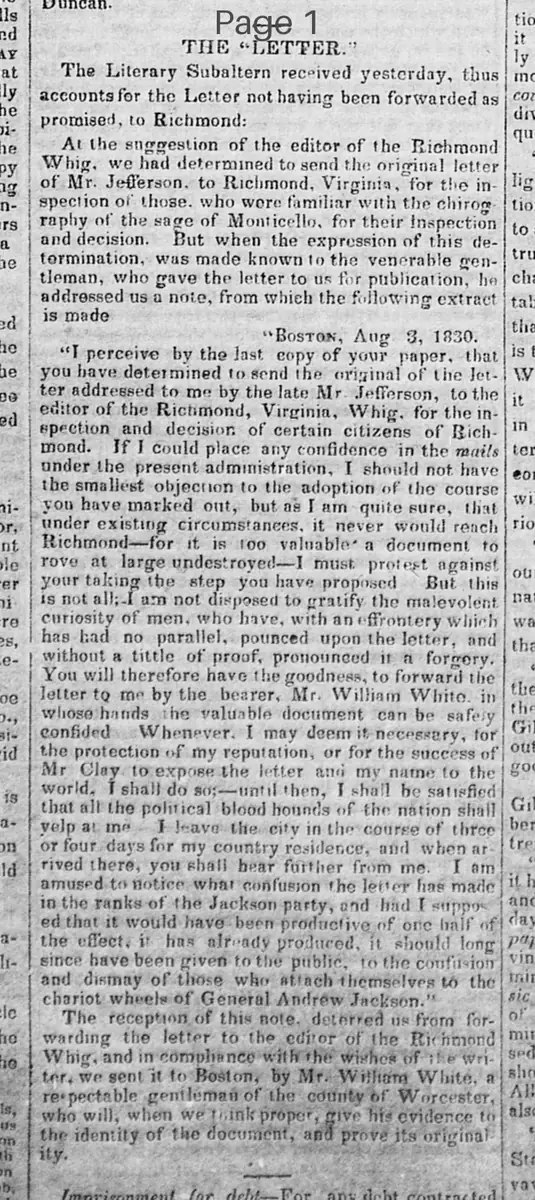
THE "LETTER."
The Literary Subaltern received yesterday, thus accounts for the Letter not having been forwarded as promised, to Richmond:
At the suggestion of the editor of the Richmond Whig, we had determined to send the original letter of Mr. Jefferson to Richmond, Virginia, for the inspection of those who were familiar with the chirography of the sage of Monticello, for their inspection and decision. But when the expression of this determination was made known to the venerable gentleman who gave the letter to us for publication, he addressed us a note, from which the following extract is made:
"Boston, Aug 3, 1830.
"I perceive by the last copy of your paper, that you have determined to send the original of the letter addressed to me by the late Mr. Jefferson, to the editor of the Richmond, Virginia, Whig, for the inspection and decision of certain citizens of Richmond. If I could place any confidence in the mails under the present administration, I should not have the smallest objection to the adoption of the course you have marked out, but as I am quite sure, that under existing circumstances, it never would reach Richmond--for it is too valuable a document to rove at large undestroyed--I must protest against your taking the step you have proposed. But this is not all; I am not disposed to gratify the malevolent curiosity of men, who have, with an effrontery which has had no parallel, pounced upon the letter, and without a tittle of proof, pronounced it a forgery.
You will therefore have the goodness to forward the letter to me by the bearer, Mr. William White, in whose hands the valuable document can be safely confided. Whenever I may deem it necessary, for the protection of my reputation, or for the success of Mr. Clay, to expose the letter and my name to the world, I shall do so; until then, I shall be satisfied that all the political blood hounds of the nation shall yelp at me. I leave the city in the course of three or four days for my country residence, and when arrived there, you shall hear further from me. I am amused to notice what confusion the letter has made in the ranks of the Jackson party, and had I supposed that it would have been productive of one half of the effect it has already produced, it should long since have been given to the public, to the confusion and dismay of those who attach themselves to the chariot wheels of General Andrew Jackson."
The reception of this note deterred us from forwarding the letter to the editor of the Richmond Whig, and in compliance with the wishes of the writer, we sent it to Boston, by Mr. William White, a respectable gentleman of the county of Worcester, who will, when we think proper, give his evidence to the identity of the document, and prove its originality.
The Literary Subaltern received yesterday, thus accounts for the Letter not having been forwarded as promised, to Richmond:
At the suggestion of the editor of the Richmond Whig, we had determined to send the original letter of Mr. Jefferson to Richmond, Virginia, for the inspection of those who were familiar with the chirography of the sage of Monticello, for their inspection and decision. But when the expression of this determination was made known to the venerable gentleman who gave the letter to us for publication, he addressed us a note, from which the following extract is made:
"Boston, Aug 3, 1830.
"I perceive by the last copy of your paper, that you have determined to send the original of the letter addressed to me by the late Mr. Jefferson, to the editor of the Richmond, Virginia, Whig, for the inspection and decision of certain citizens of Richmond. If I could place any confidence in the mails under the present administration, I should not have the smallest objection to the adoption of the course you have marked out, but as I am quite sure, that under existing circumstances, it never would reach Richmond--for it is too valuable a document to rove at large undestroyed--I must protest against your taking the step you have proposed. But this is not all; I am not disposed to gratify the malevolent curiosity of men, who have, with an effrontery which has had no parallel, pounced upon the letter, and without a tittle of proof, pronounced it a forgery.
You will therefore have the goodness to forward the letter to me by the bearer, Mr. William White, in whose hands the valuable document can be safely confided. Whenever I may deem it necessary, for the protection of my reputation, or for the success of Mr. Clay, to expose the letter and my name to the world, I shall do so; until then, I shall be satisfied that all the political blood hounds of the nation shall yelp at me. I leave the city in the course of three or four days for my country residence, and when arrived there, you shall hear further from me. I am amused to notice what confusion the letter has made in the ranks of the Jackson party, and had I supposed that it would have been productive of one half of the effect it has already produced, it should long since have been given to the public, to the confusion and dismay of those who attach themselves to the chariot wheels of General Andrew Jackson."
The reception of this note deterred us from forwarding the letter to the editor of the Richmond Whig, and in compliance with the wishes of the writer, we sent it to Boston, by Mr. William White, a respectable gentleman of the county of Worcester, who will, when we think proper, give his evidence to the identity of the document, and prove its originality.
What sub-type of article is it?
Deception Fraud
Historical Event
Curiosity
What themes does it cover?
Deception
Justice
Misfortune
What keywords are associated?
Jefferson Letter
Forgery Accusation
Political Controversy
Jackson Party
Clay Supporter
Mail Security
What entities or persons were involved?
Thomas Jefferson
Mr. Clay
General Andrew Jackson
William White
Where did it happen?
Boston, Richmond Virginia
Story Details
Key Persons
Thomas Jefferson
Mr. Clay
General Andrew Jackson
William White
Location
Boston, Richmond Virginia
Event Date
Aug 3, 1830
Story Details
Newspaper plans to send Jefferson's letter to Richmond for authenticity check but owner protests due to mail risks and political foes accusing forgery, demands return via safe bearer, notes its disruptive effect on Jackson party.