Thank you for visiting SNEWPapers!
Sign up free
Editorial
March 11, 1858
Quasqueton Guardian
Quasqueton, Buchanan County, Iowa
What is this article about?
This editorial argues that the Lecompton Constitution for Kansas cannot be altered before 1864 without violating its own provisions and established law. It cites President Buchanan's Kansas Message on popular sovereignty and obedience to law, and notes oaths of office would prevent such changes, referencing the Rhode Island case.
Clipping
OCR Quality
98%
Excellent
Full Text
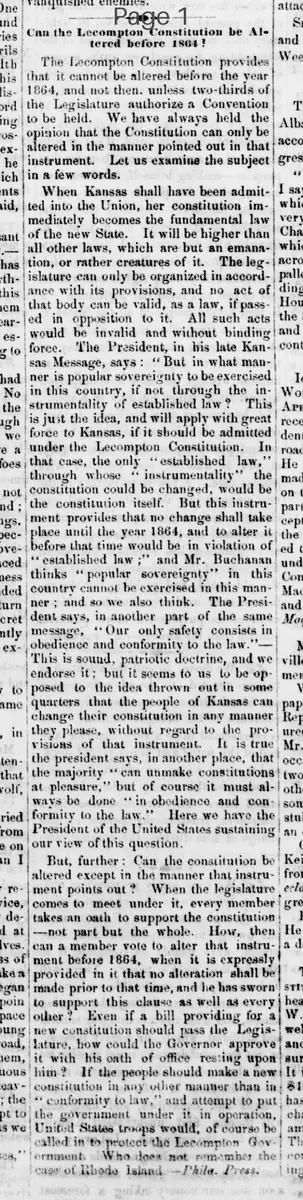
Can the Lecompton Constitution be Altered before 1864!
The Lecompton Constitution provides that it cannot be altered before the year 1864, and not then, unless two-thirds of the Legislature authorize a Convention to be held. We have always held the opinion that the Constitution can only be altered in the manner pointed out in that instrument. Let us examine the subject in a few words.
When Kansas shall have been admitted into the Union, her constitution immediately becomes the fundamental law of the new State. It will be higher than all other laws, which are but an emanation, or rather creatures of it. The legislature can only be organized in accordance with its provisions, and no act of that body can be valid, as a law, if passed in opposition to it. All such acts would be invalid and without binding force. The President, in his late Kansas Message, says: "But in what manner is popular sovereignty to be exercised in this country, if not through the instrumentality of established law? This is just the idea, and will apply with great force to Kansas, if it should be admitted under the Lecompton Constitution. In that case, the only "established law," through whose "instrumentality" the constitution could be changed, would be the constitution itself. But this instrument provides that no change shall take place until the year 1864, and to alter it before that time would be in violation of "established law;" and Mr. Buchanan thinks "popular sovereignty" in this country cannot be exercised in this manner; and so we also think. The President says, in another part of the same message, "Our only safety consists in obedience and conformity to the law." This is sound, patriotic doctrine, and we endorse it: but it seems to us to be opposed to the idea thrown out in some quarters that the people of Kansas can change their constitution in any manner they please, without regard to the provisions of that instrument. It is true the president says, in another place, that the majority "can unmake constitutions at pleasure," but of course it must always be done "in obedience and conformity to the law." Here we have the President of the United States sustaining our view of this question.
But, further: Can the constitution be altered except in the manner that instrument points out? When the legislature comes to meet under it, every member takes an oath to support the constitution --not part but the whole. How, then can a member vote to alter that instrument before 1864, when it is expressly provided in it that no alteration shall be made prior to that time, and he has sworn to support this clause as well as every other? Even if a bill providing for a new constitution should pass the Legislature, how could the Governor approve it with his oath of office resting upon him? If the people should make a new constitution in any other manner than in "conformity to law," and attempt to put the government under it in operation, United States troops would, of course be called in to protect the Lecompton Government. Who does not remember the case of Rhode Island? --Phila. Press.
The Lecompton Constitution provides that it cannot be altered before the year 1864, and not then, unless two-thirds of the Legislature authorize a Convention to be held. We have always held the opinion that the Constitution can only be altered in the manner pointed out in that instrument. Let us examine the subject in a few words.
When Kansas shall have been admitted into the Union, her constitution immediately becomes the fundamental law of the new State. It will be higher than all other laws, which are but an emanation, or rather creatures of it. The legislature can only be organized in accordance with its provisions, and no act of that body can be valid, as a law, if passed in opposition to it. All such acts would be invalid and without binding force. The President, in his late Kansas Message, says: "But in what manner is popular sovereignty to be exercised in this country, if not through the instrumentality of established law? This is just the idea, and will apply with great force to Kansas, if it should be admitted under the Lecompton Constitution. In that case, the only "established law," through whose "instrumentality" the constitution could be changed, would be the constitution itself. But this instrument provides that no change shall take place until the year 1864, and to alter it before that time would be in violation of "established law;" and Mr. Buchanan thinks "popular sovereignty" in this country cannot be exercised in this manner; and so we also think. The President says, in another part of the same message, "Our only safety consists in obedience and conformity to the law." This is sound, patriotic doctrine, and we endorse it: but it seems to us to be opposed to the idea thrown out in some quarters that the people of Kansas can change their constitution in any manner they please, without regard to the provisions of that instrument. It is true the president says, in another place, that the majority "can unmake constitutions at pleasure," but of course it must always be done "in obedience and conformity to the law." Here we have the President of the United States sustaining our view of this question.
But, further: Can the constitution be altered except in the manner that instrument points out? When the legislature comes to meet under it, every member takes an oath to support the constitution --not part but the whole. How, then can a member vote to alter that instrument before 1864, when it is expressly provided in it that no alteration shall be made prior to that time, and he has sworn to support this clause as well as every other? Even if a bill providing for a new constitution should pass the Legislature, how could the Governor approve it with his oath of office resting upon him? If the people should make a new constitution in any other manner than in "conformity to law," and attempt to put the government under it in operation, United States troops would, of course be called in to protect the Lecompton Government. Who does not remember the case of Rhode Island? --Phila. Press.
What sub-type of article is it?
Constitutional
Partisan Politics
What keywords are associated?
Lecompton Constitution
Kansas Admission
Popular Sovereignty
Buchanan Message
Constitutional Law
Oath Of Office
What entities or persons were involved?
Lecompton Constitution
President Buchanan
Kansas Legislature
Rhode Island
Editorial Details
Primary Topic
Immutability Of The Lecompton Constitution Until 1864
Stance / Tone
Defense Of Constitutional Provisions And Obedience To Law Against Premature Alteration
Key Figures
Lecompton Constitution
President Buchanan
Kansas Legislature
Rhode Island
Key Arguments
The Lecompton Constitution Prohibits Alteration Before 1864 Unless Two Thirds Of The Legislature Authorizes A Convention.
Upon Admission To The Union, The Constitution Becomes The Fundamental Law Superior To All Others.
Legislative Acts Opposing The Constitution Are Invalid.
Popular Sovereignty Must Be Exercised Through Established Law, As Per Buchanan's Kansas Message.
Oaths Of Office Bind Legislators And The Governor To Support The Entire Constitution, Preventing Votes Or Approvals For Early Changes.
Violating The Constitution Could Lead To Federal Intervention, As In The Rhode Island Case.