Thank you for visiting SNEWPapers!
Sign up free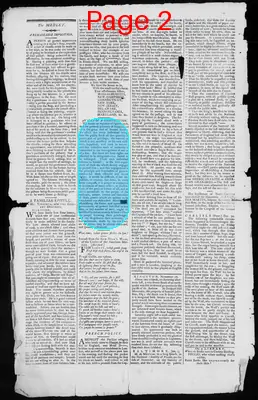
Editorial
January 27, 1790
The New Hampshire Gazette And General Advertiser
Portsmouth, Rockingham County, New Hampshire
What is this article about?
This editorial presents philosophical ideas on the foundations of government, stressing equality of rights, reservation of essential individual liberties, and clear definition of powers to prevent encroachments by authorities on the people.
Clipping
OCR Quality
98%
Excellent
Full Text
AN IDEA OF A CONSTITUTION.
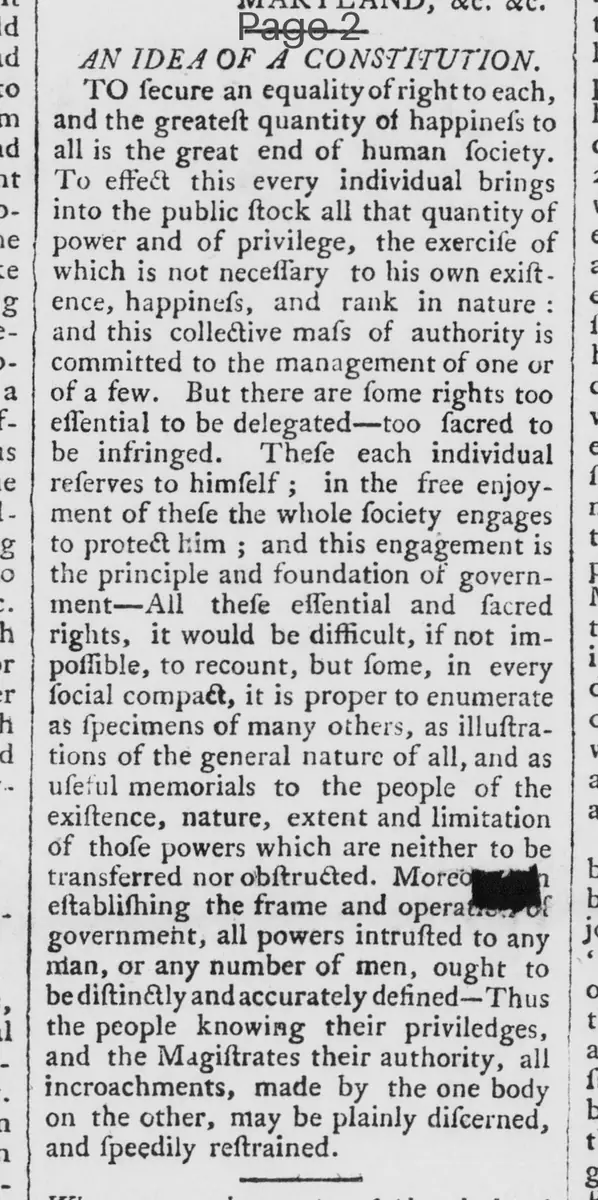
To secure an equality of right to each, and the greatest quantity of happiness to all is the great end of human society. To effect this every individual brings into the public stock all that quantity of power and of privilege, the exercise of which is not necessary to his own existence, happiness, and rank in nature: and this collective mass of authority is committed to the management of one or of a few. But there are some rights too essential to be delegated--too sacred to be infringed. These each individual reserves to himself; in the free enjoyment of these the whole society engages to protect him; and this engagement is the principle and foundation of government--All these essential and sacred rights, it would be difficult, if not impossible, to recount, but some, in every social compact, it is proper to enumerate as specimens of many others, as illustrations of the general nature of all, and as useful memorials to the people of the existence, nature, extent and limitation of those powers which are neither to be transferred nor obstructed. More especially in establishing the frame and operation of government, all powers intrusted to any man, or any number of men, ought to be distinctly and accurately defined--Thus the people knowing their privileges, and the Magistrates their authority, all encroachments, made by the one body on the other, may be plainly discerned, and speedily restrained.
To secure an equality of right to each, and the greatest quantity of happiness to all is the great end of human society. To effect this every individual brings into the public stock all that quantity of power and of privilege, the exercise of which is not necessary to his own existence, happiness, and rank in nature: and this collective mass of authority is committed to the management of one or of a few. But there are some rights too essential to be delegated--too sacred to be infringed. These each individual reserves to himself; in the free enjoyment of these the whole society engages to protect him; and this engagement is the principle and foundation of government--All these essential and sacred rights, it would be difficult, if not impossible, to recount, but some, in every social compact, it is proper to enumerate as specimens of many others, as illustrations of the general nature of all, and as useful memorials to the people of the existence, nature, extent and limitation of those powers which are neither to be transferred nor obstructed. More especially in establishing the frame and operation of government, all powers intrusted to any man, or any number of men, ought to be distinctly and accurately defined--Thus the people knowing their privileges, and the Magistrates their authority, all encroachments, made by the one body on the other, may be plainly discerned, and speedily restrained.
What sub-type of article is it?
Constitutional
What keywords are associated?
Constitution
Rights
Government
Social Compact
Essential Liberties
Magistrates
What entities or persons were involved?
The People
Magistrates
Editorial Details
Primary Topic
Foundations Of Government And Essential Rights
Stance / Tone
Philosophical Exposition On Limited Government
Key Figures
The People
Magistrates
Key Arguments
Equality Of Rights And Maximum Happiness As The End Of Society
Individuals Delegate Non Essential Powers To Government
Essential Rights Are Reserved And Protected By Society
Powers Of Government Must Be Clearly Defined To Prevent Encroachments