Thank you for visiting SNEWPapers!
Sign up free
The Virginia Gazette
Williamsburg, Virginia
What is this article about?
John Page writes to Mrs. Rind defending his testimony against Rev. Samuel Henley, accusing him of Socinian views denying the Trinity and misrepresenting church litany. He provides evidence from personal conversations, Mr. Andrews' recollections, and Theophilus Lindsey's apology to affirm Henley's unorthodox beliefs and his own authorized statements.
Merged-components note: Continuation of the letter by John Page regarding Mr. Henley's religious opinions.
Clipping
OCR Quality
Full Text
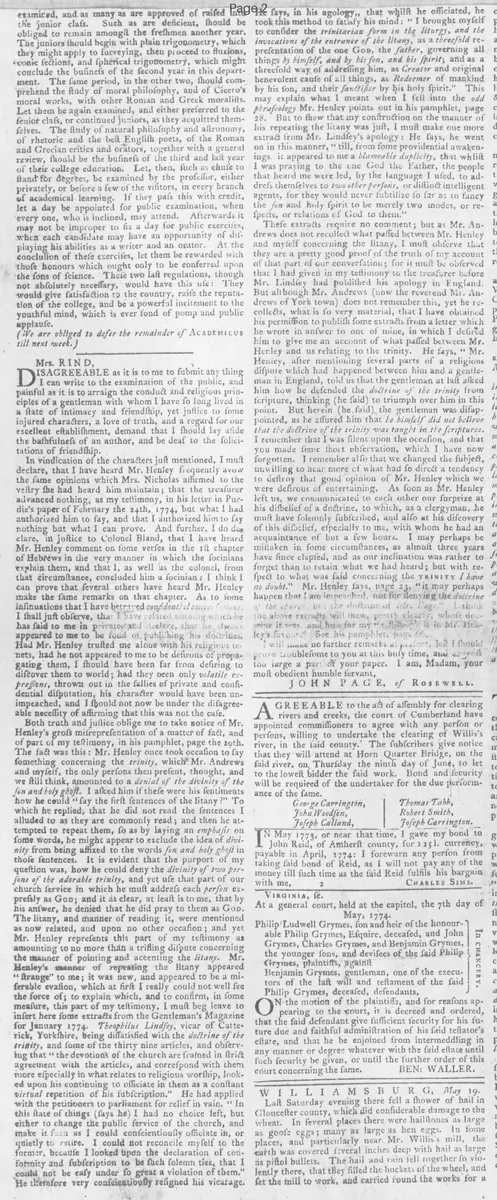
DISAGREEABLE as it is to me to submit any thing I can write to the examination of the public, and painful as it is to arraign the conduct and religious principles of a gentleman with whom I have so long lived in a state of intimacy and friendship, yet justice to some injured characters, a love of truth, and a regard for our excellent establishment, demand that I should lay aside the bashfulness of an author, and be deaf to the solicitations of friendship.
In vindication of the characters just mentioned, I must declare, that I have heard Mr. Henley frequently avow the same opinions which Mrs. Nicholas affirmed to the vestry she had heard him maintain; that the treasurer advanced nothing, as my testimony, in his letter in Purdie's paper of February the 24th, 1774, but what I had authorized him to say, and that I authorized him to say nothing but what I can prove. And further, I do declare, in justice to Colonel Bland, that I have heard Mr. Henley comment on some verses in the 1st chapter of Hebrews in the very manner in which the socinians explain them, and that I, as well as the colonel, from that circumstance, concluded him a socinian: I think I can prove that several others have heard Mr. Henley make the same remarks on that chapter. As to some insinuations that I have betrayed confidential concerns, I shall just observe, that I have related nothing which he has said to me in private, and declare, that his views appeared to me to be fond of publishing his doctrines.
Had Mr. Henley trusted me alone with his religious tenets, had he not appeared to me to be desirous of propagating them, I should have been far from desiring to discover them to world; had they been only volatile expressions, thrown out in the fallies of private and confidential disputation, his character would have been unimpeached, and I should not now be under the disagreeable necessity of affirming that this was not the case.
Both truth and justice oblige me to take notice of Mr. Henley's gross misrepresentation of a matter of fact, and of part of my testimony, in his pamphlet, page the 29th. The fact was this: Mr. Henley once took occasion to say something concerning the trinity, which Mr. Andrews and myself, the only persons then present, thought, and we still think, amounted to a denial of the divinity of the Son and Holy Ghost. I asked him if these were his sentiments, how he could say the first sentences of the litany? To which he replied, that he did not read the sentences I alluded to as they are commonly read: and then he attempted to repeat them, so as by laying an emphasis on some words, he might appear to exclude the idea of divinity from being affixed to the words Son and Holy Ghost in those sentences. It is evident that the purport of my question was, how he could deny the divinity of two persons of the adorable trinity, and yet use that part of our church service in which he must address each person expressly as God; and it as clear, at least is to me, that by his answer, he denied that he did pray to them as God.
The litany, and manner of reading it, were mentioned as now related, and upon no other occasion; and yet Mr. Henley represents this part of my testimony as amounting to no more than a trifling dispute concerning the manner of pointing and accenting the litany. Mr. Henley's manner of repeating the litany appeared 'strange' to me; it was new, and appeared to be a miserable evasion, which at first I really could not well see the force of; to explain which, and to confirm, in some measure, this part of my testimony, I must beg leave to insert here some extracts from the Gentleman's Magazine for January 1774. Theophilus Lindsey, vicar of Catterick, Yorkshire, being dissatisfied with the doctrine of the trinity, and some of the thirty nine articles, and observing that 'the devotions of the church are framed in strict agreement with the articles, and correspond with them more especially in what relates to religious worship, looked upon his continuing to officiate in them as a constant virtual repetition of his subscription.' He had applied with the petitioners to parliament for relief in vain. 'In this state of things (says he) I had no choice left, but either to change the public service of the church, and make it such as I could conscientiously officiate in, or quietly to retire. I could not reconcile myself to the former, because I looked upon the declaration of conformity and subscription to be such solemn ties, that I could not be easy under so great a violation of them.'
He therefore very conscientiously resigned his vicarage.
He says, in his apology, that whilst he officiated, he took this method to satisfy his mind: 'I brought myself to consider the trinitarian form in the liturgy, and the invocations of the response of the litany, as a threefold representation of the one God, the Father, governing all things by himself, and by his Son, and his Spirit; and as a threefold way, of addressing him, as Creator and original benevolent cause of all things, as Redeemer of mankind by his Son, and their sanctifier by his Holy Spirit.' This may explain what I meant when I fell into the odd phraseology Mr. Henley points out in his pamphlet, page 28. But to shew that my construction on the manner of his repeating the litany was just, I must make one more extract from Mr. Lindsey's apology: He says, he went on in this manner, 'till, from some providential awakenings it appeared to me a blameable duplicity, that whilst I was praying to the one God the Father, the people that heard me were led, by the language I used, to address themselves to two other persons, or distinct intelligent agents, for they would never subtilize so far as to fancy the Son and Holy Spirit to be merely two modes, or respects, or relations of God to them.'
These extracts require no comment: but as Mr. Andrews does not recollect what passed between Mr. Henley and myself concerning the litany, I must observe that they are a pretty good proof of the truth of my account of that part of our conversation; for it must be observed that I had given in my testimony to the treasurer before Mr. Lindsey had published his apology in England.
But although Mr. Andrews (now the reverend Mr. Andrews of York town) does not remember this, yet he recollects, what is so very material, that I have obtained his permission to publish some extracts from a letter which he wrote in answer to one of mine, in which I desired him to give me an account of what passed between Mr. Henley and us relating to the trinity. He says, 'Mr. Henley, after mentioning several parts of a religious dispute which had happened between him and a gentleman in England, told us that the gentleman at last asked him how he defended the doctrine of the trinity from scripture, thinking (he said) to triumph over him in this point. But herein (he said) the gentleman was disappointed, as he assured him that he himself did not believe that the doctrine of the trinity was taught in the scriptures. I remember that I was silent upon the occasion, and that you made some short observation, which I have now forgotten. I remember also that we changed the subject, unwilling to hear more of what had so direct a tendency to destroy that good opinion of Mr. Henley which we were desirous of entertaining. As soon as Mr. Henley left us, we communicated to each other our surprize at his disbelief of a doctrine, to which, as a clergyman, he must have solemnly subscribed, and also at his discovery of this disbelief, especially to me, with whom he had an acquaintance of but a few hours. I may perhaps be mistaken in some circumstances, as almost three years have since elapsed, and as our inclination was rather to forget than to retain what we had heard: but with respect to what was said concerning the Trinity I have no doubt.' Mr. Henley says, page 23, 'it may perhaps happen that I am impeached, not for denying the doctrine of the church but the doctrine of Mr. Page.' I think the above extracts will shew, pretty clearly, whose doctrine it was, and how far my son is in Mr. Henley's favour. See his pamphlet, page 6.
I will make no farther remarks at present, lest I should prove troublesome to you at this busy time, and encroach too large a part of your paper. I am, Madam, your most obedient humble servant,
JOHN PAGE, of ROSEWELL.
What sub-type of article is it?
What themes does it cover?
What keywords are associated?
What entities or persons were involved?
Letter to Editor Details
Author
John Page, Of Rosewell
Recipient
Mrs. Rind
Main Argument
john page defends his testimony accusing rev. mr. henley of holding socinian views denying the trinity and misrepresenting church litany, providing evidence from conversations with henley and mr. andrews, and references to theophilus lindsey's apology to affirm the accuracy of his claims and counter henley's pamphlet.
Notable Details