Thank you for visiting SNEWPapers!
Sign up free
Editorial
June 5, 1824
The Virginian
Lynchburg, Virginia
What is this article about?
In 'No. 3' of a series, A Citizen of Campbell examines Virginia's constitution, critiquing the executive branch's lack of independence and responsibility to the people, contrasting it with the U.S. Constitution's balanced powers, and noting excessive legislative authority.
Clipping
OCR Quality
95%
Excellent
Full Text
FOR THE VIRGINIAN
To the People of Virginia. No. 3.
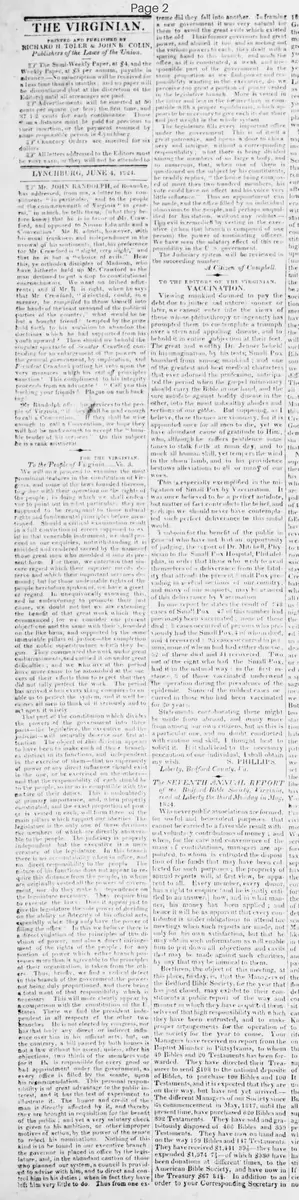
We will now proceed to examine the most prominent features in the constitution of Virginia, and some of the laws founded thereon, together with their operation on the rights of the people. In doing which we shall endeavor to point out in what particulars they are supposed to be repugnant to those natural rights and fundamental principles before mentioned. Should a critical examination result in a full conviction of errors supposed to exist in that venerable instrument, we shall proceed in our enquiries, notwithstanding it is shielded and rendered sacred by the names of those great men who moulded it into its present form. For them, we entertain that sincere regard which their superior merits deserve and which their important services demand; but for those undeniable rights of the people heretofore spoken of, we have a greater regard in unequivocally avowing this, and in endeavoring to promote their just cause, we doubt not but we are extending the benefit of that great work which they commenced, for we consider our present object one and the same with theirs, founded on the like basis, and supported by the same immutable pillars of justice—the completion of the noble superstructure which they began. They commenced the work under great embarrassments, and carried it on under great difficulties, and we who live at this period have more cause to be astonished at the success of their efforts than to regret that they did not fully perfect the work. The period has arrived when every thing conspires to enable us to perfect the system, and it well becomes all men to think of it seriously and to act upon it wisely.
That part of the constitution which divides the powers of the government into three parts—the legislative, the executive and the judicial—will naturally deserve our first attention. The object of this division appears to have been to make each of those branches distinct in its functions, and independent in the exercise of them—that no superiority of power or any direct influence should exist in the one, or be exercised on the others—and that the responsibility of each should be to the people, so far as is compatible with the nature of their duties. This undoubtedly of primary importance, and, when properly constituted, and the exact proportion of power is vested in each, will form three of the main pillars which support our liberties. The legislature is the only one of these divisions the members of which are directly answerable to the people. The judiciary is properly independent but the executive is a mere creature of the legislature. In this branch there is no accountability when in office, and no direct responsibility to the people. The nature of his functions does not appear to require this distance from the people, in whom are originally vested all the powers of government, nor do they make his independence on the legislature necessary. They require him to execute the laws: Does it appear just to give the legislature the sole power of deciding on the ability or integrity of his official acts, especially when they only have the power of filling the office? In this we believe there is a direct violation of the principles of this division of power, and also a direct infringement of the rights of the people, for any portion of power which either branch possesses more than is agreeable to the principles of their organization, is taken from the others. Thus, briefly, we find a radical defect in this branch of the government the powers not being duly proportioned, and there being a total want of that responsibility which is necessary. This will more clearly appear by a comparison with the constitution of the United States. There we find the president independent in all respects of the other two branches. He is not elected by congress, not has that body any direct or indirect influence over him in his official acts; but, on the contrary, a bill passed by both houses is not a law without his assent, unless, after his objections, two thirds of the members vote for it. He is responsible for every good or bad appointment under the government, as every office is filled by the senate, upon his recommendation. This personal responsibility is of great advantage to the public interest, and it has the test of experiment to illustrate it. The honor and credit of the man is directly affected by it, and thereby they are brought in requisition for the benefit of the public; and yet a very salutary check is given to his ambition, or other improper motives of action, by the power of the senate to reject his nominations. Nothing of this kind is to be found in our executive branch: the governor is placed in office by the legislature, and, in the abundant caution of those who planned our system, a council is provided to advise with him, and to direct and control him in his duties; when in fact they have left him very little to do. Thus from one extreme did they fall into another. In framing a new government it was very natural for them to avoid the great evils which existed in the old. Their former governor had great power, and abused it too and in meting out the various powers to each, they dealt with a sparing hand to this branch, and make the office, as it is constituted, a weak and irresponsible part of the government. In the same proportion as we find power and responsibility wanting in the executive, do we perceive too great a portion of power vested in the legislative branch. More is vested in the latter than is in the former that is compatible with a proper equilibrium, which appears to be necessary to give each its due share and just weight in the whole system. The legislature fill every important office under the government. This is of itself a great patronage, and opens a door to chicanery and intrigue, without a corresponding responsibility, what there is being divided among the members of so large a body, and so numerous, that, when one of them is questioned on the subject by his constituents, he readily replies, "the house being composed of more than two hundred members, his vote could have no effect and his voice very little influence." Thus an appointment can be made, and the office filled by an individual obnoxious to the people, and perhaps unqualified for his station, without any redress—This evil is remedied by vesting in the executive (when that branch is composed of one person) the power of nominating officers. We have seen the salutary effect of this responsibility in the U. S. government.
The Judiciary system will be reviewed in the succeeding number.
A Citizen of Campbell.
To the People of Virginia. No. 3.
We will now proceed to examine the most prominent features in the constitution of Virginia, and some of the laws founded thereon, together with their operation on the rights of the people. In doing which we shall endeavor to point out in what particulars they are supposed to be repugnant to those natural rights and fundamental principles before mentioned. Should a critical examination result in a full conviction of errors supposed to exist in that venerable instrument, we shall proceed in our enquiries, notwithstanding it is shielded and rendered sacred by the names of those great men who moulded it into its present form. For them, we entertain that sincere regard which their superior merits deserve and which their important services demand; but for those undeniable rights of the people heretofore spoken of, we have a greater regard in unequivocally avowing this, and in endeavoring to promote their just cause, we doubt not but we are extending the benefit of that great work which they commenced, for we consider our present object one and the same with theirs, founded on the like basis, and supported by the same immutable pillars of justice—the completion of the noble superstructure which they began. They commenced the work under great embarrassments, and carried it on under great difficulties, and we who live at this period have more cause to be astonished at the success of their efforts than to regret that they did not fully perfect the work. The period has arrived when every thing conspires to enable us to perfect the system, and it well becomes all men to think of it seriously and to act upon it wisely.
That part of the constitution which divides the powers of the government into three parts—the legislative, the executive and the judicial—will naturally deserve our first attention. The object of this division appears to have been to make each of those branches distinct in its functions, and independent in the exercise of them—that no superiority of power or any direct influence should exist in the one, or be exercised on the others—and that the responsibility of each should be to the people, so far as is compatible with the nature of their duties. This undoubtedly of primary importance, and, when properly constituted, and the exact proportion of power is vested in each, will form three of the main pillars which support our liberties. The legislature is the only one of these divisions the members of which are directly answerable to the people. The judiciary is properly independent but the executive is a mere creature of the legislature. In this branch there is no accountability when in office, and no direct responsibility to the people. The nature of his functions does not appear to require this distance from the people, in whom are originally vested all the powers of government, nor do they make his independence on the legislature necessary. They require him to execute the laws: Does it appear just to give the legislature the sole power of deciding on the ability or integrity of his official acts, especially when they only have the power of filling the office? In this we believe there is a direct violation of the principles of this division of power, and also a direct infringement of the rights of the people, for any portion of power which either branch possesses more than is agreeable to the principles of their organization, is taken from the others. Thus, briefly, we find a radical defect in this branch of the government the powers not being duly proportioned, and there being a total want of that responsibility which is necessary. This will more clearly appear by a comparison with the constitution of the United States. There we find the president independent in all respects of the other two branches. He is not elected by congress, not has that body any direct or indirect influence over him in his official acts; but, on the contrary, a bill passed by both houses is not a law without his assent, unless, after his objections, two thirds of the members vote for it. He is responsible for every good or bad appointment under the government, as every office is filled by the senate, upon his recommendation. This personal responsibility is of great advantage to the public interest, and it has the test of experiment to illustrate it. The honor and credit of the man is directly affected by it, and thereby they are brought in requisition for the benefit of the public; and yet a very salutary check is given to his ambition, or other improper motives of action, by the power of the senate to reject his nominations. Nothing of this kind is to be found in our executive branch: the governor is placed in office by the legislature, and, in the abundant caution of those who planned our system, a council is provided to advise with him, and to direct and control him in his duties; when in fact they have left him very little to do. Thus from one extreme did they fall into another. In framing a new government it was very natural for them to avoid the great evils which existed in the old. Their former governor had great power, and abused it too and in meting out the various powers to each, they dealt with a sparing hand to this branch, and make the office, as it is constituted, a weak and irresponsible part of the government. In the same proportion as we find power and responsibility wanting in the executive, do we perceive too great a portion of power vested in the legislative branch. More is vested in the latter than is in the former that is compatible with a proper equilibrium, which appears to be necessary to give each its due share and just weight in the whole system. The legislature fill every important office under the government. This is of itself a great patronage, and opens a door to chicanery and intrigue, without a corresponding responsibility, what there is being divided among the members of so large a body, and so numerous, that, when one of them is questioned on the subject by his constituents, he readily replies, "the house being composed of more than two hundred members, his vote could have no effect and his voice very little influence." Thus an appointment can be made, and the office filled by an individual obnoxious to the people, and perhaps unqualified for his station, without any redress—This evil is remedied by vesting in the executive (when that branch is composed of one person) the power of nominating officers. We have seen the salutary effect of this responsibility in the U. S. government.
The Judiciary system will be reviewed in the succeeding number.
A Citizen of Campbell.
What sub-type of article is it?
Constitutional
Legal Reform
What keywords are associated?
Virginia Constitution
Separation Of Powers
Executive Independence
Legislative Power
Us Constitution
Governor Responsibility
Government Balance
What entities or persons were involved?
Virginia Constitution
United States Constitution
Governor
Legislature
President
Congress
Senate
A Citizen Of Campbell
Editorial Details
Primary Topic
Examination Of Virginia Constitution's Division Of Powers
Stance / Tone
Critical Of Executive Branch's Dependence On Legislature
Key Figures
Virginia Constitution
United States Constitution
Governor
Legislature
President
Congress
Senate
A Citizen Of Campbell
Key Arguments
Executive Branch Lacks Independence And Direct Responsibility To The People
Legislature Has Excessive Power In Appointing Officials Without Accountability
Comparison Shows U.S. President's Independence Provides Better Balance
Virginia's System Creates Imbalance Violating Separation Of Powers Principles
Governor Controlled By Council, Leaving Little Authority