Thank you for visiting SNEWPapers!
Sign up free
Letter to Editor
August 26, 1789
Gazette Of The United States
New York, New York County, New York
What is this article about?
Extract of a letter from a U.S. Congress member to a friend in Philadelphia, dated August 17, critiquing the recent decision on congressional salaries and wages. The writer argues that high emoluments fail to attract respectable candidates and yield insufficient compensation after expenses, potentially leading to less qualified representatives.
Clipping
OCR Quality
78%
Good
Full Text
PHILADELPHIA, AUGUST 20.
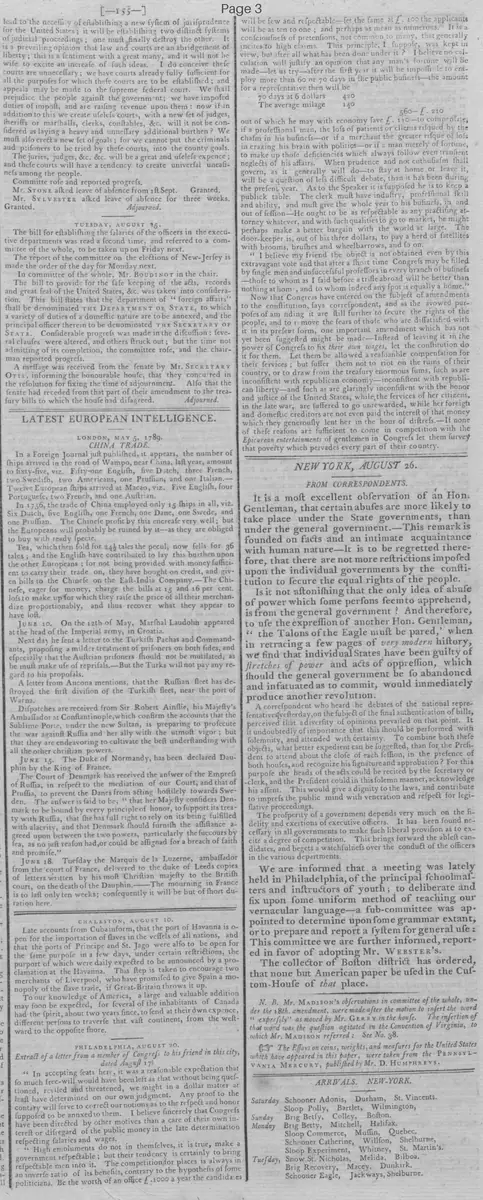
Extract of a letter from a member of Congress to his friend in this city, dated August 17. In accepting seats here, it was a reasonable expectation that so much free-will would have been left as that without being questioned, reviled and threatened, we might in a dollar matter at least have determined on our own judgment. Any proof to the contrary will serve to correct our notions as to the respect and honor supposed to be annexed to them. I believe sincerely that Congress have been directed by other motives than a care of their own interest or disregard of the public money in the late determination respecting salaries and wages. High emoluments do not in themselves, it is true, make a government respectable; but their tendency is certainly to bring an inverse ratio of its benefits, contrary to the hypothesis of some respectable men into it. The competition for places is always in politicians. Be the worth of an office £1000 a year the candidates will be few and respectable—if the same at £100 the applicants will be as ten to one; and perhaps as mean as numerous. It is a consciousness of pretensions, not common to many, that generally incites to high claims. This principle, I suppose, was kept in view, but after all what has been done under it? I believe no calculation will justify an opinion that any man's fortune will be made—let us try—after the first year it will be impossible to employ more than 60 or 70 days in the public business—the amount for a representative then will be 70 days at 6 dollars 420 The average mileage 140 560—£210 out of which he may with economy save £110—to compensate, if a professional man, the loss of patients or clients risked by the chasm in his business—or if a merchant the greater risque of loss in crazing his brain with politics—or if a man merely of fortune, to make up those deficiencies which always follow even transient neglects of his affairs. When prudence and not enthusiasm shall govern, as it generally will do—to stay at home or leave it, will be a question of less difficult debate, than it has been during the present year. As to the Speaker it is supposed he is to keep a public table. The clerk must have industry, professional skill and ability, and must give the whole year to his business, in and out of session—He ought to be as respectable as any practising attorney whatever, and with such qualities to go to market, he might perhaps make a better bargain with the world at large. The door-keeper is, out of his three dollars, to pay a herd of satellites with brooms, brushes and wheelbarrows, and so on. "I believe my friend the object is not obtained even by this extravagant vote and that after a short time Congress may be filled by single men and unsuccessful professors in every branch of business—those to whom as I said before a trifle abroad will be better than nothing at home, and to whom indeed any spot is equally a home."
Extract of a letter from a member of Congress to his friend in this city, dated August 17. In accepting seats here, it was a reasonable expectation that so much free-will would have been left as that without being questioned, reviled and threatened, we might in a dollar matter at least have determined on our own judgment. Any proof to the contrary will serve to correct our notions as to the respect and honor supposed to be annexed to them. I believe sincerely that Congress have been directed by other motives than a care of their own interest or disregard of the public money in the late determination respecting salaries and wages. High emoluments do not in themselves, it is true, make a government respectable; but their tendency is certainly to bring an inverse ratio of its benefits, contrary to the hypothesis of some respectable men into it. The competition for places is always in politicians. Be the worth of an office £1000 a year the candidates will be few and respectable—if the same at £100 the applicants will be as ten to one; and perhaps as mean as numerous. It is a consciousness of pretensions, not common to many, that generally incites to high claims. This principle, I suppose, was kept in view, but after all what has been done under it? I believe no calculation will justify an opinion that any man's fortune will be made—let us try—after the first year it will be impossible to employ more than 60 or 70 days in the public business—the amount for a representative then will be 70 days at 6 dollars 420 The average mileage 140 560—£210 out of which he may with economy save £110—to compensate, if a professional man, the loss of patients or clients risked by the chasm in his business—or if a merchant the greater risque of loss in crazing his brain with politics—or if a man merely of fortune, to make up those deficiencies which always follow even transient neglects of his affairs. When prudence and not enthusiasm shall govern, as it generally will do—to stay at home or leave it, will be a question of less difficult debate, than it has been during the present year. As to the Speaker it is supposed he is to keep a public table. The clerk must have industry, professional skill and ability, and must give the whole year to his business, in and out of session—He ought to be as respectable as any practising attorney whatever, and with such qualities to go to market, he might perhaps make a better bargain with the world at large. The door-keeper is, out of his three dollars, to pay a herd of satellites with brooms, brushes and wheelbarrows, and so on. "I believe my friend the object is not obtained even by this extravagant vote and that after a short time Congress may be filled by single men and unsuccessful professors in every branch of business—those to whom as I said before a trifle abroad will be better than nothing at home, and to whom indeed any spot is equally a home."
What sub-type of article is it?
Persuasive
Political
Reflective
What themes does it cover?
Politics
Economic Policy
What keywords are associated?
Congress Salaries
Wages Determination
Emoluments Critique
Political Candidates
Representative Compensation
Public Business
Professional Loss
What entities or persons were involved?
A Member Of Congress
His Friend In This City
Letter to Editor Details
Author
A Member Of Congress
Recipient
His Friend In This City
Main Argument
the recent congressional decision on high salaries and wages is misguided, as it attracts unworthy candidates and provides insufficient net compensation after expenses, potentially filling congress with less qualified individuals.
Notable Details
Calculation Of Representative's Earnings: 70 Days At $6 = $420, Plus $140 Mileage = $560 (£210), Saving £110 After Expenses
Critique Of Emoluments Attracting 'Mean' Applicants
Speaker To Keep Public Table; Clerk Needs Full Year Dedication