Thank you for visiting SNEWPapers!
Sign up free
Martinsburg Gazette And Public Advertiser
Martinsburg, Berkeley County, West Virginia
What is this article about?
In woodland near Wallkill, Ulster and Orange counties, NY, discoveries of a cloak, bridle headstall, saddle, and a starved horse skeleton suggest a traveler was robbed and murdered in June last summer. Items were scattered to mislead; cries of distress heard.
Clipping
OCR Quality
Full Text
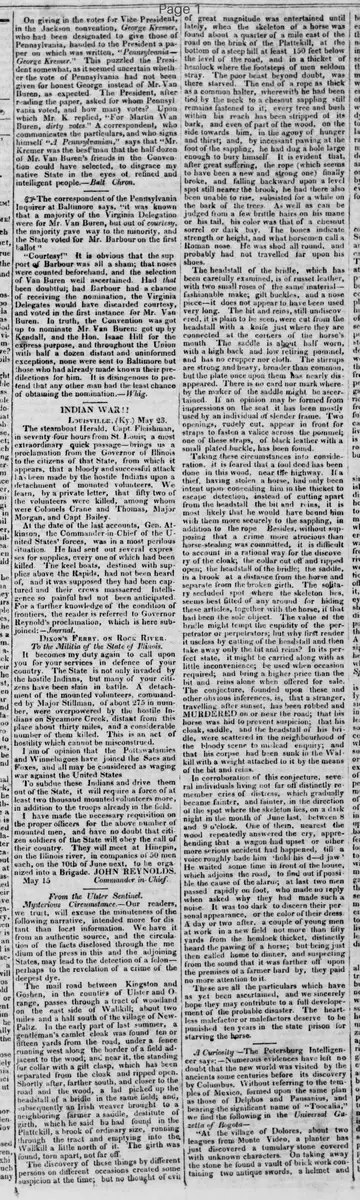
Mysterious Circumstance.—Our readers, we trust, will excuse the minuteness of the following narrative, intended more for distant than local information. We have it from an authentic source, and the circulation of the facts disclosed through the medium of the press in this and the adjoining States, may lead to the detection of a felon—perhaps to the revelation of a crime of the deepest dye.
The mail road between Kingston and Goshen, in the counties of Ulster and Orange, passes through a tract of woodland on the east side of Wallkill; about two miles and a half south of the village of New-Paltz. In the early part of last summer, a gentleman's camlet cloak was found ten or fifteen yards from the road, under a fence running west along the border of a field adjacent to the wood; and near it, the standing fur collar with a gilt clasp, which has been separated from the cloak and ripped open.
Shortly after, farther south, and closer to the road and the wood, a lad picked up the headstall of a bridle in the same field; and, subsequently an Irish weaver brought to a neighboring farmer a saddle, destitute of girth, which he said he had found in the Plattekill, a brook of ordinary size, running through the tract and emptying into the Wallkill a little north of it. The girth was found, torn apart, not far off.
The discovery of these things by different persons on different occasions created some suspicion at the time; but no thought of evil of great magnitude was entertained until lately, when the skeleton of a horse was found about a quarter of a mile east of the road on the brink of the Plattekill, at the bottom of a steep hill at least 150 feet below the level of the road, and in a thicket of hemlock where the footsteps of men seldom stray. The poor beast beyond doubt, was there starved. The end of a rope as thick as a common halter, wherewith he had been tied by the neck to a chestnut sapling still remains fastened to it; every tree and bush within his reach has been stripped of its bark, and even of part of the wood, on the side towards him, in the agony of hunger and thirst; and, by incessant pawing at the foot of the sapling, he had dug a hole large enough to bury himself. It is evident that, after great suffering, the rope (which seems to have been a new and strong one) finally broke, and falling backward upon a level spot still nearer the brook, he had there also been unable to rise, subsisted for a while on the bark of the trees. As well as can be judged from a few brittle hairs on his mane or his tail, his color was that of a chestnut sorrel or dark bay. The bones indicate strength of height, and what horsemen call a Roman nose. He was shod all round, and probably had not travelled far upon his shoes.
The headstall of the bridle, which has been carefully examined, is of russet leather, with two small rosettes of the same material—fashionable make; gilt buckles, and a nose piece—it does not appear to have been used very long. The bit and reins, still undiscovered, it is plain to be seen, were cut from the headstall with a knife just where they are connected at the corners of the horse's mouth. The saddle is about half worn, with a high back and low retiring pommel, and has no crupper nor cloth. The stirrups are strong and heavy, broader than common, but the plate once upon them has nearly disappeared. There is no card nor mark whereby the maker of the saddle might be ascertained. If an opinion may be formed from impressions on the seat it has been mostly used by an individual of slender frame. Two openings, rudely cut, appear in front for straps to fasten a valise across the pommel; one of these straps, of black leather with a small plated buckle, has been found.
Taking these circumstances into consideration, it is feared that a foul deed has been done in this wood, near the highway. If a thief, having stolen a horse, had only been intent upon concealing him in the thicket to escape detection, instead of cutting apart from the headstall the bit and reins, it is most likely that he would have bound him with them more securely to the sapling, in addition to the rope. Besides, without supposing that a crime more atrocious than horse-stealing was committed, it is difficult to account in a rational way for the discovery of the cloak; the collar cut off and ripped open; the headstall of the bridle; the saddle, in a brook at a distance from the horse and separate from the broken girth. The solitary secluded spot where the skeleton lies, seems best fitted of any around for hiding these articles, together with the horse, if that had been the sole object. The value of the bridle might tempt the cupidity of the perpetrator or perpetrators; but why first render it useless by cutting off the headstall and then take away only the bit and reins? In its perfect state, it might be carried along with as little inconvenience; be used when occasion required; and bring a higher price than the bit and reins alone when offered for sale.
The conjecture, founded upon these and other obvious inferences, is, that a stranger, travelling after sunset, has been robbed and MURDERED on or near the road; that his horse was hid to prevent suspicion; that his cloak, saddle, and the headstall of his bridle, were scattered in the neighbourhood of the bloody scene to mislead enquiry; and that his corpse had been sunk in the Wallkill with a weight attached to it by the means of the bit and reins.
In corroboration of this conjecture, several individuals living not far off distinctly remember cries of distress, which gradually became fainter, and fainter, in the direction of the spot where the skeleton lies, on a dark night in the month of June last, between 8 and 9 o'clock. One of them, nearest the wood repeatedly answered the cry, apprehending that a wagon had upset or other more serious accident had happened, till a voice roughly bade him 'hold his d-d jaw.' He waited some time in front of the house, which adjoins the road, to find out if possible the cause of the alarm; at last two men passed rapidly on foot, who made no reply when asked why they had made such a noise. It was too dark to discern their personal appearance, or the color of their dress.
A day or two after, a couple of young men at work in a new field not more than fifty yards from the hemlock thicket, distinctly heard the pawing of a horse; but being just then called home to dinner, and suspecting from the sound that it was farther off upon the premises of a farmer hard by, they paid no more attention to it.
These are all the particulars which have as yet been ascertained, and we sincerely hope they may contribute to a full development of the probable disaster. The heartless malefactor or malefactors deserve to be punished ten years in the state prison for starving the horse.
What sub-type of article is it?
What themes does it cover?
What keywords are associated?
Where did it happen?
Story Details
Location
Woodland Tract On The East Side Of Wallkill, Between Kingston And Goshen, Ulster And Orange Counties, About Two Miles South Of New Paltz
Event Date
Early Part Of Last Summer, Month Of June Last
Story Details
A gentleman's cloak, bridle headstall, saddle, and girth are found scattered near a road in woodland; later, a starved horse skeleton tied to a sapling is discovered nearby. Cries of distress heard on a June night suggest a traveler was robbed, murdered, horse hidden, and body sunk in Wallkill using bit and reins.