Thank you for visiting SNEWPapers!
Sign up free
Norfolk Gazette And Publick Ledger
Norfolk, Virginia
What is this article about?
The Publick Ledger publishes the correspondence between Alexander Hamilton and Aaron Burr leading to their fatal duel on July 11, 1804, Hamilton's personal reflections and will, details of his funeral procession in New York, and widespread public mourning and resolutions in New York and Philadelphia honoring his life and services.
Merged-components note: These components form a single coherent story covering the correspondence leading to the Hamilton-Burr duel, Hamilton's final statement and will, details of the funeral, and public reactions in New York and Philadelphia.
Clippings
1 of 3
OCR Quality
Full Text
TO SHEW
THE VERY AGE AND BODY OF THE TIME,
HIS FORM AND PRESSURE.
TUESDAY, JULY 24, 1804.
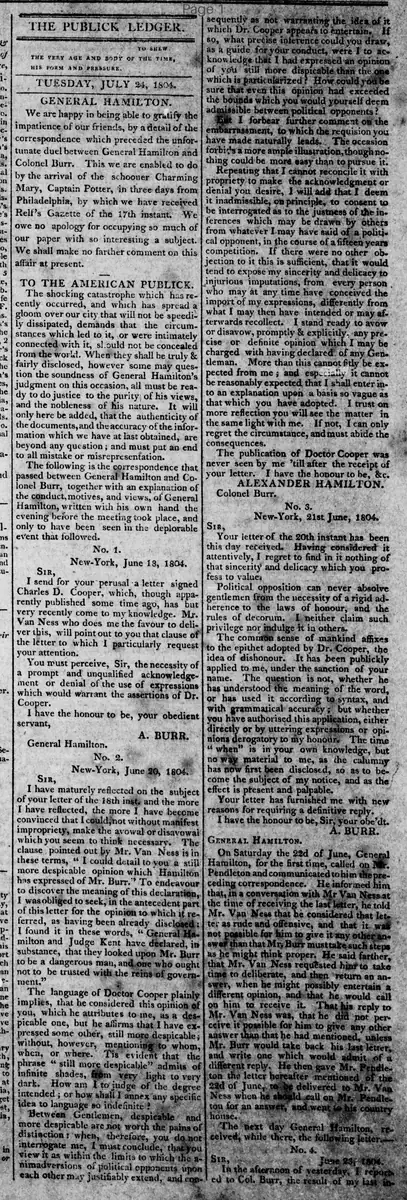
GENERAL HAMILTON.
We are happy in being able to gratify the impatience of our friends, by a detail of the correspondence which preceded the unfortunate duel between General Hamilton and Colonel Burr. This we are enabled to do by the arrival of the schooner Charming Mary, Captain Potter, in three days from Philadelphia, by which we have received Relf's Gazette of the 17th instant. We owe no apology for occupying so much of our paper with so interesting a subject.
We shall make no farther comment on this affair at present.
TO THE AMERICAN PUBLICK.
The shocking catastrophe which has recently occurred, and which has spread a gloom over our city that will not be speedily dissipated, demands that the circumstances which led to it, or were intimately connected with it, should not be concealed from the world. When they shall be truly & fairly disclosed, however some may question the soundness of General Hamilton's judgment on this occasion, all must be ready to do justice to the purity of his views, and the nobleness of his nature. It will only here be added, that the authenticity of the documents, and the accuracy of the information which we have at last obtained, are beyond any question; and must put an end to all mistake or misrepresentation.
The following is the correspondence that passed between General Hamilton and Colonel Burr, together with an explanation of the conduct, motives, and views, of General Hamilton, written with his own hand the evening before the meeting took place, and only to have been seen in the deplorable event that followed.
No. 1.
New-York, June 18, 1804.
SIR,
I send for your perusal -a letter signed Charles D. Cooper, which, though apparently published some time ago, has but very recently come to my knowledge. Mr. Van Ness who does me the favour to deliver this, will point out to you that clause of the letter to which I particularly request your attention.
You must perceive, Sir, the necessity of a prompt and unqualified acknowledgement or denial of the use of expressions which would warrant the assertions of Dr. Cooper.
I have the honour to be, your obedient servant,
A. BURR.
General Hamilton.
No. 2.
New-York, June 20, 1804.
SIR,
I have maturely reflected on the subject of your letter of the 18th inst. and the more I have reflected, the more I have become convinced that I could, not without manifest impropriety, make the avowal or disavowal which you seem to think necessary. The clause pointed out by Mr. Van Ness is in these terms, " I could detail to you a still more despicable opinion which Hamilton has expressed of Mr. Burr." To endeavour to discover the meaning of this declaration, I was obliged to seek, in the antecedent part of this letter for the opinion to which it referred, as having been already disclosed: I found it in these words, " General Ha. milton and Judge Kent have declared, in substance, that they looked upon Mr. Burr to be a dangerous man, and one who ought not to be trusted with the reins of government."
The language of Doctor Cooper plainly implies, that he considered this opinion of you, which he attributes to me, as a despicable one, but he affirms that I have expressed some other, still more despicable; without, however, mentioning to whom, when, or where.' Tis evident that the phrase " still more despicable" admits of infinite shades, from very light to very dark. How am I to judge of the degree intended ; or how shall I annex any specific idea to language so indefinite :
Between Gentlemen, despicable and more despicable are not worth the pains of distinction; when, therefore, you do not interrogate me, I must conclude that you view it as within the limits to which the animadversions of political opponents upon each other may justifiably extend, and consequently as not warranting the idea of it which Dr. Cooper appears to entertain. If so, what precise inference could you draw, as a guide for your conduct were I to acknowledge that I had expressed an opinion of you still more despicable than the one which is particularized? How could you be sure that even this opinion had exceeded the bounds which you would yourself deem admissible between political opponents?
But I forbear further comment on the embarrassment, to which the requisition you have made naturally leads.: the occasion forbids a more ample illustration, though nothing could be more easy than to pursue it.
Repeating that I cannot reconcile it with propriety to make the acknowledgment or denial you desire, I will add that I deem it inadmissible, on principle to consent to be interrogated as to the justness of the inferences which may be drawn by others from whatever I. may have said of a political opponent, in the course of a fifteen years competition. If there were no other objection to it this is sufficient, that it would tend to expose my sincerity and delicacy to injurious imputations, from every person who may at any time have conceived the import of my expressions, differently from what I may then have intended or may afterwards recollect. I stand ready to avow or disavow, promptly & explicitly, any precise or definite opinion which I may be charged with having declared of any Gentleman. More than this cannot fitly be expected from me; and especially it cannot be reasonably expected that I shall enter into an explanation upon a basis so vague as that which you have adopted.' I trust on more reflection you will see the matter in the same light with me. If not, I can only regret the circumstance, and must abide the consequences.
The publication of Doctor Cooper was never seen by me 'till after the receipt of your letter. I have the honour to be, &c.
ALEXANDER HAMILTON.
Colonel Burr.
No. 3.
New-York, 21st June, 1804.
SIR,
Your letter of the 20th instant has been this day received. Having considered it attentively, I regret to find in it nothing of that sincerity and delicacy which you profess to value.
Political opposition can never absolve gentlemen from the necessity of a rigid adherence to the laws of honour and the rules of decorum. I neither claim such privilege nor indulge it in others.
The common sense of mankind affixes to the epithet adopted by Dr. Cooper, the idea of dishonour. It has been publickly applied to me, under the sanction of your name. The question is not, whether he has understood the meaning of the word or has used it according to syntax, and with grammatical accuracy: but whether you have authorised this application, either directly or by uttering expressions or opinions derogatory to my honour The time " when" is in your own knowledge, but no way material to me, as the calumny has now first been disclosed, so as to become the subject of my notice, and as the effect is present and palpable.
Your letter has furnished me with new reasons for requiring a definitive reply.
I have the honour to be, Sir your obe dt.
A. BURR.
GENERAL HAMILTON.
On Saturday the 22d of June, General Hamilton, for the first time, called on Pendleton and communicated to him the preceding correspondence. He informed him that, in a conversation with Mr Van Ness at the time of receiving the last letter, he told Mr. Van Ness that he considered that letter as rude and offensive, and that it was not possible for him to give it any other answer than that Mr Burr must take such steps as he might think proper. He said farther, that Mr. Van Ness requested him to take time to deliberate, and then return an answer when he might possibly entertain a different opinion, and that he would call on him to receive it. That his reply to Mr. Van Ness was, that he did not perceive it possible for him to give any other answer than that he had mentioned, unless Mr. Burr would take back his last letter, and write one which would admit of a different reply, He then gave Mr. Pendleton the letter hereafter mentioned of the 22d of June to be delivered to Mr. Van Ness when he should call on Mr. Pendleton for an answer and went to his country house
The next day General Hamilton received while there, the following letter...
No.4.
SIR,
June 23- 18
In the afternoon of yesterday, I reported to Col. Burr, the result of my last
Interview with you, and appointed the evening to receive his further instructions.
Some private engagements, however, prevented me from calling on him till this morning. On my return to the city I found upon enquiry, both at your office and house, that you had returned to your residence in the country. Lest an interview there might be less agreeable to you than elsewhere, I have taken the liberty of addressing you this note, to enquire when and where it will be most convenient to you to receive a communication. Your most obt. and very humble servt.
W.P. VANNESS.
GENERAL HAMILTON.
Mr. Pendleton understood from General Hamilton that he immediately answered, that if the communication was pressing he would receive it at his country house that day. If not, he would be at his house in town the next morning at 9 o'clock. But he did not give Mr. Pendleton any copy of this note.
No. 5.
New-York, June 22, 1804.
SIR,
Your first letter in a style too peremptory, made a demand, in my opinion, unprecedented and unwarrantable. My answer, pointing out the embarrassment, gave an opportunity to take a less exceptionable course. You have not chosen to do it, but by your last letter, received this day, containing expressions indecorous and improper, you have increased the difficulties to explanation intrinsically incident to the nature of your application.
If by "definite reply," you mean the direct avowal or disavowal required in your first letter, I have no other answer to give, than that which has already been given. If you mean any thing different, admitting of greater latitude, it is requisite you should explain.
ALEX. HAMILTON.
Aaron Burr, Esq.
This letter, although dated on the 23d June remained in Mr. Pendleton's possession until the 25th, within which period he had several conversations with Mr. Van Ness. In these conversations Mr. Pendleton endeavoured to illustrate and enforce the propriety of the ground General Hamilton had taken. Mr. Pendleton mentioned to Mr. Van Ness, as the result, that if Colonel Burr would write a letter, requesting to know, in substance, whether, in the conversation to which Dr. Cooper alluded, any particular instance of dishonourable conduct was imputed to Col. Burr, or whether there was any impeachment of his private character, General Hamilton would declare to the best of his recollection what passed in that conversation: and Mr. Pendleton read to Mr. Van Ness a paper containing the substance of what General Hamilton would say on this subject, which is as follows:
No. 6.
"General Hamilton says he cannot imagine to what Dr. Cooper may have alluded, unless it were to a conversation at Mr. Taylor's, in Albany, last winter, (at which Mr. Taylor, he, and General Hamilton were present) General Hamilton cannot recollect distinctly the particulars of that conversation, so as to undertake to repeat them, without running the risk of varying, or omitting, what may be deemed important circumstances. The expressions are entirely forgotten, and the specifick ideas imperfectly remembered; but to the best of his recollection it consisted of comments on the political principles and views of Col. Burr, and the results that might be expected from them in the event of his election as Governour, without reference to any particular instance of past conduct, or to private character."
After the delivery of the letter of the 22d, as above mentioned, in another interview with Mr. Van Ness, he desired Mr. Pendleton to give him in writing the substance of what he had proposed on the part of General Hamilton, which Mr. Pendleton did in the words following:
No. 7.
"In answer to a letter properly adapted to obtain from Gen. Hamilton a declaration whether he had charged Col. Burr with any particular instance of dishonourable conduct, or had impeached his private character either in the conversation alluded to by Dr. Cooper, or in any other particular instance to be specified.
He would be able to answer, consistently with his honour, and the truth, in substance, that the conversation to which Dr. Cooper alluded, turned wholly on political topicks, and did not attribute to Col. Burr any instance of dishonourable conduct, nor relate to his private character; and in relation to any other language or conversation of General Hamilton, which Col. Burr will specify, a prompt and frank avowal or denial will be given."
On the 26th June Mr. P. received the following letter:
No. 8.
SIR,
The letter which you yesterday delivered me, and your subsequent communication, in Col. Burr's opinion evince no disposition on the part of Gen. Hamilton to come to a satisfactory accommodation. The injury complained of and the reparation expected, are so definitely expressed in Col. Burr's letter of the 21st inst. that there is not perceived a necessity for further explanation on his part. The difficulty that would result from confining the enquiry to any particular times and occasions must be manifest. The denial of a specified conversation only, would leave strong implications that, on other occasions, improper language had been used. When and where injurious opinions and expressions have been uttered by Gen. Hamilton, must be best known to him, and of him only will Col. Burr enquire. No denial or declaration will be satisfactory, unless, it be general, so as wholly to exclude the idea that rumours derogatory to Col. Burr's honour have originated with Gen. Hamilton, or have been fairly inferred from any thing he has said. A definite reply to a requisition of this nature was demanded by Col. Burr's letter of the 21st inst. This being refused, invites the alternative alluded to in Gen. Hamilton's letter of the 20th.
It was required by the position in which the controversy was placed by Gen. Hamilton on Friday last, and I was immediately furnished with a communication demanding a personal interview. The necessity of this measure has not, in the opinion of Col. Burr, been diminished by the General's last letter, or any communication which has since been received. I am consequently again instructed to deliver you a message, as soon as it may be convenient for you to receive it. I beg, therefore, you will be so good as to inform me, at what hour I can have the pleasure of seeing you.
Your most obedient and very humble servant,
W.P. VAN NESS.
Nathaniel Pendleton, Esq.
June 26th.
No. 9.
SIR,
26th June, 1804.
I have communicated the letter which you did me the honour to write to me of this date, to General Hamilton. The expectations now disclosed on the part of Col. Burr, appear to him to have greatly extended the original ground of enquiry, & embrace an inquisition into his most confidential conversations, as well as others, through the whole period of his acquaintance with Col. Burr.
While he was prepared to meet the particular case fairly and fully, he thinks it inadmissible that he should be expected to answer at large, to every thing that he may possibly have said, in relation to the character of Col. Burr, at any time or upon any occasion. Though he is not conscious that any charges which are in circulation to the prejudice of Col. Burr have originated with him, except one which may have been so considered, and which has long since been fully explained between Col. Burr and himself yet he cannot consent to be questioned, generally, as to any rumours which may be afloat derogatory to the character of Colonel Burr without specification of the several rumours, many of them probably unknown to him.
He does not, however, mean to authorise any conclusion as to the real nature of his conduct in relation to Col. Burr, by his declining so loose and vague a basis of explanation, and he disavows an unwillingness to come to a satisfactory, provided it be an honourable, accommodation. His objection is, the very indefinite ground which Col. Burr has assumed, in which he is sorry to be able to discern nothing short of predetermined hostility. Presuming, therefore that it will be adhered to, he has instructed me to receive the message which you have it in charge to deliver. For this purpose I shall be at home, and at your command, to-morrow morning from eight to ten o'clock.
I have the honour to be respectfully,
Your obedient servant.
NATHANIEL PENDLETON.
William P. Van Ness, Esq.
No. 10.
SIR,
The letter which I had the honour to receive from you, under date of yesterday, states, among other things, that in General Hamilton's opinion, Col. Burr has taken a very indefinite ground, in which he evinces nothing short of predetermined hostility, and that General Hamilton thinks it inadmissible that the enquiry should extend to his confidential as well as other conversations. To this Col. Burr can only reply, that secret whispers traducing his fame, and impeaching his honour, are, at least, equally injurious with slanders, publicly uttered; That Gen. Hamilton had at no time, and in no place, a right to use any such injurious expressions; and that the partial negative he is disposed to give, with the reservations he wishes to make, are proofs that he has done the injury specified.
Col. Burr's request was, in the first instance, proposed in a form the most simple, in order that General Hamilton might give to the affair that course to which he might be induced by his temper and his knowledge of facts. Colonel Burr trusted with confidence, that, from the frankness of a soldier, and the candour of a gentleman, he might expect an ingenuous declaration. That if, as he had reason to believe, Gen. Hamilton had uttered expressions derogatory to his honour, he would have had the magnanimity to retract them; and that if, from his language, injurious inferences had been improperly drawn, he would have perceived the propriety of correcting errors, which might thus have been widely diffused. With these impressions, Col. Burr was greatly surprised at receiving a letter which he considered as evasive, and which was conceived in a manner deemed not altogether decorous. In one expectation, however, he was not wholly deceived, for the close of Gen. Hamilton's letter contained an intimation that if Col. Burr should dislike his refusal to acknowledge or deny, he was ready to meet the consequences. This Col. Burr deemed a sort of defiance, and would have felt justified in making it the basis of an immediate message. But as the communication contained something concerning the indefiniteness of the request, as he believed it rather the offspring of false pride than of reflection, and as he felt the utmost reluctance to proceed to extremities, while any other hope remained, his request was repeated in terms more explicit. The replies and propositions on the part of Gen. Hamilton have, in Colonel Burr's opinion, been constantly in substance the same.
Col. Burr disavows all motives of predetermined hostility, a charge by which he thinks insult added to injury. He feels as a gentleman should feel when his honour is impeached or assailed, and, without sensations of hostility or wishes of revenge, he is determined to vindicate that honour, at such hazard as the nature of the case demands.
The length to which this correspondence has extended, only tending to prove that the satisfactory redress, earnestly desired, cannot be obtained, he deems it useless to offer any propositions, except the simple message which I shall have the honour to deliver.
I have the honour to be, with great respect, your obedient and very humble servant.
W. P. VAN NESS.
N. Pendleton, Esq.
Wednesday morning, June 27th 1804.
With this letter, a message was received, such as was to be expected containing an invitation, which was accepted, and Mr. Pendleton informed Mr. Van Ness, he should hear from him the next day as to further particulars.
This letter was delivered to Gen. Hamilton on the same evening, and a very short conversation ensued between him and Mr. Pendleton, who was to call on him early the next morning for a farther conference.
When he did so, General Hamilton said, he had not understood whether the message and answer were definitively concluded, or whether another meeting was to take place for that purpose between Mr. Pendleton and Mr. Van Ness. Under the latter impression, and as the letter contained matter that naturally led to animadversion, he gave Mr. Pendleton a paper of remarks, in his own hand writing, to be communicated to Mr. Van Ness, if the state of the affair rendered it proper.
In the farther interview with Mr. Van Ness that day, after explaining the causes which had induced General Hamilton to suppose that the state of the affair did not render it improper, he offered this paper to Mr. Van Ness, who declined receiving it, alledging that he considered the correspondence as closed by the acceptance of the message that he had delivered.
Mr. Pendleton informed Mr. Van Ness of the inducements, mentioned by General Hamilton in those remarks, for the postponing the meeting until the close of the Circuit: and as this was uncertain, Mr. Pendleton was to let him know when it would be convenient.
On Friday the 6th of July, the Circuit being closed, Mr. Pendleton gave this information, and that General Hamilton would be ready at any time after the Sunday following. On Monday the particulars were arranged, and the publick are but too well acquainted with the sad result.
The paper above alluded to is as follows:
No. 11.
Remarks on the letter of June 27 1804.
Whether the observations on this letter are designed merely to justify the result which is indicated in the close of the letter, or may be intended to give an opening for rendering any thing explicit, which may have been deemed vague heretofore, can only be judged of by the sequel. At any rate, it appears to me necessary not to be misunderstood. Mr. Pendleton is therefore authorised to say, that, in the course of the present discussion, written or verbal, there has been no intention to evade, defy or insult, but a sincere disposition to avoid extremities if it could be done with propriety. With this view, General Hamilton has been ready to enter into a frank and free explanation on any and every object of a specifick nature; but not to answer a general and abstract enquiry, embracing a period too long for any accurate recollection, and exposing him to unpleasant criticisms from, or unpleasant discussions, with any and every person, who may have understood him in an unfavourable sense. This (admitting that he could answer in a manner the most satisfactory to Colonel Burr) he could deem inadmissible, in principle and precedent, and humiliating in practice.
To this, therefore, he can never submit.
Frequent allusion has been made to slanders said to be, in circulation. Whether they are openly or in whispers they have a form and shape, and might be specified. If the alternative alluded to in the close of the letter is definitively tendered, it must be accepted; the time, place, and manner to be afterwards regulated. I should not think it right, in the midst of a Circuit Court, to withdraw my services from those who may have confided important interests to me, and expose them to the embarrassments of seeking other counsel, who may not have time to be sufficiently instructed in their cause. I shall also want a little time to make some arrangements respecting my own affairs.
The following paper, in the hand writing of General Hamilton, was enclosed with his will and some other papers, in a packet addressed to one of his executors, which was of course not to have been delivered, but in case of the melancholy event that has happened. As it contains his motives, and reflections on the causes that have led to this fatal catastrophe, it is deemed proper to communicate it to the publick.
No. 12.
On my expected interview with Colonel Burr, I think it proper to make some remarks explanatory of my conduct, motives and views.
I was certainly desirous of avoiding this interview, for the most cogent reasons.
1. My religious and moral principles are strongly opposed to the practice of duelling, and it would ever give me pain to be obliged to shed the blood of a fellow creature, in a private combat, forbidden by the laws.
2. My wife and children are extremely dear to me, and my life is of the utmost importance to them, in various views.
3. I feel a sense of obligation towards my creditors, who in case of accident to me, by the forced sale of my property, may be in some degree sufferers. I did not think myself at liberty, as a man of probity, lightly to expose them to this hazard.
4. I am conscious of no ill will to Colonel Burr, distinct from political opposition, which, as I trust, has proceeded from pure and upright motives.
Lastly, I shall hazard much, and can possibly gain nothing by the issue of the interview.
But it was, as I conceive, impossible for me to avoid it. There were intrinsick difficulties in the thing, and artificial embarrassments, from the manner of proceeding on the part of Colonel Burr.
Intrinsick, because it is not to be denied, that my animadversions on the political principles, character, and views of Colonel Burr, have been extremely severe, and on different occasions, I, in common with many others, have made very unfavourable criticisms on particular instances of the private conduct of this gentleman.
In proportion as these impressions were entertained with sincerity and uttered with motives, and for purposes, which might appear to me commendable, would be the difficulty (until they could be removed by evidence of their being erroneous) of explanation or apology. The disavowal required of me by Colonel Burr, in a general and indefinite form, was out of my power, if it had really been proper for me to submit to be so questioned; but I was sincerely of opinion, that this could not be; and in this opinion I was confirmed by that of a very moderate and judicious friend whom I consulted. Besides that Colonel Burr appeared to me to assume, in the first instance, a tone unnecessarily peremptory and menacing, and in the second, positively offensive. Yet I wished, as far as might be practicable, to leave a door open to accommodation. This, I think will be inferred from the written communications made by me, and by my direction, and would be confirmed by conversations between Mr. Van Ness and myself, which arose out of the subject.
I am not sure, whether, under all the circumstances, I did not go further in the attempt to accommodate, than a punctilious delicacy will justify. If so I hope the motive I have stated will excuse me.
It is not my design, by what I have said to affix any odium on the conduct of Colonel Burr, in this case. He doubtless has heard of animadversions of mine which bore very hard upon him; and it is probable that, as usual, they were accompanied with some falsehoods. He may have supposed himself under a necessity of acting as he has done. I hope the grounds of his taking offence will appear to the world satisfactory and honourable, as they are to me.
Proceedings have been such as ought to satisfy his own conscience.
I trust, at the same time, that the world will do me the justice to believe, that I have not censured him on light grounds, nor from unworthy inducements. I certainly have had strong reasons for what I may have said, though it is possible that, in some particulars, I may have been influenced by misconstruction or misinformation. It is also my ardent wish that he may have been more mistaken than I think I have been, and that he, by his future conduct, may shew himself worthy of all confidence and esteem, and prove an ornament and blessing to this country.
As well because it is possible that I may have injured Colonel Burr, however convinced myself that my opinions and declarations have been well founded, as from my general principles and temper in relation to similar affairs--I have resolved, if our interview is conducted in the usual manner, and it pleases God to give me the opportunity, to reserve and throw away my first fire, and I have thoughts even of reserving my second fire--and thus giving a double opportunity to Colonel Burr to pause and to reflect.
It is not, however, my intention to enter into any explanations on the ground--Apology from principle, I hope, rather than pride, is out of the question.
To those who, with me, abhorring the practice of duelling, may think that I ought on no account to have added to the number of bad examples, I answer, that my relative situation, as well in publick as private, enforcing all the considerations which constitute what men of the world denominate honour, imposed on me (as I thought) a peculiar necessity not to decline the call. The ability to be in future useful, whether in resisting mischief or effecting good, in those crisis of our publick affairs which seem likely to happen, would probably be inseparable from a conformity with publick prejudice in this particular.
ALEXANDER HAMILTON.
On the foregoing letters and papers, the Editor will make no comment.--He submits them to the heart and understanding of every reader.
[N. Y. Eve. Post.]
WILL.
In the name of God, Amen, I, ALEXANDER HAMILTON, of the city of New-York, Counsellor at Law; do make this my Last Will and Testament, as follows :
First. I appoint John B. Church, Nicholas Fish, and Nathaniel Pendleton, of the city aforesaid, Esquires, to be Executors and Trustees of this my will, and I devise to them, their heirs and assigns, as joint tenants, and not as tenants in common, all my estate real, & personal, whatsoever, and wheresoever upon trust at their discretion to sell and dispose of the same, at such time and times, in such manner, and upon such terms as they the survivors and survivor shall think fit, and out of the proceeds to pay all the debts which I shall owe at the time of my decease ; in whole, if the fund be sufficient, proportionably, if it shall be insufficient, and the residue, if any there shall be, to pay and deliver to my excellent and dear wife Elizabeth Hamilton.
Though if it should please God to spare my life, I may look for a considerable surplus out of my present property: yet if he should speedily call me to the eternal world, a forced sale, as is usual, may possibly render it insufficient to satisfy my debts. I pray God that something may remain for the maintenance and education of my dear wife and children. But should it on the contrary happen, that there is not enough for the payment of my debts, I entreat my dear children, if they, or any of them should ever be able, to make up the deficiency. I without hesitation commit to their delicacy a wish that is dictated by my own. Though conscious that I have too far sacrificed the interests of my family to publick avocations, and on this account have the less claim to burthen my children, yet I trust in their magnanimity to appreciate as they ought, this my request. In so unfavourable an event of things, the support of their dear mother, with the most respectful and tender attention, is a duty, all the sacredness of which they will feel.
Probably her own patrimonial resources will preserve her from indigence. But in all situations they are charged to bear in mind, that she has been to them the most devoted and best of mothers.
In testimony whereof, I have hereunto subscribed my hand, the 9th day of July, the year of our Lord 1804
ALEXANDER HAMILTON.
Signed, sealed, published and declared as and for his last will and testament, in our presence, who have subscribed the same in his presence, the words J. B. Church being above interlined.
DOMINICK F. BLAKE,
GRAHAM BURRELL,
THEO. B. VALLAEAU.
New-York, Surrogate's Office, ss.
July 16th, 1804.
I do hereby certify the preceding to be a true copy of the original will of Alexander Hamilton, deceased, now on file in my office.
SILVANUS MILLER, Surrogate,
The funeral obsequies of the General were performed on Saturday the 14th instant, with a pomp and solemnity surpassing any thing ever before witnessed in New-York. Nothing can more strongly demonstrate the high respect and affection entertained for him, while living, nor the profound regret and sorrow which his death has implanted in every bosom, than the extraordinary sensibility discovered by every class of citizens in that place where he was most intimately known to each individual; and where the fiend-like spirit of party watched and analyzed his most minute action or word. All its vindictive passions were laid asleep ; and grief, for a national and individual calamity, was the only sentiment which prevailed.
The society of the Cincinnati being charged with the direction of the Funeral Ceremonies of its President General, which will take place to-morrow at 10 o'clock, commemorative of an event of the deepest national regret, direct the following
ORDER OF PROCESSION.
1. The military corps, commanded by Col. Morton.
2. The Society of the Cincinnati.
3. Clergy of all denominations.
4. THE CORPSE.
5. The General's Horse.
6. Relatives of the deceased.
7. Physicians.
8. the Judges of the Supreme Court.
9. The Hon. Gouverneur Morris in his carriage,
10. Gentlemen of the Bar and Students at Law.
11. The Governour and Lieutenant Governour of the State.
12. Mayor and Corporation of the City.
13. Members of Congress and Civil Officers of the United States.
14. Ministers, Consuls, and Residents of Foreign Powers.
15. Officers of the Army and Navy of the United States.
16. Military and Naval Officers of Foreign Powers.
17. Militia Officers of the State.
18. Presidents, Directors, and officers of the respective Banks.
19. Chamber of Commerce & Merchants.
20. Marine Society, Wardens of the Ports, and Masters and Officers of all the Vessels in the harbour.
21. The President, Professors, and Students of Columbia College.
22. The different societies, in such order as their respective Presidents may arrange.
23. Citizens in general.
Then follow the instructions to Col. Morton and the military, regulating the order of the march.
The following letter is in Relf's paper, from his correspondent at New-York, received by the express which enabled him to anticipate the other papers at Philadelphia in the foregoing correspondence.
"New-York, July 16.
" The last solemn rites due to the great HamilTon, were paid yesterday. Such a day of mourning was never witnessed in this city.--Not a store was seen open.-- All classes crowded, and each seemed anxious to be the first to shew his respect to the best and greatest of men.
" The funeral took place agreeably to the arrangements, which you have already received.--The procession left the house of Mr. Church, near Mechanick-hall, a quarter before 12, and was two hours reaching Trinity church. Hundreds were seen on the side-way, as well as in the ranks, shedding tears--it was truly affecting. Four of Mr. Hamilton's sons followed him to the grave !--Having arrived at the church, and after a short pause, Gouverneur Morris, Esq. rose on an elevation in front, and addressed the surrounding spectators, the General's four sons being on the stage with him.--He was so much affected, that it was with difficulty he could proceed; but having recovered, he recapitulated, very concisely, the services which Mr. Hamilton had rendered the United States, as a Soldier, as a Statesman, and as a professional Man at the bar. I should have stated, that in his introduction, he observed, that his object was not to excite the sensibility of the General's friends, but to endeavour to allay it.--He avoided any remarks that tended to encrease the general indignation. --He barely touched on the cause of his death.
" The British frigate Boston, lying at anchor within the Hook, fired minute guns all yesterday, and the French frigates, of the Battery, had their colours half mast, and also fired minute guns.
" A jury of inquest sat for several hours on Friday; they meet again at 4 o'clock to-morrow.--It is believed the duel will be proved, if nothing worse. Col. Burr left the city on Friday, and has gone, it is said, to the southward.
" The probability is, that in the course of a few days, the correspondence between General Hamilton and Colonel Burr, will be published. It is said, it will go to prove, that too much was required of the General."
In all the papers we have received since this fatal occurrence was first announced, we are pleased to notice that the memory of the general has been treated with the most marked respect. The conduct of the British and French frigates in the harbour of New-York merits every acknowledgment.
At New York, a meeting of merchants and other citizens, entered into resolutions expressive of their sense of the worth of general Hamilton, and recommending to the citizens of all descriptions, to close their houses on Saturday, and observe it as a day of solemn sorrow.
The common council of the city passed resolutions in order to give an "unequivocal testimony of the great loss which not only this city, but the state of New-York and the United States, have sustained by the death of this great and good man," that all business be suspended on Saturday, that the council in a body attend his funeral, and that a committee be appointed to make arrangements for performing the funeral obsequies, at the expense of the common council.
The society of Cincinnati, resolved to mourn thirty days.
The gentlemen of the Bar have resolved to "wear crape for their deceased brother, for the space of six weeks."
The St. Andrew's, St. Tammany's, and Mechanical Societies, the military associations, the students of Columbia College, in short every description of citizens, had unanimously joined in the one design of paying every honourable tribute of sorrow and respect to his memory.
At a general meeting of the citizens of Philadelphia, Southwark and the Northern Liberties, it was resolved, that solemn service should be performed in the different places of worship on Sunday last, the 15th, when the citizens should render their prayers of thanksgiving to God, for his goodness in having blessed our nation with men of talents to discern, and of virtue to pursue, her safety, her honour, and her welfare ; and especially for having thus long continued to us the eminently useful talents of the deceased. That the bells should be muffled and tolled during the day ; that the ships in the harbour should display their flags half-mast high ; and that the citizens should wear crape round their left arms for thirty days.
At a meeting of the gentlemen of the Bar, it was resolved to wear crape round the hat for thirty. A similar resolution was adopted by the students of law of that city.
All these resolutions are accompanied by expressions of the most profound respect and regret for the loss sustained.
Amongst all these demonstrations of sorrow will not the voice of Norfolk be heard ?
What sub-type of article is it?
What themes does it cover?
What keywords are associated?
What entities or persons were involved?
Where did it happen?
Story Details
Key Persons
Location
New York
Event Date
July 11, 1804
Story Details
Correspondence between Hamilton and Burr escalates from a letter by Cooper alleging Hamilton's despicable opinions of Burr, leading to demands for denial and ultimately a duel where Hamilton is mortally wounded; includes Hamilton's reflections on his motives, opposition to dueling, intent to throw away his shot, his will providing for his family, and extensive public mourning with funeral procession and resolutions.