Thank you for visiting SNEWPapers!
Sign up free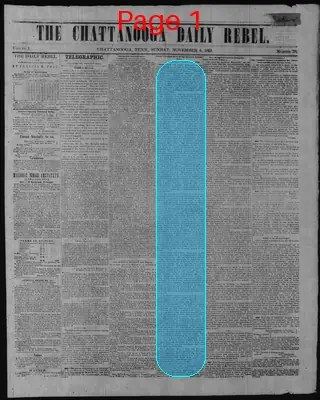
The Chattanooga Daily Rebel
Chattanooga, Hamilton County, Tennessee
What is this article about?
In October 1862, a correspondent in Richmond reports dire clothing and supply shortages in the Confederate army after the Maryland campaign, highlighting government production shortfalls and urging civilians to provide winter essentials to avert suffering among troops.
Clipping

OCR Quality
Full Text
There being but slight prospects of any more fighting on the line of the Potomac this fall, and a good opportunity offering to get from Winchester down to Staunton, I decided to come on to Richmond, especially as my physician had advised me to that course.-- Typhoid fever and chills and fever were prevailing in a considerable extent in the lower Valley of the Shenandoah, and the supply of medicines and of suitable food for the sick was so limited, and the weather so raw and damp, that when one is once attacked with chills or fever, he finds it exceedingly difficult to get rid of them.
I am glad to learn that my appeal in behalf of the army has been received with so much favor throughout the Confederacy. It has been a coal fire even upon the back of the Government which has already began to send forward supplies of clothing and shoes. Thirty wagons loaded with winter supplies reached Winchester the day before I left, and I meet others en route for the same destination. I called at the Clothing Bureau in this city this morning, for the purpose of improving my own wardrobe, which is none the better for the Maryland campaign, but was told that there was not a yard of officer's cloth in the establishment, the supply having been exhausted some time since. There was a considerable stock on hand of coarse strong cloth, which is being made up for the troops as rapidly as possible. An officer connected with the Bureau informed me that 33,600 garments had been sent up to Gen. Lee's army within the last twenty days, and that clothing for the army is being made up at the rate of 9,000 garments per week. The Government has fifty-eight tailors in its employ, whose business it is to cut out the garments, and two thousand seven hundred women who make them up. The scraps of woolen cloth left by the cutters are sent to the Penitentiary, where they are converted into quilts, &c., for the use of the army, whilst those of cotton fabrics are disposed of to the paper manufacturers.
Allowing three garments to a man--coat, pants and shirt--the 33,000 pieces sent up to the army will furnish an outfit for 11,000 soldiers. This will afford very great relief as far as it goes; yet it will fall far short of the necessities of the army. Estimating the clothing manufactured at all the government establishments in the country at 20,000 garments per week, and the number of troops in the field at 300,000 men, it would require more than a year at this rate to furnish each man with one suit of clothes. I do not include in this estimate blankets, shoes, socks, gloves which are absolutely indispensable in a climate like this.
I have no means of knowing how many complete suits of clothing the government will be able to provide; but estimating them at 100,000--including a blanket, pair of shoes, two pairs of socks and pair of gloves, there will still be left 200,000 men who must perish unless they are supplied by the people at home. If we suppose the government will be able to furnish winter outfits to 200,000 men, there will yet be 100,000 who must look to the open hearts and willing fingers at home.
The government, however will not be in a condition to supply so many of the troops either with blankets, shoes, socks or gloves. Indeed, I am not aware that any provision has been made to secure a supply of either of these indispensable articles. Possibly some action was taken by Congress to have the shoemakers in the army detailed temporarily for the purpose of making shoes; but the shoe want is no less pressing than ever. This step to have been of any benefit, should have been taken months ago.
It is too late now to procure supplies of leather thread and pegs; and even if we had an abundant stock of each, it would be months before a sufficient number of shoes could be manufactured to meet the present wants of the army.
These facts will enable the people of the country to appreciate the magnitude of the labor before them. All my figures are merely rough estimates, especially in regard to the number of men in the field; but they are sufficiently accurate for the purpose for which they are offered. Whilst the country will be amazed that no more effort has been made by those in authority to provide the army with suitable clothing, it will readily perceive the necessity of the most prompt and energetic measures on the part of the people if they would meet the shortcomings of the government. If every man, woman and child in the South were to exert themselves to the utmost in this good work, still there would be many a brave fellow in the field who would suffer all the pains of a rigorous winter, if not of death, before the much needed relief could be received.
A statement appeared in one of the Richmond papers yesterday, based upon the report of a "passenger by the cars," to the effect that the condition of the troops was excellent, and that all they needed to render them entirely comfortable was a supply of blankets. Such statements as this may be gratifying to the public but they are a cruelty to the army. I know, as every other observing man who has been with the army knows, that the condition of a vast number of troops is deplorable. A few regiments and companies may have an adequate supply of clothing and shoes, but a large majority are in no condition to encounter the rigors of the approaching winter. Why, there are men in the hospitals at Winchester who are as naked as babes just born, and I saw here in the heart of Richmond this morning a poor emaciated soldier, who was hardly able to drag his bare feet along the pavement! In the army I know there are thousands of as true men as ever fired a musket, who have neither shoes nor stockings, no more than one suit of clothes, and that a summer suit, and dirty and ragged at that.
But I forbear. Nay, I dare not tell the people all I know of the condition of the best and bravest army that ever trod the earth. If they knew how many men in this army are without shirts--how many wear pants that do not cover their nakedness--and how many stand guard to-night upon bruised and bleeding feet--men, too, who have been accustomed to every comfort that a reasonable mind can desire--if they did not rise with indignation against those whose neglect has reduced the army to this deplorable condition, they would at least see that their most urgent and immediate duty is to come to its instant relief.
What sub-type of article is it?
What themes does it cover?
What keywords are associated?
What entities or persons were involved?
Where did it happen?
Story Details
Key Persons
Location
Richmond, Va.; Winchester; Shenandoah Valley; Potomac Line
Event Date
Oct. 18th, 1862
Story Details
A firsthand account from a correspondent details the severe shortages of clothing, shoes, and winter supplies in Gen. Lee's Confederate army following the Maryland campaign, critiques the government's inadequate production efforts, and appeals to Southern civilians for urgent aid to prevent troops from suffering in the coming winter.