Thank you for visiting SNEWPapers!
Sign up free
Literary
July 22, 1874
Juniata Sentinel And Republican
Mifflintown, Juniata County, Pennsylvania
What is this article about?
Anecdote from Trelawny's memoir describing Lord Byron's extreme fear of gaining weight due to his temperament and lameness, leading to starvation diets of biscuits, soda-water, and vinegar-soaked foods. He reacts angrily to a compliment on his appearance implying fatness and discusses his indifference to life and fear of pain.
Clipping
OCR Quality
95%
Excellent
Full Text
Lord Byron's Fear
of
Getting
Fat.
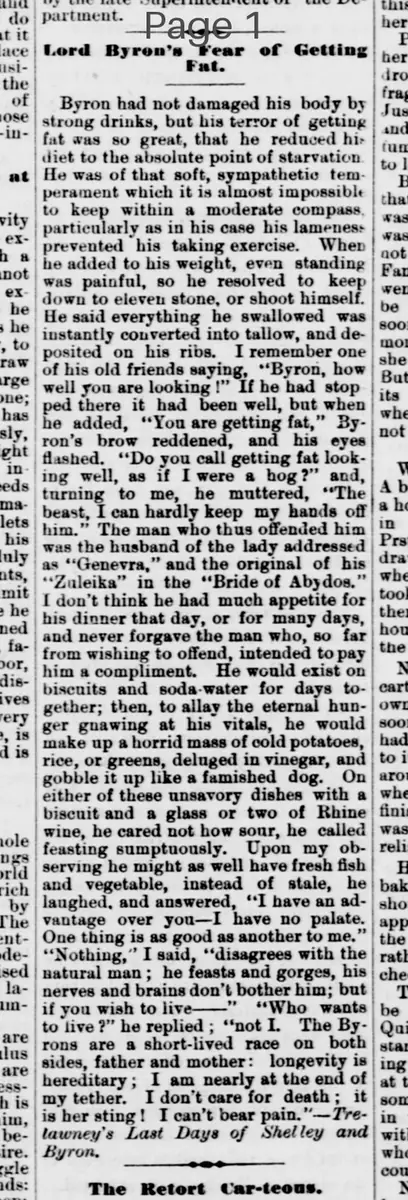
Byron had not damaged his body by strong drinks, but his terror of getting fat was so great, that he reduced his diet to the absolute point of starvation. He was of that soft, sympathetic temperament which it is almost impossible to keep within a moderate compass particularly as in his case his lameness prevented his taking exercise. When he added to his weight, even standing was painful, so he resolved to keep down to eleven stone, or shoot himself. He said everything he swallowed was instantly converted into tallow, and deposited on his ribs. I remember one of his old friends saying, "Byron, how well you are looking!" If he had stopped there it had been well, but when he added, "You are getting fat," Byron's brow reddened, and his eyes flashed. "Do you call getting fat looking well, as if I were a hog?" and, turning to me, he muttered, "The beast, I can hardly keep my hands off him." The man who thus offended him was the husband of the lady addressed as "Genevra," and the original of his "Zuleika" in the "Bride of Abydos."
I don't think he had much appetite for his dinner that day, or for many days, and never forgave the man who, so far from wishing to offend, intended to pay him a compliment. He would exist on biscuits and soda-water for days together; then, to allay the eternal hunger gnawing at his vitals, he would make up a horrid mass of cold potatoes, rice, or greens, deluged in vinegar, and gobble it up like a famished dog. On either of these unsavory dishes with a biscuit and a glass or two of Rhine wine, he cared not how sour, he called feasting sumptuously. Upon my observing he might as well have fresh fish and vegetable, instead of stale, he laughed, and answered, "I have an advantage over you-I have no palate. One thing is as good as another to me."
"Nothing," I said, "disagrees with the natural man; he feasts and gorges, his nerves and brains don't bother him: but if you wish to live-"
"Who wants to live?" he replied; "not I. The Byrons are a short-lived race on both sides, father and mother: longevity is hereditary: I am nearly at the end of my tether. I don't care for death; it is its sting! I can't bear pain."-Trelawney's Last Days of Shelley and Byron.
of
Getting
Fat.
Byron had not damaged his body by strong drinks, but his terror of getting fat was so great, that he reduced his diet to the absolute point of starvation. He was of that soft, sympathetic temperament which it is almost impossible to keep within a moderate compass particularly as in his case his lameness prevented his taking exercise. When he added to his weight, even standing was painful, so he resolved to keep down to eleven stone, or shoot himself. He said everything he swallowed was instantly converted into tallow, and deposited on his ribs. I remember one of his old friends saying, "Byron, how well you are looking!" If he had stopped there it had been well, but when he added, "You are getting fat," Byron's brow reddened, and his eyes flashed. "Do you call getting fat looking well, as if I were a hog?" and, turning to me, he muttered, "The beast, I can hardly keep my hands off him." The man who thus offended him was the husband of the lady addressed as "Genevra," and the original of his "Zuleika" in the "Bride of Abydos."
I don't think he had much appetite for his dinner that day, or for many days, and never forgave the man who, so far from wishing to offend, intended to pay him a compliment. He would exist on biscuits and soda-water for days together; then, to allay the eternal hunger gnawing at his vitals, he would make up a horrid mass of cold potatoes, rice, or greens, deluged in vinegar, and gobble it up like a famished dog. On either of these unsavory dishes with a biscuit and a glass or two of Rhine wine, he cared not how sour, he called feasting sumptuously. Upon my observing he might as well have fresh fish and vegetable, instead of stale, he laughed, and answered, "I have an advantage over you-I have no palate. One thing is as good as another to me."
"Nothing," I said, "disagrees with the natural man; he feasts and gorges, his nerves and brains don't bother him: but if you wish to live-"
"Who wants to live?" he replied; "not I. The Byrons are a short-lived race on both sides, father and mother: longevity is hereditary: I am nearly at the end of my tether. I don't care for death; it is its sting! I can't bear pain."-Trelawney's Last Days of Shelley and Byron.
What sub-type of article is it?
Essay
Prose Fiction
What themes does it cover?
Temperance
Death Mortality
What keywords are associated?
Byron
Diet
Obesity Fear
Trelawny
Memoir
Starvation
Lameness
What entities or persons were involved?
Trelawny
Literary Details
Title
Lord Byron's Fear Of Getting Fat
Author
Trelawny
Subject
Byron's Extreme Dieting Due To Fear Of Obesity
Form / Style
Anecdotal Memoir Excerpt In Prose
Key Lines
"Do You Call Getting Fat Looking Well, As If I Were A Hog?"
"Who Wants To Live?" He Replied; "Not I. The Byrons Are A Short Lived Race On Both Sides, Father And Mother: Longevity Is Hereditary: I Am Nearly At The End Of My Tether. I Don't Care For Death; It Is Its Sting! I Can't Bear Pain."