Thank you for visiting SNEWPapers!
Sign up free
Alexandria Gazette
Alexandria, Alexandria County, District Of Columbia
What is this article about?
In Paris on April 1, 1831, the French Chamber of Deputies rejected a bill to pay 25 million francs indemnity to the US under a recent treaty, by a vote of 176-168. This led to resignations by Duke de Broglie and General Sebastiani. Debates highlighted historical claims from Napoleonic era seizures and trade benefits.
Merged-components note: Continuation of the same article detailing the French Chamber of Deputies' debate and rejection of the indemnity bill to the United States.
Clipping
OCR Quality
Full Text
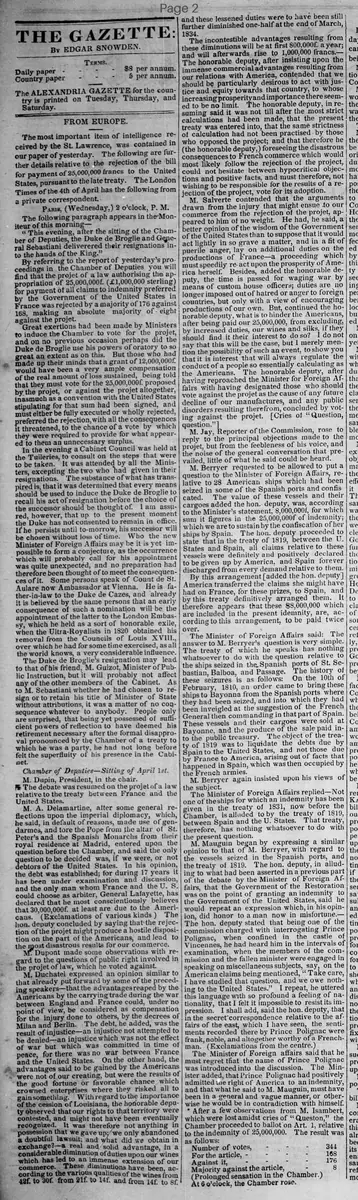
The most important item of intelligence received by the St. Lawrence, was contained in our paper of yesterday. The following are further details relative to the rejection of the bill for payment of 25,000,000 francs to the United States, pursuant to the late treaty. The London Times of the 4th of April has the following from a private correspondent.
Paris, (Wednesday,) 2 o'clock, P. M.
The following paragraph appears in the Moniteur of this morning
"This evening, after the sitting of the Chamber of Deputies, the Duke de Broglie and General Sebastiani delivered their resignations into the hands of the King."
By referring to the report of yesterday's proceedings in the Chamber of Deputies you will find that the projet of a law authorising the appropriation of 25,000,000f. (£1,000,000 sterling) for payment of all claims to indemnity preferred by the Government of the United States in France was rejected by a majority of 176 against 168, making an absolute majority of eight against the projet.
Great exertions had been made by Ministers to induce the Chamber to vote for the projet and on no previous occasion perhaps did the Duke de Broglie use his powers of oratory to so great an extent as on this. But those who had made up their minds that a grant of 12,000,000f. of the real amount of loss sustained, being told would have been a very ample compensation that they must vote for the 25,000,000f. proposed inasmuch as a convention with the United States stipulating for that sum had been signed, and must either be fully executed or wholly rejected, preferred the rejection, with all the consequences it threatened, to the chance of a vote by which they were required to provide for what appeared to them an unnecessary surplus.
In the evening a Cabinet Council was held at the Tuileries, to consult on the steps that were to be taken. It was attended by all the Ministers, excepting the two who had given in their resignations. The substance of what has transpired is, that it was determined that every means should be used to induce the Duke de Broglie to recall his act of resignation before the choice of the successor should be thought of. I am assured, however, that up to the present moment the Duke has not consented to remain in office. If he persists until to-morrow, his successor will be chosen without loss of time. Who the new Minister of Foreign Affairs may be it is yet impossible to form a conjecture, as the occurrence which will probably call for his appointment was quite unexpected, and no preparation had therefore been thought of to meet the consequences of it. Some persons speak of Count de St. Auliare now Ambassador at Vienna. He is father-in-law to the Duke de Cazes, and already it is believed by the same persons that an early consequence of such a nomination will be the appointment of the latter to the London Embassy, which he held as a sort of honorable exile, when the Ultra-Royalists in 1820 obtained his removal from the Councils of Louis XVIII., over which he had for some time exercised, as all the world knows, a very considerable influence.
The Duke de Broglie's resignation may lead to that of his friend, M. Guizot, Minister of Public Instruction, but it will probably not affect any of the other members of the Cabinet. As to M. Sebastiani whether he had chosen to resign or to retain his title of Minister of State without attributions, it was a matter of no consequence whatever to anybody. People only are surprised, that being yet possessed of sufficient powers of reflection to have deemed his retirement necessary after the formal disapprobation pronounced by the Chamber of a treaty to which he was a party, he had not long before felt the superfluity of his presence in the Cabinet.
Chamber of Deputies—Sitting of April 1st.
M. Dupin, President, in the chair.
The debate was resumed on the projet of a law relative to the treaty between France and the United States.
M. A. Lamartine, after some general reflections upon the imperial diplomacy, which, he said, in default of reasons, made use of gendarmes, and tore the Pope from the altar of St. Peter's and the Spanish Monarchs from their royal residence at Madrid, entered upon the question before the Chamber, and said the only question to be decided was, if we were, or not debtors of the United States. In his opinion, the debt was established; for during 17 years it has been under examination and discussion, and the only man whom France and the U. S. could choose as arbiter, General Lafayette, has declared that he most conscientiously believes that 30,000,000f. at least are due to the Americans. (Exclamations of various kinds) The hon. deputy concluded by saying that the rejection of the projet might produce a hostile disposition on the part of the Americans, and lead to the most disastrous results for our commerce.
M. Dupont made some observations with regard to the questions of public right involved in the projet of law, which he voted against.
M. Duchatel expressed an opinion similar to that already put forward by some of the preceding speakers—that the advantages reaped by the Americans by the carrying trade during the war between England and France could, under no point of view, be considered as compensation for the injury done to others, by the decrees of Milan and Berlin. The debt, he added, was the result of injustice—an injustice not attempted to be denied—an injustice which was not the effect of war but which was committed in time of peace, for there was no war between France and the United States. On the other hand, the advantages said to be gained by the Americans were not of our creating, but were the results of the good fortune or favorable chance which crowned enterprises where they risked all to gain something. With regard to the importance of the cession of Louisiana, the honorable deputy observed that our rights to that territory were contested, and might not have been eventually recognized. It was therefore not anything in possession that we gave up; we only abandoned a doubtful lawsuit; and what did we obtain in exchange?—a real and solid advantage, in a considerable diminution of duties upon our wines which has led to an immense extension of our commerce. These diminutions have been, according to the various qualities of the wines from 42f. to 30f. from 21f. to 14f. and from 14f. to 8f.
and these lessened duties were to have been still further diminished one-half at the end of March, 1834.
The incontestible advantages resulting from these diminutions will be at first 800,000f. a year; and will afterwards rise to 1,000,000 francs.—
The honorable deputy, after insisting upon the immense commercial advantages resulting from our relations with America, contended that we should be particularly desirous to act with justice and equity towards that country, to whose increasing prosperity and importance there seemed to be no limit. The honorable deputy, in resuming said it was not till after the most strict calculations had been made, that the present treaty was entered into, that the same strictness of calculation had not been practised by those who opposed the project; and that therefore he (the honorable deputy,) foreseeing the disastrous consequences to French commerce which would most likely follow the rejection of the project could not hesitate between hypocritical objections and positive facts, and must therefore, not wishing to be responsible for the results of a rejection of the project, vote for its adoption.
M. Salverte contended that the arguments drawn from the injury that might ensue to our commerce from the rejection of the projet, appeared to him of no weight. He had, he said, a better opinion of the wisdom of the Government of the United States than to suppose that it would act lightly in so grave a matter, and in a fit of puerile anger, lay on additional duties on the productions of France—a proceeding which must speedily re-act upon the prosperity of America herself. Besides, added the honorable deputy, the time is passed for waging war by means of custom house officers; duties are no longer imposed out of hatred or anger to foreign countries, but only with a view of encouraging productions of our own. But, continued the honorable deputy, what is to hinder the Americans, after being paid our 25,000,000, from excluding, by increased duties, our wines and silks, if they should find it their interest to do so? I do not say that this will be the case, but I merely mention the possibility of such an event, to show you that it is interest that will always regulate the conduct of a people so essentially calculating as the Americans. The honorable deputy, after having reproached the Minister for Foreign Affairs with having designated those who should vote against the projet as the cause of any future decline of our manufactures, and any public disorders resulting therefrom, concluded by voting against the projet. [Cries of "Question, question."]
M. Jay, Reporter of the Commission, rose to reply to the principal objections made to the projet, but from the feebleness of his voice, and the noise of the general conversation that prevailed, little of what he said could be heard.
M. Berryer requested to be allowed to put a question to the Minister of Foreign Affairs, relative to 28 American ships which had been seized in some of the Spanish ports and confiscated. The value of these vessels and their cargoes added the hon. deputy, was, according to the Minister's statement, 8,000,000f, for which sum it figures in the 25,000,000f of indemnity; which we are to sustain by the confiscation of her ships by Spain. The hon. deputy proceeded to state that in the treaty of 1819, between the U. States and Spain, all claims relative to these vessels were definitely and positively declared to be given up by America, and Spain forever discharged from every demand relative to them. By this arrangement [added the hon. deputy] America transferred the claims she might have had on France, for these prizes, to Spain, and by this treaty definitively arranged them. It therefore appears that these $8,000,000 which are included in the present indemnity, are, according to this arrangement, to be paid twice over.
The Minister of Foreign Affairs said: The answer to M. Berryer's question is very simple. The treaty of which he speaks has nothing whatsoever to do with the question relative to the ships seized in the Spanish ports of St. Sebastian, Balboa, and Passage. The history of these seizures is as follows:
On the 10th of February, 1810, an order came to bring these ships to Bayonna from the Spanish ports where they had been seized, and into which they had been inveigled at the suggestion of the French General then commanding in that part of Spain. These vessels and their cargoes were sold at Bayonne, and the produce of the sale paid into the public treasury. The object of the treaty of 1819 was to liquidate the debts due by Spain to the United States, and not those due by France to America, arising out of facts that happened in Spain, which was then occupied by the French armies.
M. Berryer again insisted upon his views of the subject.
The Minister of Foreign Affairs replied—Not one of the ships for which an indemnity has been given in the treaty of 1831, now before the Chamber, is alluded to by the treaty of 1819, between Spain and the U. States. That treaty, therefore, has nothing whatsoever to do with the present question.
M. Mauguin began by expressing a similar opinion to that of M. Berryer, with regard to the vessels seized in the Spanish ports, and the treaty of 1819. The hon. deputy, in alluding to what had been asserted in a previous part of the debate by the Minister of Foreign Affairs, that the Government of the Restoration was on the point of granting an indemnity to the Government of the United States, said he would repeat an expression which, in his opinion, did honor to a man now in misfortune.— The hon. deputy stated that being one of the commission charged with interrogating Prince Polignac, when confined in the castle of Vincennes, he had heard him in the intervals of examination, when the members of the commission and the fallen minister were engaged in speaking on miscellaneous subjects, say, on the American claims being mentioned, "Take care, I have studied that question, and we owe nothing to the United States." I repeat, he uttered this language with so profound a feeling of nationality, that I felt it impossible to resist its impression. I shall add, said the hon. deputy, that in the secret correspondence relative to the affairs of the east, which I have seen, the sentiments recorded there by Prince Polignac were frank, noble, and altogether worthy of a Frenchman. (Exclamations from the centre.)
The Minister of Foreign affairs said that he must regret that the name of Prince Polignac was introduced into the discussion. The Minister added, that Prince Polignac had positively admitted the right of America to an indemnity. and that what he said to M. Mauguin, must have been in a general and vague manner, or otherwise he would be in contradiction with himself
• After a few observations from M. Isambert which were lost amidst cries of "Question," the Chamber proceeded to ballot on Art. 1, relative to the indemnity of 25,000,000. The result was as follows:
Number of votes, 344
For the article, 168
Against it. 176
Majority against the article, 8
(Prolonged sensation in the Chamber.)
At 6 o'clock, the Chamber rose.
What sub-type of article is it?
What keywords are associated?
What entities or persons were involved?
Where did it happen?
Foreign News Details
Primary Location
Paris
Event Date
April 1 4, 1831
Key Persons
Outcome
bill rejected 176-168; resignations of duke de broglie and general sebastiani; potential cabinet changes.
Event Details
The French Chamber of Deputies debated and rejected a bill authorizing 25,000,000 francs payment to the US for treaty claims from Napoleonic-era seizures. Speakers argued over debt validity, historical injustices, trade benefits like reduced wine duties, and risks to commerce. Post-vote, ministers resigned; cabinet council sought to retain Broglie.