Thank you for visiting SNEWPapers!
Sign up free
Literary
July 24, 1790
Gazette Of The United States
New York, New York County, New York
What is this article about?
John Adams' 'Discourses on Davila, No. XV' reflects on the 1774 Continental Congress principles of liberty, English rights, and balanced government. It warns revolutionary France against errors in emulating America, emphasizing equilibrium of powers to prevent despotism, class rivalries, and atheism's dangers.
Clipping
OCR Quality
98%
Excellent
Full Text
DISCOURSES ON DAVILA.-No. XV.
(Concluded from our last.)
First follow nature and your judgment frame
By her just standard which is still the same.
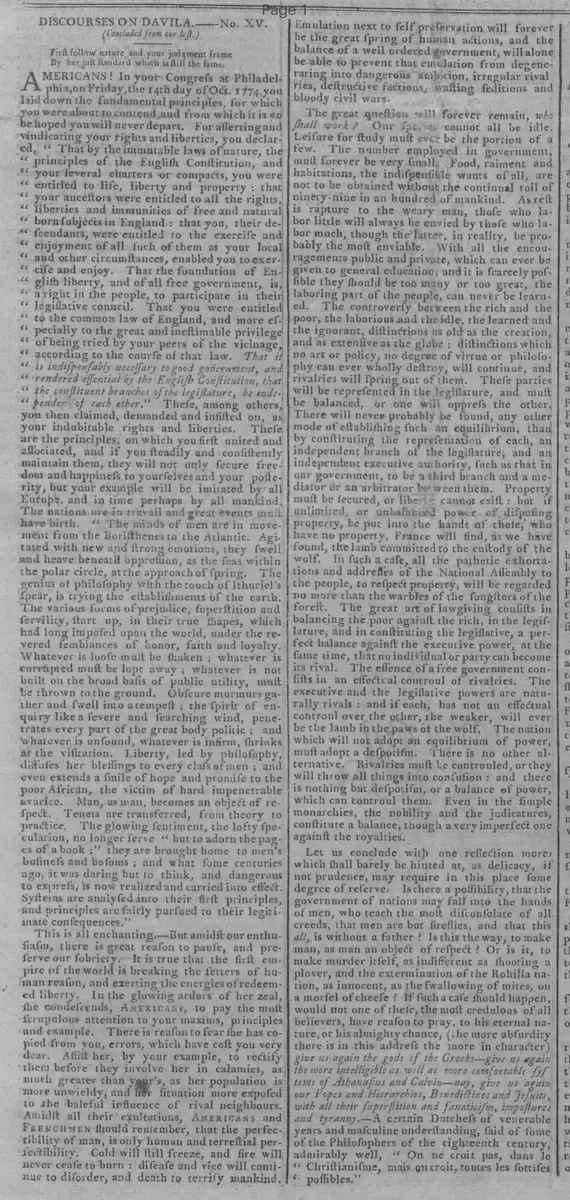
AMERICANS! In your Congress at Philadelphia, on Friday, the 14th day of Oct. 1774, you laid down the fundamental principles, for which you were about to contend, and from which it is not to be hoped you will never depart. For asserting and vindicating your rights and liberties, you declared, "That by the immutable laws of nature, the principles of the English Constitution, and your several charters or compacts, you were entitled to life, liberty and property: that your ancestors were entitled to all the rights, liberties and immunities of free and natural born subjects in England: that you, their descendants, were entitled to the exercise and enjoyment of all such of them as your local and other circumstances, enabled you to exercise and enjoy. That the foundation of English liberty, and of all free government, is, a right in the people, to participate in their legislative council. That you were entitled to the common law of England, and more especially to the great and inestimable privilege of being tried by your peers of the vicinage, according to the course of that law. That it is indispensably necessary to good government, and rendered essential by the English Constitution, that the constituent branches of the legislature, be independent of each other." These, among others, you then claimed, demanded and insisted on, as your indubitable rights and liberties. These are the principles, on which you first united and associated, and if you steadily and consistently maintain them, they will not only secure freedom and happiness to yourselves and your posterity, but your example will be imitated by all Europe, and in time perhaps by all mankind.
The nations are in travail and great events must have birth. "The minds of men are in movement from the Borysthenes to the Atlantic. Agitated with new and strong emotions, they swell and heave beneath oppression, as the seas within the polar circle, at the approach of spring. The genius of philosophy with the touch of Ithuriel's spear, is trying the establishments of the earth. The various forms of prejudice, superstition and servility, start up, in their true shapes, which had long imposed upon the world, under the revered semblances of honor, faith and loyalty. Whatever is loose must be shaken; whatever is corrupted must be lopt away; whatever is not built on the broad basis of public utility, must be thrown to the ground. Obscure murmurs gather and swell into a tempest; the spirit of enquiry like a severe and searching wind, penetrates every part of the great body politic; and whatever is unsound, whatever is infirm, shrinks at the visitation. Liberty, led by philosophy, diffuses her blessings to every class of men; and even extends a smile of hope and promise to the poor African, the victim of hard impenetrable avarice. Man, as man, becomes an object of respect. Tenets are transferred, from theory to practice. The glowing sentiment, the lofty speculation, no longer serve "but to adorn the pages of a book;" they are brought home to men's business and bosoms; and what some centuries ago, it was daring but to think, and dangerous to express, is now realized and carried into effect. Systems are analyzed into their first principles, and principles are fairly pursued to their legitimate consequences."
This is all enchanting. - But amidst our enthusiasm, there is great reason to pause, and preserve our observations. It is true that the first empire of the world is breaking the fetters of human reason, and exerting the energies of redeemed liberty. In the glowing ardors of her zeal, she condescends, AMERICANS, to pay the most scrupulous attention to your maxims, principles and example. There is reason to fear she has copied from you, errors, which have cost you very dear. Aid her, by your example, to rectify them before they involve her in calamities, as much greater than yours, as her population is more unwieldy, and her situation more exposed to the baleful influence of rival neighbours.
Amidst all their exultations, Americans and French Men should remember, that the perfectibility of man, is only human and terrestrial perfectibility. Cold will still freeze, and fire will never cease to burn: disease and vice will continue to disorder, and death to terrify mankind.
Emulation next to self preservation will forever be the great spring of human actions, and the balance of a well ordered government, will alone be able to prevent that emulation from degenerating into dangerous ambition, irregular rivalries, destructive factions, wasting seditions and bloody civil wars.
The great question will forever remain, who shall work? Our species cannot all be idle. Leisure for study must ever be the portion of a few. The number employed in government, must forever be very small. Food, raiment and habitations, the indispensable wants of all, are not to be obtained without the continual toil of ninety-nine in an hundred of mankind. As rest is rapture to the weary man, those who labor little will always be envied by those who labor much, though the latter, in reality, be probably the most enviable. With all the encouragements public and private, which can ever be given to general education, and it is scarcely possible they should be too many or too great, the laboring part of the people, can never be learned. The controversy between the rich and the poor, the laborious and the idle, the learned and the ignorant, distinctions as old as the creation, and as extensive as the globe; distinctions which no art or policy, no degree of virtue or philosophy can ever wholly destroy, will continue, and rivalries will spring out of them. These parties will be represented in the legislature, and must be balanced, or one will oppress the other.
There will never probably be found, any other mode of establishing such an equilibrium, than by constituting the representation of each, an independent branch of the legislature, and an independent executive authority, such as that in our government, to be a third branch and a mediator or an arbitrator between them. Property must be secured, or liberty cannot exist: but if unlimited, or unbalanced power of disposing property, be put into the hands of those who have no property, France will find, as we have found, the lamb committed to the custody of the wolf. In such a case, all the pathetic exhortations and addresses of the National Assembly to the people, to respect property, will be regarded no more than the warbles of the songsters of the forest. The great art of lawgiving consists in balancing the poor against the rich, in the legislature, and in constituting the legislative, a perfect balance against the executive power, at the same time, that no individual or party can become its rival. The essence of a free government consists in an effectual controul of rivalries. The executive and the legislative powers are naturally rivals: and if each, has not an effectual controul over the other, the weaker, will ever be the lamb in the paws of the wolf. The nation which will not adopt an equilibrium of power, must adopt a despotism. There is no other alternative. Rivalries must be controuled, or they will throw all things into confusion: and there is nothing but despotism, or a balance of power, which can controul them. Even in the simple monarchies, the nobility and the judicatures, constitute a balance, though a very imperfect one against the royalties.
Let us conclude with one reflection more, which shall barely be hinted at, as delicacy, if not prudence, may require in this place some degree of reserve. Is there a possibility, that the government of nations may fall into the hands of men, who teach the most disconsolate of all creeds, that men are but fireflies, and that this all, is without a father? Is this the way, to make man, as man an object of respect? Or is it, to make murder itself, as indifferent as shooting a plover, and the extermination of the Rohilla nation, as innocent, as the wallowing of mites, on a morsel of cheese? If such a case should happen, would not one of these, the most credulous of all believers, have reason to pray, to his eternal nature, or his almighty chance, (the more absurdity there is in this address the more in character) give us again the gods of the Greeks-give us again the more intelligible as well as more comfortable systems of Athanasius and Calvin-nay, give us again our Popes and Hierarchies, Benedictines and Jesuits, with all their superstition and fanaticism, impostures and tyranny.—A certain Dutchess of venerable years and masculine understanding, said of some of the Philosophers of the eighteenth century, admirably well, "On ne croit pas, dans le Christianisme, mais on croit, toutes les autres sottises possibles."
(Concluded from our last.)
First follow nature and your judgment frame
By her just standard which is still the same.
AMERICANS! In your Congress at Philadelphia, on Friday, the 14th day of Oct. 1774, you laid down the fundamental principles, for which you were about to contend, and from which it is not to be hoped you will never depart. For asserting and vindicating your rights and liberties, you declared, "That by the immutable laws of nature, the principles of the English Constitution, and your several charters or compacts, you were entitled to life, liberty and property: that your ancestors were entitled to all the rights, liberties and immunities of free and natural born subjects in England: that you, their descendants, were entitled to the exercise and enjoyment of all such of them as your local and other circumstances, enabled you to exercise and enjoy. That the foundation of English liberty, and of all free government, is, a right in the people, to participate in their legislative council. That you were entitled to the common law of England, and more especially to the great and inestimable privilege of being tried by your peers of the vicinage, according to the course of that law. That it is indispensably necessary to good government, and rendered essential by the English Constitution, that the constituent branches of the legislature, be independent of each other." These, among others, you then claimed, demanded and insisted on, as your indubitable rights and liberties. These are the principles, on which you first united and associated, and if you steadily and consistently maintain them, they will not only secure freedom and happiness to yourselves and your posterity, but your example will be imitated by all Europe, and in time perhaps by all mankind.
The nations are in travail and great events must have birth. "The minds of men are in movement from the Borysthenes to the Atlantic. Agitated with new and strong emotions, they swell and heave beneath oppression, as the seas within the polar circle, at the approach of spring. The genius of philosophy with the touch of Ithuriel's spear, is trying the establishments of the earth. The various forms of prejudice, superstition and servility, start up, in their true shapes, which had long imposed upon the world, under the revered semblances of honor, faith and loyalty. Whatever is loose must be shaken; whatever is corrupted must be lopt away; whatever is not built on the broad basis of public utility, must be thrown to the ground. Obscure murmurs gather and swell into a tempest; the spirit of enquiry like a severe and searching wind, penetrates every part of the great body politic; and whatever is unsound, whatever is infirm, shrinks at the visitation. Liberty, led by philosophy, diffuses her blessings to every class of men; and even extends a smile of hope and promise to the poor African, the victim of hard impenetrable avarice. Man, as man, becomes an object of respect. Tenets are transferred, from theory to practice. The glowing sentiment, the lofty speculation, no longer serve "but to adorn the pages of a book;" they are brought home to men's business and bosoms; and what some centuries ago, it was daring but to think, and dangerous to express, is now realized and carried into effect. Systems are analyzed into their first principles, and principles are fairly pursued to their legitimate consequences."
This is all enchanting. - But amidst our enthusiasm, there is great reason to pause, and preserve our observations. It is true that the first empire of the world is breaking the fetters of human reason, and exerting the energies of redeemed liberty. In the glowing ardors of her zeal, she condescends, AMERICANS, to pay the most scrupulous attention to your maxims, principles and example. There is reason to fear she has copied from you, errors, which have cost you very dear. Aid her, by your example, to rectify them before they involve her in calamities, as much greater than yours, as her population is more unwieldy, and her situation more exposed to the baleful influence of rival neighbours.
Amidst all their exultations, Americans and French Men should remember, that the perfectibility of man, is only human and terrestrial perfectibility. Cold will still freeze, and fire will never cease to burn: disease and vice will continue to disorder, and death to terrify mankind.
Emulation next to self preservation will forever be the great spring of human actions, and the balance of a well ordered government, will alone be able to prevent that emulation from degenerating into dangerous ambition, irregular rivalries, destructive factions, wasting seditions and bloody civil wars.
The great question will forever remain, who shall work? Our species cannot all be idle. Leisure for study must ever be the portion of a few. The number employed in government, must forever be very small. Food, raiment and habitations, the indispensable wants of all, are not to be obtained without the continual toil of ninety-nine in an hundred of mankind. As rest is rapture to the weary man, those who labor little will always be envied by those who labor much, though the latter, in reality, be probably the most enviable. With all the encouragements public and private, which can ever be given to general education, and it is scarcely possible they should be too many or too great, the laboring part of the people, can never be learned. The controversy between the rich and the poor, the laborious and the idle, the learned and the ignorant, distinctions as old as the creation, and as extensive as the globe; distinctions which no art or policy, no degree of virtue or philosophy can ever wholly destroy, will continue, and rivalries will spring out of them. These parties will be represented in the legislature, and must be balanced, or one will oppress the other.
There will never probably be found, any other mode of establishing such an equilibrium, than by constituting the representation of each, an independent branch of the legislature, and an independent executive authority, such as that in our government, to be a third branch and a mediator or an arbitrator between them. Property must be secured, or liberty cannot exist: but if unlimited, or unbalanced power of disposing property, be put into the hands of those who have no property, France will find, as we have found, the lamb committed to the custody of the wolf. In such a case, all the pathetic exhortations and addresses of the National Assembly to the people, to respect property, will be regarded no more than the warbles of the songsters of the forest. The great art of lawgiving consists in balancing the poor against the rich, in the legislature, and in constituting the legislative, a perfect balance against the executive power, at the same time, that no individual or party can become its rival. The essence of a free government consists in an effectual controul of rivalries. The executive and the legislative powers are naturally rivals: and if each, has not an effectual controul over the other, the weaker, will ever be the lamb in the paws of the wolf. The nation which will not adopt an equilibrium of power, must adopt a despotism. There is no other alternative. Rivalries must be controuled, or they will throw all things into confusion: and there is nothing but despotism, or a balance of power, which can controul them. Even in the simple monarchies, the nobility and the judicatures, constitute a balance, though a very imperfect one against the royalties.
Let us conclude with one reflection more, which shall barely be hinted at, as delicacy, if not prudence, may require in this place some degree of reserve. Is there a possibility, that the government of nations may fall into the hands of men, who teach the most disconsolate of all creeds, that men are but fireflies, and that this all, is without a father? Is this the way, to make man, as man an object of respect? Or is it, to make murder itself, as indifferent as shooting a plover, and the extermination of the Rohilla nation, as innocent, as the wallowing of mites, on a morsel of cheese? If such a case should happen, would not one of these, the most credulous of all believers, have reason to pray, to his eternal nature, or his almighty chance, (the more absurdity there is in this address the more in character) give us again the gods of the Greeks-give us again the more intelligible as well as more comfortable systems of Athanasius and Calvin-nay, give us again our Popes and Hierarchies, Benedictines and Jesuits, with all their superstition and fanaticism, impostures and tyranny.—A certain Dutchess of venerable years and masculine understanding, said of some of the Philosophers of the eighteenth century, admirably well, "On ne croit pas, dans le Christianisme, mais on croit, toutes les autres sottises possibles."
What sub-type of article is it?
Essay
What themes does it cover?
Political
Liberty Freedom
Moral Virtue
What keywords are associated?
American Principles
Liberty Rights
Balanced Government
French Revolution
Class Rivalries
Political Equilibrium
Human Perfectibility
Literary Details
Title
Discourses On Davila. No. Xv.
Key Lines
First Follow Nature And Your Judgment Frame By Her Just Standard Which Is Still The Same.
That By The Immutable Laws Of Nature, The Principles Of The English Constitution, And Your Several Charters Or Compacts, You Were Entitled To Life, Liberty And Property
The Foundation Of English Liberty, And Of All Free Government, Is, A Right In The People, To Participate In Their Legislative Council.
The Great Art Of Lawgiving Consists In Balancing The Poor Against The Rich, In The Legislature
The Nation Which Will Not Adopt An Equilibrium Of Power, Must Adopt A Despotism. There Is No Other Alternative.