Thank you for visiting SNEWPapers!
Sign up free
Editorial
June 11, 1827
Phenix Gazette
Alexandria, Virginia
What is this article about?
The Norfolk Herald rebukes the Virginia Palladium for misrepresenting Henry Clay's jocular remarks on political appointments as insulting, defending Clay and accusing the Palladium's editor of dishonesty, obstinacy, and partisan bias in refusing to correct the error.
Merged-components note: The two components are a continuation of the same editorial article across columns on the page, maintaining coherent topic and flow.
Clipping
OCR Quality
88%
Good
Full Text
From the Norfolk Herald
THE VIRGINIA PALLADIUM
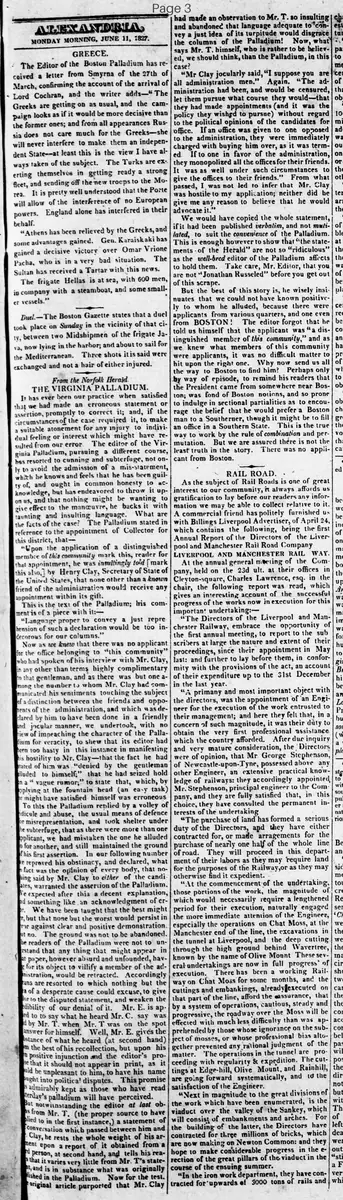
It has ever been our practice when satisfied that we had made an erroneous statement or assertion, promptly to correct it; and, if the circumstances of the case required it, to make a suitable atonement for any injury to individual feeling or interest which might have resulted from our error. The editor of the Virginia Palladium, pursuing a different course, has resorted to cunning and subterfuge, not only to avoid the admission of a mis-statement, which he knows and feels that he has been guilty of, and ought in common honesty to acknowledge, but has endeavored to throw it upon us, and that nothing might be wanting to give effect to the manœuvre, he backs it with taunting and insulting language. What are the facts of the case? The Palladium stated in reference to the appointment of Collector for this district, that—
"Upon the application of a distinguished member of this community—mark this, reader—for that appointment, he was insultingly told—mark this also—by Henry Clay, Secretary of State of the United States, that none other than a known friend of the administration would receive any appointment within its gift."
This is the text of the Palladium; his comment is of a piece with it:-
"Language proper to convey a just representation of such a declaration would be too indecorous for our columns."
Now as we knew that there was no applicant for the office belonging to "this community" who had spoken of his interview with Mr. Clay, in any other than terms highly complimentary to that gentleman, and as there was but one among the number to whom Mr. Clay had communicated his sentiments touching the subject of a distinction between the friends and opponents of the administration, and which was declared by him to have been done in a friendly and jocular manner, we undertook, with no view of impeaching the character of the Palladium for veracity, to shew that its editor had been too hasty in this instance in manifesting his hostility to Mr. Clay—that the fact he had stated of him was "denied by the gentleman alluded to himself;" that he had seized hold upon a "vague rumor;" to state that, which, by applying at the fountain head (an easy task) he might have satisfied himself was erroneous. To this the Palladium replied by a volley of ridicule and abuse, the usual means of defence or misrepresentation, and took shelter under the subterfuge, that as there were more than one applicant, we had mistaken the one he alluded for another, and still maintained the ground of his first assertion. In our following number we reproved his obstinacy, and declared, what a fact was the opinion of every body, that nothing said by Mr. Clay to either of the candidates, warranted the assertion of the Palladium. We expected after this a decent explanation, and something like an acknowledgment of error. We have been taught that the best might err, but that none but the worst would persist in error against clear and positive demonstration. But no. The ground was not to be abandoned. The readers of the Palladium were not to understand that any thing that might appear in that paper, however absurd and unfounded, having for its object to villify a member of the administration, would be retracted. Accordingly means are resorted to which nothing but the audacity of a desperate cause could excuse, to give color to the disputed statement, and weaken the credibility of our denial of it. Mr. E. is appealed to to say what he heard Mr. C. say was told by Mr. T. when Mr. T was on the spot to answer for himself. Well, Mr. E. gives the substance of what he heard (at second hand) from the best of his recollection, but upon his own positive injunction and the editor's promise that it should not appear in print, as it would be unpleasant to him, to have his name brought into political disputes. This promise is admirably kept as those who have read yesterday's palladium will have perceived.
But notwithstanding the editor at last obtained from Mr. [T. the proper source to have applied to in the first instance,] a statement of conversation which passed between him and Clay, he rests the whole weight of his argument upon a report of it obtained from a third person, at second hand, and tells his readers that it varies very little from Mr. T's statement, and is in substance what was originally published in the Palladium. Now for the test.
[original article number, that Mr. Lar]
had made an observation to Mr. T. so insulting and abandoned that language adequate to convey a just idea of its turpitude would disgrace the columns of the Palladium! Now, what says Mr. T. himself, who is rather to be believed, we should think, than the Palladium, in this case?
"Mr Clay jocularly said, 'I suppose you are all administration men.' Again. 'The administration had been, and would be censured, let them pursue what course they would—that they had made appointments (and it was the policy they wished to pursue) without regard to the political opinions of the candidates or office. If an office was given to one opposed to the administration, they were immediately charged with buying him over, as it was termed. If to one in favor of the administration, they monopolized all the offices for their friends. It was as well under such circumstances to give the offices to their friends.' From what passed, I was not led to infer that Mr. Clay was hostile to my application; neither did he give me any reason to believe that he would advocate it."
We would have copied the whole statement, if it had been published verbatim, and not mutilated, to suit the convenience of the Palladium. This is enough however to show that "the statements of the Herald" are not so "ridiculous" as the well-bred editor of the Palladium affects to hold them. Take care, Mr. Editor, that you are not "Jonathan Russeled" before you get out of this scrape.
But the best of this story is, he wisely insinuates that we could not have known positively to whom he alluded, because there were applicants from various quarters, and one even from BOSTON! The editor forgot that he told us himself that the applicant was "a distinguished member of this community," and as we knew what members of this community were applicants, it was no difficult matter to hit upon the right one. Why now send us all the way to Boston to find him? Perhaps only by way of episode, to remind his readers that the President came from somewhere near Boston; was fond of Boston notions, and so prone to indulge in sectional partialities as to encourage the belief that he would prefer a Boston man to a Southerner, though it might be to fill an office in a Southern State. This is the true way to work by the rule of combination and permutation. But we are assured there is not the least truth in the story. There was no applicant from Boston.
THE VIRGINIA PALLADIUM
It has ever been our practice when satisfied that we had made an erroneous statement or assertion, promptly to correct it; and, if the circumstances of the case required it, to make a suitable atonement for any injury to individual feeling or interest which might have resulted from our error. The editor of the Virginia Palladium, pursuing a different course, has resorted to cunning and subterfuge, not only to avoid the admission of a mis-statement, which he knows and feels that he has been guilty of, and ought in common honesty to acknowledge, but has endeavored to throw it upon us, and that nothing might be wanting to give effect to the manœuvre, he backs it with taunting and insulting language. What are the facts of the case? The Palladium stated in reference to the appointment of Collector for this district, that—
"Upon the application of a distinguished member of this community—mark this, reader—for that appointment, he was insultingly told—mark this also—by Henry Clay, Secretary of State of the United States, that none other than a known friend of the administration would receive any appointment within its gift."
This is the text of the Palladium; his comment is of a piece with it:-
"Language proper to convey a just representation of such a declaration would be too indecorous for our columns."
Now as we knew that there was no applicant for the office belonging to "this community" who had spoken of his interview with Mr. Clay, in any other than terms highly complimentary to that gentleman, and as there was but one among the number to whom Mr. Clay had communicated his sentiments touching the subject of a distinction between the friends and opponents of the administration, and which was declared by him to have been done in a friendly and jocular manner, we undertook, with no view of impeaching the character of the Palladium for veracity, to shew that its editor had been too hasty in this instance in manifesting his hostility to Mr. Clay—that the fact he had stated of him was "denied by the gentleman alluded to himself;" that he had seized hold upon a "vague rumor;" to state that, which, by applying at the fountain head (an easy task) he might have satisfied himself was erroneous. To this the Palladium replied by a volley of ridicule and abuse, the usual means of defence or misrepresentation, and took shelter under the subterfuge, that as there were more than one applicant, we had mistaken the one he alluded for another, and still maintained the ground of his first assertion. In our following number we reproved his obstinacy, and declared, what a fact was the opinion of every body, that nothing said by Mr. Clay to either of the candidates, warranted the assertion of the Palladium. We expected after this a decent explanation, and something like an acknowledgment of error. We have been taught that the best might err, but that none but the worst would persist in error against clear and positive demonstration. But no. The ground was not to be abandoned. The readers of the Palladium were not to understand that any thing that might appear in that paper, however absurd and unfounded, having for its object to villify a member of the administration, would be retracted. Accordingly means are resorted to which nothing but the audacity of a desperate cause could excuse, to give color to the disputed statement, and weaken the credibility of our denial of it. Mr. E. is appealed to to say what he heard Mr. C. say was told by Mr. T. when Mr. T was on the spot to answer for himself. Well, Mr. E. gives the substance of what he heard (at second hand) from the best of his recollection, but upon his own positive injunction and the editor's promise that it should not appear in print, as it would be unpleasant to him, to have his name brought into political disputes. This promise is admirably kept as those who have read yesterday's palladium will have perceived.
But notwithstanding the editor at last obtained from Mr. [T. the proper source to have applied to in the first instance,] a statement of conversation which passed between him and Clay, he rests the whole weight of his argument upon a report of it obtained from a third person, at second hand, and tells his readers that it varies very little from Mr. T's statement, and is in substance what was originally published in the Palladium. Now for the test.
[original article number, that Mr. Lar]
had made an observation to Mr. T. so insulting and abandoned that language adequate to convey a just idea of its turpitude would disgrace the columns of the Palladium! Now, what says Mr. T. himself, who is rather to be believed, we should think, than the Palladium, in this case?
"Mr Clay jocularly said, 'I suppose you are all administration men.' Again. 'The administration had been, and would be censured, let them pursue what course they would—that they had made appointments (and it was the policy they wished to pursue) without regard to the political opinions of the candidates or office. If an office was given to one opposed to the administration, they were immediately charged with buying him over, as it was termed. If to one in favor of the administration, they monopolized all the offices for their friends. It was as well under such circumstances to give the offices to their friends.' From what passed, I was not led to infer that Mr. Clay was hostile to my application; neither did he give me any reason to believe that he would advocate it."
We would have copied the whole statement, if it had been published verbatim, and not mutilated, to suit the convenience of the Palladium. This is enough however to show that "the statements of the Herald" are not so "ridiculous" as the well-bred editor of the Palladium affects to hold them. Take care, Mr. Editor, that you are not "Jonathan Russeled" before you get out of this scrape.
But the best of this story is, he wisely insinuates that we could not have known positively to whom he alluded, because there were applicants from various quarters, and one even from BOSTON! The editor forgot that he told us himself that the applicant was "a distinguished member of this community," and as we knew what members of this community were applicants, it was no difficult matter to hit upon the right one. Why now send us all the way to Boston to find him? Perhaps only by way of episode, to remind his readers that the President came from somewhere near Boston; was fond of Boston notions, and so prone to indulge in sectional partialities as to encourage the belief that he would prefer a Boston man to a Southerner, though it might be to fill an office in a Southern State. This is the true way to work by the rule of combination and permutation. But we are assured there is not the least truth in the story. There was no applicant from Boston.
What sub-type of article is it?
Partisan Politics
Press Freedom
What keywords are associated?
Partisan Dispute
Newspaper Correction
Henry Clay
Political Appointment
Collector District
Administration Policy
What entities or persons were involved?
Virginia Palladium
Norfolk Herald
Henry Clay
Mr. T.
Mr. E.
Mr. Lar
Editorial Details
Primary Topic
Dispute Over Misreported Henry Clay Statement On Political Appointments
Stance / Tone
Critical Of Virginia Palladium's Dishonesty And Partisanship, Defensive Of Henry Clay
Key Figures
Virginia Palladium
Norfolk Herald
Henry Clay
Mr. T.
Mr. E.
Mr. Lar
Key Arguments
Palladium Misrepresented Clay's Jocular Remarks As Insulting
Palladium Refuses To Correct Error Despite Evidence From Applicant Mr. T.
Palladium Uses Ridicule And Subterfuge Instead Of Admitting Mistake
Clay's Policy Favors Administration Friends Due To Inevitable Criticism
No Boston Applicant For The Position