Thank you for visiting SNEWPapers!
Sign up free
New Hampshire Journal Of Agriculture
Manchester, Hillsborough County, New Hampshire
What is this article about?
A letter from 'Stella,' a former Northern schoolteacher in Tennessee, reflects on her experiences teaching Southern children, local dialects, enslaved people's dignity, parental notes on education, and Southern hospitality, in response to letters from a Mississippi schoolmaster.
Clipping
OCR Quality
Full Text
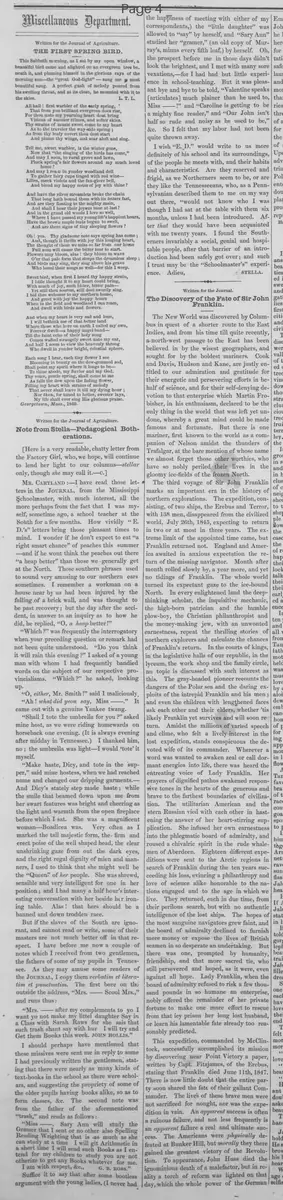
Note from Stella—Pedagogical Both-erations.
Here is a very readable, chatty letter from the Factory Girl, who, we hope, will continue to lend her light to our columns—stellar only, though she may call it.—Ed.]
MR. CARTLAND:—I have read those letters in the JOURNAL, from the Mississippi Schoolmaster, with much interest, all the more perhaps from the fact that I was myself, sometime ago, a school teacher at the South for a few months. How vividly "E. D.'s" letters bring those pleasant times to mind. I wonder if he don't expect to eat "a right smart chance" of peaches this summer—and if he won't think the peaches out there "a heap better" than those we generally get at the North. Those southern phrases used to sound very amusing to our northern ears sometimes. I remember a workman on a house near by us had been injured by the falling of a brick wall, and was thought to be past recovery; but the day after the accident, in answer to an inquiry as to how he did, he replied, "O, a heap better!"
"Which?" was frequently the interrogatory when your preceding question or remark had not been quite understood. "Do you think it will rain this evening?" I asked of a young man with whom I had frequently bandied words on the subject of our respective provincialisms. "Which?" he asked, looking up.
"O, either, Mr. Smith!" said I maliciously
"Ah! what did yeou say, Miss It came out with a genuine Yankee twang.
"Shall I tote the umbrella for you?" asked mine host, as we were riding homewards on horseback one evening. (It is always evening after midday in Tennessee.) I thanked him, no; the umbrella was light—I would 'tote' it myself.
"Make haste, Dicy, and tote in the supper," said mine hostess, when we had reached home and changed our dripping garments.
And Dicy's stately step made haste: while the smile that beamed down upon me from her swart features was bright and cheering as the light and warmth from the open fireplace before which I sat. She was a magnificent woman—Boadicea was. Very often as I marked the tall majestic form, the firm and erect poise of the well shaped head, the clear unshrinking gaze from out the dark eyes, and the right regal dignity of mien and manners, I used to think that she might well be the "Queen" of her people. She was shrewd, sensible and very intelligent for one in her position; and I had many a half hour's interesting conversation with her beside her ironing table. Alas! that hers should be a banned and down trodden race.
But if the slaves of the South are ignorant, and cannot read or write, some of their masters are not much better off in that respect. I have before me now a couple of notes which I received from two gentlemen, the fathers of some of my pupils in Tennessee. As they may amuse some readers of the JOURNAL, I copy them verbatim et literatim et punctuatim. The first bore on the outside the address, "Mrs. - Scool Mrs.." and runs thus:
"Mrs. —after my complements to yo I want yo not make my littel daughter Say in a Class with Sarah Raws for she sais that such trash shant say with hur I will try and Get them Books this week. JOiN HoLLIs."
I should perhaps have mentioned that these missives were sent me in reply to some I had previously written the gentlemen, stating that there were nearly as many kinds of text-books in the school as there were scholars, and suggesting the propriety of some of the older pupils having books alike, so as to form classes, &c. The second note was from the father of the aforementioned "trash," and reads as follows:
"Miss.
Sary Ann will study the Gramer that I sent or no other also Spelling Reading Wrighting that is -as much as she can study at a time I will git Arithmetic in a short time I will send such Books as I entend for my children to study you are not otherize to get any Books whatever for me.
I am with respect, &c.,
G. B. ROSS."
Suffice it to say that after some bootless argument with the young ladies, (I never had the happiness of meeting with either of my correspondents,) the "little daughter" was allowed to "say" by herself, and "Sary Ann" studied her "graimer." (an old copy of Murray's, minus every fifth leaf,) by herself, Oh, the prospect before me in those days didn't look the brightest, and I met with many sore vexations,—for I had had but little experience in school-teaching. But it was pleasant to hear the parents say, as they came in occasionally, "My Tommy articulates much plainer than he used to, Miss —!" and "Caroline is getting to be a mighty fine reader," and "Our John isn't half so rude and noisy as he used to be." &c, So I felt that my labor had not been quite thrown away.
I wish "E. D." would write to us more definitely of his school and its surroundings. of the people he meets with, and their habits and characteristics. Are they reserved and frigid, as we Northerners seem to be, or are they like the Tennesseeans, who, as a Pennsylvanian described them to me on my way out there, "would not know who I was though I had sat at the table with them six months, unless I had been introduced. After that they would have been acquainted with me twenty years. I found the Southerners invariably a social, genial and hospitable people, after that barrier of an introduction had been safely got over; and such I trust may be the "Schoolmaster's" experience.
Adieu,
STELLA.
What sub-type of article is it?
What themes does it cover?
What keywords are associated?
What entities or persons were involved?
Letter to Editor Details
Author
Stella
Recipient
Mr. Cartland
Main Argument
the writer shares nostalgic reflections on her brief experience teaching in tennessee, highlighting amusing southern dialects, the dignity of enslaved people like dicy, challenges with illiterate parents and varied textbooks, small successes in student improvement, and the hospitality of southerners after introductions.
Notable Details