Thank you for visiting SNEWPapers!
Sign up free
Story
June 19, 1898
The Sun
Wilmington, New Castle County, Delaware
What is this article about?
Veteran cavalry horses share their riders' hopes and fears in battle, displaying nervousness before charges, excitement during advances, stoic endurance when wounded, and post-battle fretfulness, as described by the Louisville Times.
Clipping
OCR Quality
75%
Good
Full Text
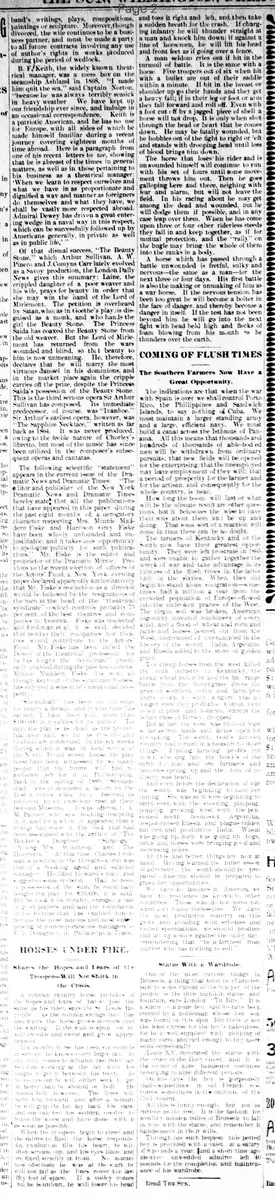
HORSES UNDER FIRE.
Shares the Hopes and Fears of the Trooper--Will Not Shirk in the Crisis.
A veteran cavalry horse partakes of the hopes and fears of his rider just the same as his rider, says the Louisville Times. As the command swings into line he understands the horse grows nervous with the waiting. If the wait is spun out too long he will tremble and sweat and grow apprehensive.
As the cavalry horse chafes to advance the rider out of position working at the bit with his tongue going between his teeth. As the moment comes he will either seek to get away or bolt. He hates it however. The horse will march forward and after a minute he will grip the bit, back his ears and one call to the brass sudden velocity to have the worst and have done with it as soon as possible.
When the troopers begin to cheer and the sabres to flash, the horse responds. An exultation tilts his heart: he will rear, scream, and his eyes blaze and are fixed steadily in front. No matter how obstinate he was at the start, he will not fail as the lines cover the last few feet of space. If a volley comes and he is unhurt, he will lower his head and toss it right and left, and then take a sudden breath for the crash. In charging infantry he will thunder straight at a man and knock him down; if against a line of horsemen, he will lift his head and front feet as if going over a fence.
A man seldom cries out if hit in the turmoil of battle. It is the same with a horse. Five troopers out of six when hit with a bullet are out of their saddle within a minute. If hit in the breast or shoulder up go their hands and they get a heavy fall; if in their leg or foot or arm they fall forward and roll off. Even with a foot cut off by a jagged piece of shell a horse will not drop. It is only when shot through the head or heart that he comes down. He may be fatally wounded, but he hobbles out of the fight to right or left and stands with drooping head until loss of blood brings him down.
The horse that loses his rider and is unwounded himself will continue to run with his set of fours until some movement throws him out. Then he goes galloping here and there, neighing with fear and alarm, but will not leave the field. In his racing about he may get among the dead and wounded, but he will dodge them if possible, and in any case leap over them. When he has come upon three or four other riderless steeds they fall in and keep together, as if for mutual protection, and the "rally" on the bugle may bring the whole of them into the ranks in a body.
A horse which has passed through a battle unwounded is fretful, sulky and nervous--the same as a man--for the next three or four days. His first battle is also the making or unmaking of him as a war horse. If the nervous tension has been too great he will become a bolter in the face of danger, and thereby become a danger in itself. If the test has not been beyond him he will go into the next fight with head held high and flecks of foam blowing from his mouth as he thunders over the earth.
Shares the Hopes and Fears of the Trooper--Will Not Shirk in the Crisis.
A veteran cavalry horse partakes of the hopes and fears of his rider just the same as his rider, says the Louisville Times. As the command swings into line he understands the horse grows nervous with the waiting. If the wait is spun out too long he will tremble and sweat and grow apprehensive.
As the cavalry horse chafes to advance the rider out of position working at the bit with his tongue going between his teeth. As the moment comes he will either seek to get away or bolt. He hates it however. The horse will march forward and after a minute he will grip the bit, back his ears and one call to the brass sudden velocity to have the worst and have done with it as soon as possible.
When the troopers begin to cheer and the sabres to flash, the horse responds. An exultation tilts his heart: he will rear, scream, and his eyes blaze and are fixed steadily in front. No matter how obstinate he was at the start, he will not fail as the lines cover the last few feet of space. If a volley comes and he is unhurt, he will lower his head and toss it right and left, and then take a sudden breath for the crash. In charging infantry he will thunder straight at a man and knock him down; if against a line of horsemen, he will lift his head and front feet as if going over a fence.
A man seldom cries out if hit in the turmoil of battle. It is the same with a horse. Five troopers out of six when hit with a bullet are out of their saddle within a minute. If hit in the breast or shoulder up go their hands and they get a heavy fall; if in their leg or foot or arm they fall forward and roll off. Even with a foot cut off by a jagged piece of shell a horse will not drop. It is only when shot through the head or heart that he comes down. He may be fatally wounded, but he hobbles out of the fight to right or left and stands with drooping head until loss of blood brings him down.
The horse that loses his rider and is unwounded himself will continue to run with his set of fours until some movement throws him out. Then he goes galloping here and there, neighing with fear and alarm, but will not leave the field. In his racing about he may get among the dead and wounded, but he will dodge them if possible, and in any case leap over them. When he has come upon three or four other riderless steeds they fall in and keep together, as if for mutual protection, and the "rally" on the bugle may bring the whole of them into the ranks in a body.
A horse which has passed through a battle unwounded is fretful, sulky and nervous--the same as a man--for the next three or four days. His first battle is also the making or unmaking of him as a war horse. If the nervous tension has been too great he will become a bolter in the face of danger, and thereby become a danger in itself. If the test has not been beyond him he will go into the next fight with head held high and flecks of foam blowing from his mouth as he thunders over the earth.
What sub-type of article is it?
Animal Story
Military Action
Curiosity
What themes does it cover?
Bravery Heroism
Survival
What keywords are associated?
Cavalry Horses
Battle Behavior
War Animals
Trooper Fears
Military Charge
Story Details
Story Details
Veteran cavalry horses mirror their riders' emotions in battle, showing nervousness in waiting, excitement in charges, stoic response to wounds, and post-battle anxiety, proving their reliability as war companions.