Thank you for visiting SNEWPapers!
Sign up free
Editorial
March 23, 1943
The Wilmington Morning Star
Wilmington, New Hanover County, North Carolina
What is this article about?
Charles P. Stewart discusses US officials' views on WWII alliances and postwar plans: Patterson notes large US troop deployment abroad by 1944; Standley urges Stalin to acknowledge US aid; Wallace warns against betraying Allies, advocating for a civilized postwar world to avoid WWIII; contrasts with English concerns and Russian governance ambiguities.
Clipping
OCR Quality
95%
Excellent
Full Text
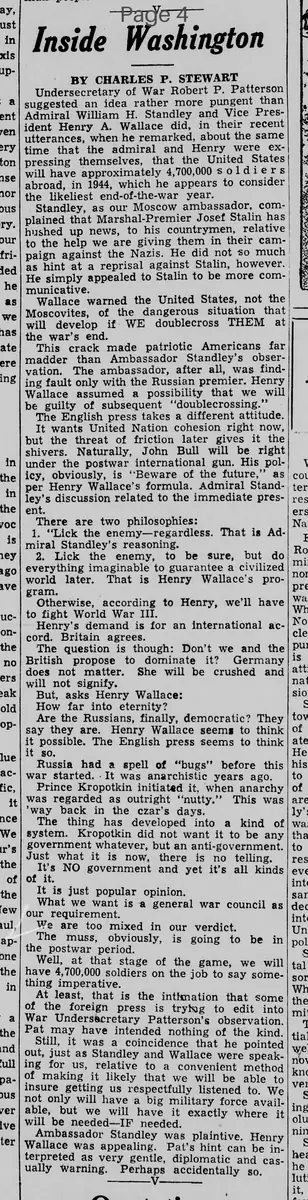
Inside Washington
BY CHARLES P. STEWART
Undersecretary of War Robert P. Patterson suggested an idea rather more pungent than Admiral William H. Standley and Vice President Henry A. Wallace did, in their recent utterances, when he remarked, about the same time that the admiral and Henry were expressing themselves, that the United States will have approximately 4,700,000 soldiers abroad, in 1944, which he appears to consider the likeliest end-of-the-war year.
Standley, as our Moscow ambassador, complained that Marshal-Premier Josef Stalin has hushed up news, to his countrymen, relative to the help we are giving them in their campaign against the Nazis. He did not so much as hint at a reprisal against Stalin, however. He simply appealed to Stalin to be more communicative.
Wallace warned the United States, not the Muscovites, of the dangerous situation that will develop if WE doublecross THEM at the war's end.
This crack made patriotic Americans far madder than Ambassador Standley's observation. The ambassador, after all, was finding fault only with the Russian premier. Henry Wallace assumed a possibility that we will be guilty of subsequent "doublecrossing."
The English press takes a different attitude. It wants United Nation cohesion right now, but the threat of friction later gives it the shivers. Naturally, John Bull will be right under the postwar international gun. His policy, obviously, is "Beware of the future," as per Henry Wallace's formula. Admiral Standley's discussion related to the immediate present.
There are two philosophies:
1. "Lick the enemy-regardless. That is Admiral Standley's reasoning.
2. Lick the enemy, to be sure, but do everything imaginable to guarantee a civilized world later. That is Henry Wallace's program.
Otherwise, according to Henry, we'll have to fight World War III.
Henry's demand is for an international accord. Britain agrees.
The question is though: Don't we and the British propose to dominate it? Germany does not matter. She will be crushed and will not signify.
But, asks Henry Wallace:
How far into eternity?
Are the Russians, finally, democratic? They say they are. Henry Wallace seems to think it possible. The English press seems to think it so.
Russia had a spell of "bugs' before this war started. It was anarchistic years ago. Prince Kropotkin initiated it, when anarchy was regarded as outright 'nutty." This was 'way back in the czar's days.
The thing has developed into a kind of system. Kropotkin did not want it to be any government whatever, but an anti-government. Just what it is now, there is no telling. It's NO government and yet it's all kinds of it.
It is just popular opinion.
What we want is a general war council as our requirement.
We are too mixed in our verdict.
The muss, obviously, is going to be in the postwar period.
Well, at that stage of the game, we will have 4,700,000 soldiers on the job to say something imperative.
At least, that is the intimation that some of the foreign press is trying to edit into War Undersecretary Patterson's observation.
Pat may have intended nothing of the kind. Still, it was a coincidence that he pointed out, just as Standley and Wallace were speaking for us, relative to a convenient method of making it likely that we will be able to insure getting us respectfully listened to. We not only will have a big military force available, but we will have it exactly where it will be needed IF needed.
Ambassador Standley was plaintive. Henry Wallace was appealing. Pat's hint can be interpreted as very gentle, diplomatic and casually warning. Perhaps accidentally so.
BY CHARLES P. STEWART
Undersecretary of War Robert P. Patterson suggested an idea rather more pungent than Admiral William H. Standley and Vice President Henry A. Wallace did, in their recent utterances, when he remarked, about the same time that the admiral and Henry were expressing themselves, that the United States will have approximately 4,700,000 soldiers abroad, in 1944, which he appears to consider the likeliest end-of-the-war year.
Standley, as our Moscow ambassador, complained that Marshal-Premier Josef Stalin has hushed up news, to his countrymen, relative to the help we are giving them in their campaign against the Nazis. He did not so much as hint at a reprisal against Stalin, however. He simply appealed to Stalin to be more communicative.
Wallace warned the United States, not the Muscovites, of the dangerous situation that will develop if WE doublecross THEM at the war's end.
This crack made patriotic Americans far madder than Ambassador Standley's observation. The ambassador, after all, was finding fault only with the Russian premier. Henry Wallace assumed a possibility that we will be guilty of subsequent "doublecrossing."
The English press takes a different attitude. It wants United Nation cohesion right now, but the threat of friction later gives it the shivers. Naturally, John Bull will be right under the postwar international gun. His policy, obviously, is "Beware of the future," as per Henry Wallace's formula. Admiral Standley's discussion related to the immediate present.
There are two philosophies:
1. "Lick the enemy-regardless. That is Admiral Standley's reasoning.
2. Lick the enemy, to be sure, but do everything imaginable to guarantee a civilized world later. That is Henry Wallace's program.
Otherwise, according to Henry, we'll have to fight World War III.
Henry's demand is for an international accord. Britain agrees.
The question is though: Don't we and the British propose to dominate it? Germany does not matter. She will be crushed and will not signify.
But, asks Henry Wallace:
How far into eternity?
Are the Russians, finally, democratic? They say they are. Henry Wallace seems to think it possible. The English press seems to think it so.
Russia had a spell of "bugs' before this war started. It was anarchistic years ago. Prince Kropotkin initiated it, when anarchy was regarded as outright 'nutty." This was 'way back in the czar's days.
The thing has developed into a kind of system. Kropotkin did not want it to be any government whatever, but an anti-government. Just what it is now, there is no telling. It's NO government and yet it's all kinds of it.
It is just popular opinion.
What we want is a general war council as our requirement.
We are too mixed in our verdict.
The muss, obviously, is going to be in the postwar period.
Well, at that stage of the game, we will have 4,700,000 soldiers on the job to say something imperative.
At least, that is the intimation that some of the foreign press is trying to edit into War Undersecretary Patterson's observation.
Pat may have intended nothing of the kind. Still, it was a coincidence that he pointed out, just as Standley and Wallace were speaking for us, relative to a convenient method of making it likely that we will be able to insure getting us respectfully listened to. We not only will have a big military force available, but we will have it exactly where it will be needed IF needed.
Ambassador Standley was plaintive. Henry Wallace was appealing. Pat's hint can be interpreted as very gentle, diplomatic and casually warning. Perhaps accidentally so.
What sub-type of article is it?
Foreign Affairs
War Or Peace
What keywords are associated?
Postwar Planning
Us Soviet Relations
Military Presence
Diplomatic Warnings
International Accord
Wwiii Prevention
What entities or persons were involved?
Robert P. Patterson
William H. Standley
Henry A. Wallace
Josef Stalin
English Press
Russians
Editorial Details
Primary Topic
Us Postwar Military Strategy And Relations With Soviet Union
Stance / Tone
Analytical Discussion Of Diplomatic Tensions And Postwar Philosophies
Key Figures
Robert P. Patterson
William H. Standley
Henry A. Wallace
Josef Stalin
English Press
Russians
Key Arguments
Us Will Have 4,700,000 Soldiers Abroad In 1944, Potential End Of War
Standley Criticizes Stalin For Not Publicizing Us Aid To Russia
Wallace Warns Against Doublecrossing Allies Postwar, Risking Wwiii
English Press Fears Postwar Friction, Supports International Accord
Two Philosophies: Focus On Defeating Enemy Now Vs. Ensuring Civilized Postwar World
Russia's System Is Unclear, Mix Of Anarchy And Government
Us Needs Strong Military Presence Postwar For Influence