Thank you for visiting SNEWPapers!
Sign up free
The Virginia Gazette
Williamsburg, Virginia
What is this article about?
A colonial Virginia judge writes to Mrs. Rind advocating for expanding the College of William & Mary, including new buildings for student accommodations, professorships in medicine and especially law, to improve education and legal practice in the colony. He proposes mandatory lectures and court attendance for aspiring lawyers.
Clipping
OCR Quality
Full Text
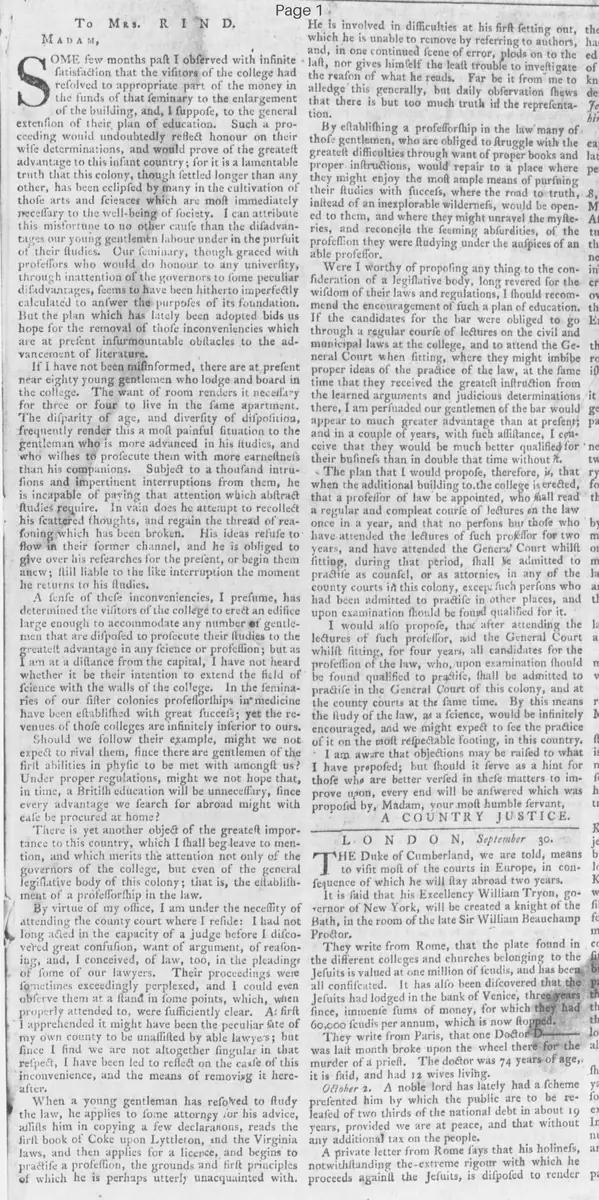
MADAM,
Some few months past I observed with infinite satisfaction that the visitors of the college had resolved to appropriate part of the money in the funds of that seminary to the enlargement of the building, and, I suppose, to the general extension of their plan of education. Such a proceeding would undoubtedly reflect honour on their wise determinations, and would prove of the greatest advantage to this infant country; for it is a lamentable truth that this colony, though settled longer than any other, has been eclipsed by many in the cultivation of those arts and sciences which are most immediately necessary to the well-being of society. I can attribute this misfortune to no other cause than the disadvantages our young gentlemen labour under in the pursuit of their studies. Our seminary, though graced with professors who would do honour to any university, through inattention of the governors to some peculiar disadvantages, seems to have been hitherto imperfectly calculated to answer the purposes of its foundation. But the plan which has lately been adopted bids us hope for the removal of those inconveniencies which are at present insurmountable obstacles to the advancement of literature.
If I have not been misinformed, there are at present near eighty young gentlemen who lodge and board in the college. The want of room renders it necessary for three or four to live in the same apartment. The disparity of age, and diversity of disposition, frequently render this a most painful situation to the gentleman who is more advanced in his studies, and who wishes to prosecute them with more earnestness than his companions. Subject to a thousand intrusions and impertinent interruptions from them, he is incapable of paying that attention which abstract studies require. In vain does he attempt to recollect his scattered thoughts, and regain the thread of reasoning which has been broken. His ideas refuse to flow in their former channel, and he is obliged to give over his researches for the present, or begin them anew; still liable to the like interruption the moment he returns to his studies.
A sense of these inconveniencies, I presume, has determined the visitors of the college to erect an edifice large enough to accommodate any number of gentlemen that are disposed to prosecute their studies to the greatest advantage in any science or profession; but as I am at a distance from the capital, I have not heard whether it be their intention to extend the field of science with the walls of the college. In the seminaries of our sister colonies professorhips in medicine have been established with great success; yet the revenues of those colleges are infinitely inferior to ours. Should we follow their example, might we not expect to rival them, since there are gentlemen of the first abilities in physic to be met with amongst us? Under proper regulations, might we not hope that, in time, a British education will be unnecessary, since every advantage we search for abroad might with ease be procured at home?
There is yet another object of the greatest importance to this country, which I shall beg leave to mention, and which merits the attention not only of the governors of the college, but even of the general legislative body of this colony; that is, the establishment of a professorship in the law.
By virtue of my office, I am under the necessity of attending the county court where I reside: I had not long acted in the capacity of a judge before I discovered great confusion, want of argument, of reasoning, and, I conceived, of law, too, in the pleadings of some of our lawyers. Their proceedings were sometimes exceedingly perplexed, and I could even observe them at a stand in some points, which, when properly attended to, were sufficiently clear. At first I apprehended it might have been the peculiar fate of my own county to be unassisted by able lawyers: but since I find we are not altogether singular in that respect, I have been led to reflect on the cause of this inconvenience, and the means of removing it hereafter.
When a young gentleman has resolved to study the law, he applies to some attorney for his advice, assists him in copying a few declarations, reads the first book of Coke upon Littleton, and the Virginia laws, and then applies for a license, and begins to practice a profession, the grounds and first principles of which he is perhaps utterly unacquainted with.
He is involved in difficulties at his first setting out, which he is unable to remove by referring to authors, and, in one continued scene of error, plods on to the last, nor gives himself the least trouble to investigate the reason of what he reads. Far be it from me to allege this generally, but daily observation shows that there is but too much truth in the representation.
By establishing a professorship in the law many of those gentlemen, who are obliged to struggle with the greatest difficulties through want of proper books and proper instructions, would repair to a place where they might enjoy the most ample means of pursuing their studies with success, where the road to truth, instead of an unexplored wilderness, would be opened to them, and where they might unravel the mysteries, and reconcile the seeming absurdities, of the profession they were studying under the auspices of an able professor.
Were I worthy of proposing any thing to the consideration of a legislative body, long revered for the wisdom of their laws and regulations, I should recommend the encouragement of such a plan of education. If the candidates for the bar were obliged to go through a regular course of lectures on the civil and municipal laws at the college, and to attend the General Court when sitting, where they might imbibe proper ideas of the practice of the law, at the same time that they received the greatest instruction from the learned arguments and judicious determinations there, I am persuaded our gentlemen of the bar would appear to much greater advantage than at present; and in a couple of years, with such assistance, I conceive that they would be much better qualified for their business than in double that time without it.
The plan that I would propose, therefore, is, that when the additional building to the college is erected, that a professor of law be appointed, who shall read a regular and complete course of lectures on the law once in a year, and that no persons but those who have attended the lectures of such professor for two years, and have attended the General Court whilst sitting, during that period, shall be admitted to practice as counsel, or as attorneys, in any of the county courts in this colony, except such persons who had been admitted to practice in other places, and upon examination should be found qualified for it.
I would also propose, that after attending the lectures of such professor, and the General Court whilst sitting, for four years, all candidates for the profession of the law, who, upon examination should be found qualified to practice, shall be admitted to practice in the General Court of this colony, and at the county courts at the same time. By this means the study of the law, as a science, would be infinitely encouraged, and we might expect to see the practice of it on the most respectable footing, in this country.
I am aware that objections may be raised to what I have proposed; but should it serve as a hint for those who are better versed in these matters to improve upon, every end will be answered which was proposed by, Madam, your most humble servant,
A COUNTRY JUSTICE.
What sub-type of article is it?
What themes does it cover?
What keywords are associated?
What entities or persons were involved?
Letter to Editor Details
Author
A Country Justice
Recipient
Mrs. Rind
Main Argument
the letter urges the establishment of a professorship in law at the college, along with building expansions and medical professorships, to improve student accommodations, advance sciences, and standardize legal education through mandatory lectures and court attendance, benefiting the colony's legal profession.
Notable Details