Thank you for visiting SNEWPapers!
Sign up free
Kentucky Gazette And General Advertiser
Lexington, Fayette County, Kentucky
What is this article about?
On March 17, 1803, the Federal Court in Frankfort, Kentucky, began its session. The grand jury presented Francis Flournoy, a farmer from Pendleton County, for unlawfully initiating written correspondence with the French government via a newspaper article published March 2, 1803, in the Guardian of Freedom, aiming to influence French policy on West Florida, New Orleans, and the Mississippi River.
Clipping
OCR Quality
Full Text
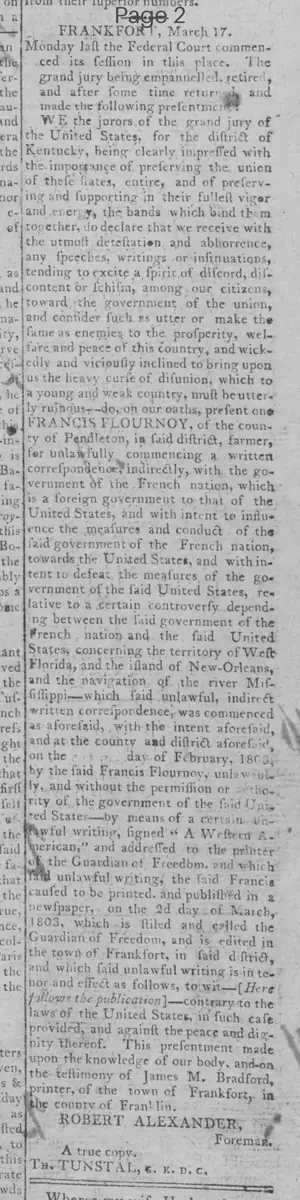
Monday last the Federal Court commenced its session in this place. The grand jury being empannelled, retired, and after some time returned, and made the following presentment:
WE the jurors of the grand jury of the United States, for the district of Kentucky, being clearly impressed with the importance of preserving the union of these states, entire, and of preserving and supporting in their fullest vigor and energy, the bands which bind them together, do declare that we receive with the utmost detestation and abhorrence, any speeches, writings or insinuations, tending to excite a spirit of discord, discontent or schism, among our citizens, toward the government of the union, and consider such as utter or make the same as enemies to the prosperity, welfare and peace of this country, and wickedly and viciously inclined to bring upon us the heavy curse of disunion, which to a young and weak country, must be utterly ruinous—do, on our oaths, present one FRANCIS FLOURNOY, of the county of Pendleton, in said district, farmer, for unlawfully commencing a written correspondence, indirectly, with the government of the French nation, which is a foreign government to that of the United States, and with intent to influence the measures and conduct of that said government of the French nation, towards the United States, and with intent to defeat the measures of the government of the said United States, relative to a certain controversy depending between the said government of the French nation and the said United States, concerning the territory of West Florida, and the island of New-Orleans, and the navigation of the river Mississippi—which said unlawful, indirect written correspondence, was commenced as aforesaid, with the intent aforesaid, and at the county and district aforesaid, on the day of February, 1803, by the said Francis Flournoy, unlawfully, and without the permission or authority of the government of the said United States—by means of a certain unlawful writing, Signed "A Western American," and addressed to the printer of the Guardian of Freedom, and which said unlawful writing, the said Francis caused to be printed, and published in a newspaper, on the 2d day of March, 1803, which is styled and called the Guardian of Freedom, and is edited in the town of Frankfort, in said district, and which said unlawful writing is in tenor and effect as follows, to wit—[Here follows the publication] contrary to the laws of the United States, in such case provided, and against the peace and dignity thereof. This presentment made upon the knowledge of our body, and on the testimony of James M. Bradford, printer, of the town of Frankfort, in the county of Franklin.
ROBERT ALEXANDER,
Foreman.
A true copy.
TH. TUNSTAL, E. K. D. C.
What sub-type of article is it?
What keywords are associated?
What entities or persons were involved?
Where did it happen?
Domestic News Details
Primary Location
Frankfort, Kentucky
Event Date
March 17, 1803
Key Persons
Outcome
grand jury presentment against francis flournoy for unlawful correspondence; no further resolution mentioned.
Event Details
The Federal Court session commenced on Monday last. The grand jury, impressed with the need to preserve the union, presented Francis Flournoy for commencing unlawful indirect written correspondence with the French government via a signed article 'A Western American' published in the Guardian of Freedom on March 2, 1803, intended to influence French measures on West Florida, New Orleans, and Mississippi navigation, without U.S. authority. The presentment was based on the jury's knowledge and testimony of James M. Bradford.