Thank you for visiting SNEWPapers!
Sign up free
Story
June 29, 1833
Richmond Palladium
Richmond, Wayne County, Indiana
What is this article about?
Account of the Black Death plague in 14th-century Europe and East, devastating populations, leading to mass deaths, abandoned goods, overwhelmed burials, and societal despair in cities like Avignon, Vienna, Florence.
Clipping
OCR Quality
95%
Excellent
Full Text
The Black Death in the 14th Century.
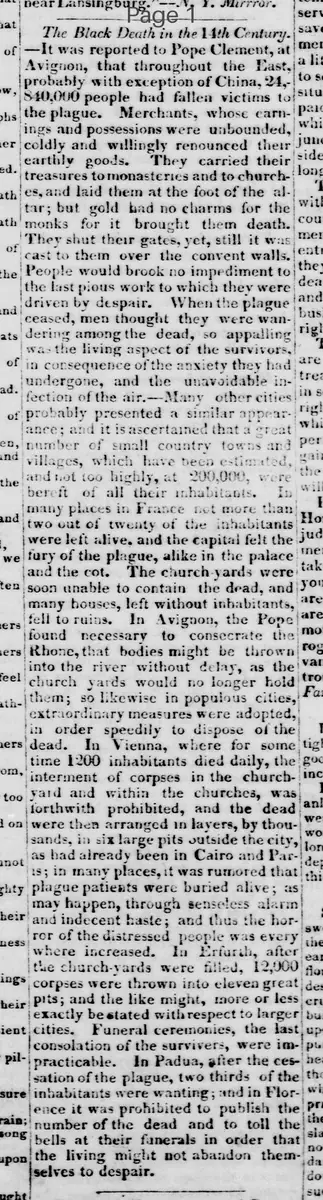
-It was reported to Pope Clement, at Avignon, that throughout the East, probably with exception of China, 24,840,000 people had fallen victims to the plague. Merchants, whose earnings and possessions were unbounded, coldly and willingly renounced their earthly goods. They carried their treasures to monasteries and to churches, and laid them at the foot of the altar; but gold had no charms for the monks for it brought them death. They shut their gates, yet, still it was cast to them over the convent walls. People would brook no impediment to the last pious work to which they were driven by despair. When the plague ceased, men thought they were wandering among the dead, so appalling was the living aspect of the survivors, in consequence of the anxiety they had undergone, and the unavoidable infection of the air. Many other cities probably presented a similar appearance; and it is ascertained that a great number of small country towns and villages, which have been estimated, and not too highly, at 200,000, were bereft of all their inhabitants. In many places in France not more than two out of twenty of the inhabitants were left alive, and the capital felt the fury of the plague, alike in the palace and the cot. The church-yards were soon unable to contain the dead, and many houses, left without inhabitants, fell to ruins. In Avignon, the Pope found necessary to consecrate the Rhone, that bodies might be thrown into the river without delay, as the church yards would no longer hold them; so likewise in populous cities, extraordinary measures were adopted, in order speedily to dispose of the dead. In Vienna, where for some time 1200 inhabitants died daily, the interment of corpses in the church-yard and within the churches, was forthwith prohibited, and the dead were then arranged in layers, by thousands, in six large pits outside the city, as had already been in Cairo and Paris; in many places, it was rumored that plague patients were buried alive; as may happen, through senseless alarm and indecent haste: and thus the horror of the distressed people was every where increased. In Erfurth, after the church-yards were filled, 12,000 corpses were thrown into eleven great pits; and the like might, more or less exactly be stated with respect to larger cities. Funeral ceremonies, the last consolation of the survivors, were impracticable. In Padua, after the cessation of the plague, two thirds of the inhabitants were wanting; and in Florence it was prohibited to publish the number of the dead and to toll the bells at their funerals in order that the living might not abandon themselves to despair.
-It was reported to Pope Clement, at Avignon, that throughout the East, probably with exception of China, 24,840,000 people had fallen victims to the plague. Merchants, whose earnings and possessions were unbounded, coldly and willingly renounced their earthly goods. They carried their treasures to monasteries and to churches, and laid them at the foot of the altar; but gold had no charms for the monks for it brought them death. They shut their gates, yet, still it was cast to them over the convent walls. People would brook no impediment to the last pious work to which they were driven by despair. When the plague ceased, men thought they were wandering among the dead, so appalling was the living aspect of the survivors, in consequence of the anxiety they had undergone, and the unavoidable infection of the air. Many other cities probably presented a similar appearance; and it is ascertained that a great number of small country towns and villages, which have been estimated, and not too highly, at 200,000, were bereft of all their inhabitants. In many places in France not more than two out of twenty of the inhabitants were left alive, and the capital felt the fury of the plague, alike in the palace and the cot. The church-yards were soon unable to contain the dead, and many houses, left without inhabitants, fell to ruins. In Avignon, the Pope found necessary to consecrate the Rhone, that bodies might be thrown into the river without delay, as the church yards would no longer hold them; so likewise in populous cities, extraordinary measures were adopted, in order speedily to dispose of the dead. In Vienna, where for some time 1200 inhabitants died daily, the interment of corpses in the church-yard and within the churches, was forthwith prohibited, and the dead were then arranged in layers, by thousands, in six large pits outside the city, as had already been in Cairo and Paris; in many places, it was rumored that plague patients were buried alive; as may happen, through senseless alarm and indecent haste: and thus the horror of the distressed people was every where increased. In Erfurth, after the church-yards were filled, 12,000 corpses were thrown into eleven great pits; and the like might, more or less exactly be stated with respect to larger cities. Funeral ceremonies, the last consolation of the survivors, were impracticable. In Padua, after the cessation of the plague, two thirds of the inhabitants were wanting; and in Florence it was prohibited to publish the number of the dead and to toll the bells at their funerals in order that the living might not abandon themselves to despair.
What sub-type of article is it?
Historical Event
Disaster
Tragedy
What themes does it cover?
Catastrophe
Misfortune
Tragedy
What keywords are associated?
Black Death
Plague
14th Century
Mass Deaths
Avignon
Vienna
Burial Pits
Despair
What entities or persons were involved?
Pope Clement
Where did it happen?
East, Avignon, France, Vienna, Cairo, Paris, Erfurth, Padua, Florence
Story Details
Key Persons
Pope Clement
Location
East, Avignon, France, Vienna, Cairo, Paris, Erfurth, Padua, Florence
Event Date
14th Century
Story Details
The Black Death plague killed millions in the East and Europe, leading to abandonment of goods, mass burials in pits and rivers, rumors of live burials, and prohibitions on funerals to prevent despair; entire villages depopulated, survivors haggard.