Thank you for visiting SNEWPapers!
Sign up free
Story
June 15, 1846
Arkansas State Gazette
Little Rock, Pulaski County, Arkansas
What is this article about?
Jefferson Davis delivers a speech in Congress praising Gen. Taylor and the U.S. army for victories in battles on May 8-9, 1846, near the Rio Grande against Mexican forces. He defends the army's professionalism, advocates for pensions, and highlights military skill's importance.
Clipping
OCR Quality
95%
Excellent
Full Text
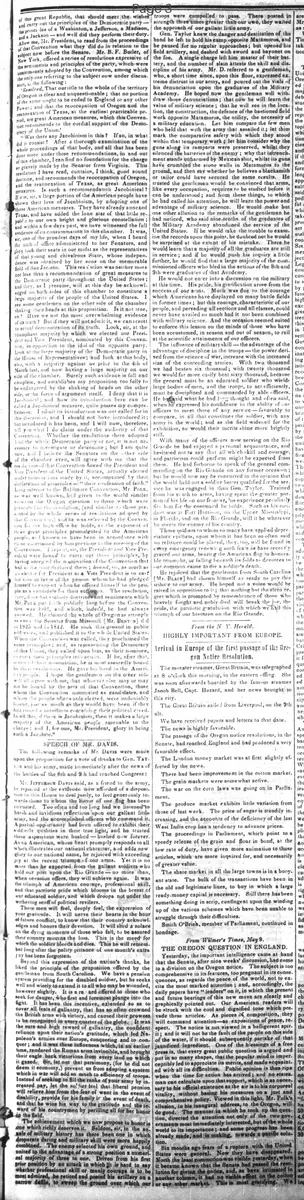
SPEECH OF MR. DAVIS.
The following remarks of Mr. Davis were made upon the proposition for a vote of thanks to Gen. Taylor and his army, made immediately after the news of the battles of the 8th and 9th had reached Congress:
Mr. Jefferson Davis said, as a friend to the army, he rejoiced at the evidence now afforded of a disposition in this House to deal justly, to feel generously towards those to whom the honor of our flag has been intrusted. Too often and too long had we listened to harsh and invidious reflections upon our gallant little army, and the accomplished officers who command it. A partial opportunity had been offered to exhibit their soldierly qualities in their true light: and he trusted these aspersions were hushed—hushed now forever.
As an American, whose heart promptly responds to all which illustrates our national character, and adds new glory to our national name, he rejoiced with exceeding joy at the recent triumph of our arms. Yet it is no more than he expected from the gallant soldiers who hold our post upon the Rio Grande—no more than, when occasion offers, they will achieve again. It was the triumph of American courage, professional skill, and that patriotic pride which blooms in the breast of our educated soldier, and which droops not under the withering scoff of political revilers.
These men will feel, deeply feel, the expression of your gratitude. It will nerve their hearts in the hour of future conflict, to know that their country acknowledges and honors their devotion. It will shed a solace on the dying moments of those who fall, to be assured their country mourns the loss. This is the meed for which the soldier bleeds and dies. This he will remember long after the paltry pittance of one month's extra pay has been forgotten.
Beyond this expression of the nation's thanks, he liked the principle of the proposition offered by the gentleman from South Carolina. We have a pension system providing for the disabled soldier, but he seeks well and wisely to extend it to all who may be wounded, however slightly. It is a reward offered to those who seek for danger, who first and foremost plunge into the fight. It has been this incentive, extended so as to cover all feats of gallantry, that has so often crowned the British arms with victory, and caused their prowess to be recognized in every quarter of the globe. It was the sure and high reward of gallantry, the confident reliance upon their nation's gratitude, which led Napoleon's armies over Europe, conquering and to conquer; and it was these influences which, in an earlier time, rendered the Roman arms invincible, and brought their eagle back victorious from every land on which it gazed. Sir, let not that parsimony, (for he did not deem it economy,) prevent us from adopting a system which in war will add so much to efficiency of troops. Instead of seeking to fill the ranks of your army by increased pay, let the soldier feel that liberal pension will relieve him from the fear of want in the event of disability, provide for his family in the event of death, and that he wins his way to the gratitude and the reward of his countrymen by perilling all for her honor in the field.
The achievement which we now propose to honor is one which richly deserves it. Seldom, sir, in the annals of military history has there been one in which desperate daring and military skill were more happily combined. The enemy selected his own ground, and united to the advantage of a strong position a numerical majority of three to one. Driven from his first position by an attack in which it is hard to say whether professional skill or manly courage is to be most admired, he retired and posted his artillery on a narrow defile, to sweep the ground over which our troops were compelled to pass. There posted in strength three times greater than our own, they waited the approach of our gallant little army.
Gen. Taylor knew the danger and destitution of the band he left to hold his camp opposite Matamoros, and he paused for no regular approaches; but opened his field artillery, and dashed with sword and bayonet on the foe. A single charge left him master of their battery, and the number of slain attests the skill and discipline of his army. Mr. D. referred to a gentleman, who, a short time since, upon this floor, expressed extreme distrust in our army, and poured out the vials of his denunciation upon the graduates of the Military Academy. He hoped now the gentleman will withdraw those denunciations; that now he will learn the value of military science; that he will see in the location, the construction, the defence of the bastioned field work opposite Matamoros, the utility, the necessity of a military education. Let him compare the few men who held that with the army that assailed it; let him mark the comparative safety with which they stood within that temporary work; let him consider why the guns along its ramparts were preserved, whilst they silenced the batteries of the enemy: why that intrenchment stands unharmed by Mexican shot, whilst its guns have crumbled the stone walls in Matamoros to the ground, and then say whether he believes a blacksmith or tailor could have secured the same results. He trusted the gentleman would be convinced that arms, like every occupation, requires to be studied before it can be understood; and from these things, to which he had called his attention, he will learn the power and advantage of military science. He would make but one other allusion to the remarks of the gentleman he had noticed, who said nine-tenths of the graduates of the Military Academy abandoned the service of the United States. If he would take the trouble to examine the records upon this point, he doubted not he would be surprised at the extent of his mistake. There he would learn that a majority of all the graduates are still in service; and if he would push his inquiry a little further, he would find that a large majority of the commissioned officers who bled in the actions of the 8th and 9th were graduates of that Academy.
He would not enter into a discussion on the military at this time. His pride, his gratification arose from the success of our arms. Much was due to the courage which Americans have displayed on many battle fields in former times: but this courage, characteristic of our people, and pervading all sections and all classes, could never have availed so much had it not been combined with military science. And the occasion seemed suited to enforce this lesson on the minds of those who have been accustomed, in season and out of season, to rail at the scientific attainments of our officers.
The influence of military skill—the advantage of discipline in the troops—the power derived from the science of war, increase with the increased size of the contending armies. With two thousand we had beaten six thousand; with twenty thousand we would far more easily beat sixty thousand, because the general must be an educated soldier who wields large bodies of men, and the troops, to act efficiently, must be disciplined and commanded by able officers.
He had said what he had long thought and often said, when he expressed his confidence in the ability of our officers to meet those of any service—favorably to compare, in all that constitutes the soldier, with any army in the world; and as the field widened for the exhibition, so would their merits shine more brightly still.
With many of the officers now serving on the Rio Grande he had enjoyed a personal acquaintance, and hesitated not to say that all which skill and courage and patriotism could perform might be expected from them. He had forborne to speak of the general commanding on the Rio Grande on any former occasion; but he would now say he concurred in the opinion that the world held not a soldier better qualified for the service he was engaged in than Gen. Taylor. Trained from his youth to arms, having spent the greater portion of his life on our frontier, his experience peculiarly fits him for the command he holds. Such as his conduct was at Fort Harrison, on the Upper Mississippi in Florida, and on the Rio Grande, will it be wherever he meets the enemy of his country.
'Those soldiers to whom so many have applied depreciatory epithets, upon whom it has been so often said no reliance could be placed, they, too, will be found in every emergency renewing such feats as have recently graced our arms, bearing the American flag to honorable triumphs, or falling beneath its folds as devotees to our common cause to die a soldier's death.
He rejoiced that the gentleman from South Carolina [Mr. Black] had shown himself so ready to pay this tribute to our army. He hoped not a voice would be raised in opposition to it; that nothing but the stern regret which is prompted by remembrance of those who bravely fought and nobly died will break the joy, the pride, the patriotic gratulation with which we hail this triumph of our brethren on the Rio Grande.
The following remarks of Mr. Davis were made upon the proposition for a vote of thanks to Gen. Taylor and his army, made immediately after the news of the battles of the 8th and 9th had reached Congress:
Mr. Jefferson Davis said, as a friend to the army, he rejoiced at the evidence now afforded of a disposition in this House to deal justly, to feel generously towards those to whom the honor of our flag has been intrusted. Too often and too long had we listened to harsh and invidious reflections upon our gallant little army, and the accomplished officers who command it. A partial opportunity had been offered to exhibit their soldierly qualities in their true light: and he trusted these aspersions were hushed—hushed now forever.
As an American, whose heart promptly responds to all which illustrates our national character, and adds new glory to our national name, he rejoiced with exceeding joy at the recent triumph of our arms. Yet it is no more than he expected from the gallant soldiers who hold our post upon the Rio Grande—no more than, when occasion offers, they will achieve again. It was the triumph of American courage, professional skill, and that patriotic pride which blooms in the breast of our educated soldier, and which droops not under the withering scoff of political revilers.
These men will feel, deeply feel, the expression of your gratitude. It will nerve their hearts in the hour of future conflict, to know that their country acknowledges and honors their devotion. It will shed a solace on the dying moments of those who fall, to be assured their country mourns the loss. This is the meed for which the soldier bleeds and dies. This he will remember long after the paltry pittance of one month's extra pay has been forgotten.
Beyond this expression of the nation's thanks, he liked the principle of the proposition offered by the gentleman from South Carolina. We have a pension system providing for the disabled soldier, but he seeks well and wisely to extend it to all who may be wounded, however slightly. It is a reward offered to those who seek for danger, who first and foremost plunge into the fight. It has been this incentive, extended so as to cover all feats of gallantry, that has so often crowned the British arms with victory, and caused their prowess to be recognized in every quarter of the globe. It was the sure and high reward of gallantry, the confident reliance upon their nation's gratitude, which led Napoleon's armies over Europe, conquering and to conquer; and it was these influences which, in an earlier time, rendered the Roman arms invincible, and brought their eagle back victorious from every land on which it gazed. Sir, let not that parsimony, (for he did not deem it economy,) prevent us from adopting a system which in war will add so much to efficiency of troops. Instead of seeking to fill the ranks of your army by increased pay, let the soldier feel that liberal pension will relieve him from the fear of want in the event of disability, provide for his family in the event of death, and that he wins his way to the gratitude and the reward of his countrymen by perilling all for her honor in the field.
The achievement which we now propose to honor is one which richly deserves it. Seldom, sir, in the annals of military history has there been one in which desperate daring and military skill were more happily combined. The enemy selected his own ground, and united to the advantage of a strong position a numerical majority of three to one. Driven from his first position by an attack in which it is hard to say whether professional skill or manly courage is to be most admired, he retired and posted his artillery on a narrow defile, to sweep the ground over which our troops were compelled to pass. There posted in strength three times greater than our own, they waited the approach of our gallant little army.
Gen. Taylor knew the danger and destitution of the band he left to hold his camp opposite Matamoros, and he paused for no regular approaches; but opened his field artillery, and dashed with sword and bayonet on the foe. A single charge left him master of their battery, and the number of slain attests the skill and discipline of his army. Mr. D. referred to a gentleman, who, a short time since, upon this floor, expressed extreme distrust in our army, and poured out the vials of his denunciation upon the graduates of the Military Academy. He hoped now the gentleman will withdraw those denunciations; that now he will learn the value of military science; that he will see in the location, the construction, the defence of the bastioned field work opposite Matamoros, the utility, the necessity of a military education. Let him compare the few men who held that with the army that assailed it; let him mark the comparative safety with which they stood within that temporary work; let him consider why the guns along its ramparts were preserved, whilst they silenced the batteries of the enemy: why that intrenchment stands unharmed by Mexican shot, whilst its guns have crumbled the stone walls in Matamoros to the ground, and then say whether he believes a blacksmith or tailor could have secured the same results. He trusted the gentleman would be convinced that arms, like every occupation, requires to be studied before it can be understood; and from these things, to which he had called his attention, he will learn the power and advantage of military science. He would make but one other allusion to the remarks of the gentleman he had noticed, who said nine-tenths of the graduates of the Military Academy abandoned the service of the United States. If he would take the trouble to examine the records upon this point, he doubted not he would be surprised at the extent of his mistake. There he would learn that a majority of all the graduates are still in service; and if he would push his inquiry a little further, he would find that a large majority of the commissioned officers who bled in the actions of the 8th and 9th were graduates of that Academy.
He would not enter into a discussion on the military at this time. His pride, his gratification arose from the success of our arms. Much was due to the courage which Americans have displayed on many battle fields in former times: but this courage, characteristic of our people, and pervading all sections and all classes, could never have availed so much had it not been combined with military science. And the occasion seemed suited to enforce this lesson on the minds of those who have been accustomed, in season and out of season, to rail at the scientific attainments of our officers.
The influence of military skill—the advantage of discipline in the troops—the power derived from the science of war, increase with the increased size of the contending armies. With two thousand we had beaten six thousand; with twenty thousand we would far more easily beat sixty thousand, because the general must be an educated soldier who wields large bodies of men, and the troops, to act efficiently, must be disciplined and commanded by able officers.
He had said what he had long thought and often said, when he expressed his confidence in the ability of our officers to meet those of any service—favorably to compare, in all that constitutes the soldier, with any army in the world; and as the field widened for the exhibition, so would their merits shine more brightly still.
With many of the officers now serving on the Rio Grande he had enjoyed a personal acquaintance, and hesitated not to say that all which skill and courage and patriotism could perform might be expected from them. He had forborne to speak of the general commanding on the Rio Grande on any former occasion; but he would now say he concurred in the opinion that the world held not a soldier better qualified for the service he was engaged in than Gen. Taylor. Trained from his youth to arms, having spent the greater portion of his life on our frontier, his experience peculiarly fits him for the command he holds. Such as his conduct was at Fort Harrison, on the Upper Mississippi in Florida, and on the Rio Grande, will it be wherever he meets the enemy of his country.
'Those soldiers to whom so many have applied depreciatory epithets, upon whom it has been so often said no reliance could be placed, they, too, will be found in every emergency renewing such feats as have recently graced our arms, bearing the American flag to honorable triumphs, or falling beneath its folds as devotees to our common cause to die a soldier's death.
He rejoiced that the gentleman from South Carolina [Mr. Black] had shown himself so ready to pay this tribute to our army. He hoped not a voice would be raised in opposition to it; that nothing but the stern regret which is prompted by remembrance of those who bravely fought and nobly died will break the joy, the pride, the patriotic gratulation with which we hail this triumph of our brethren on the Rio Grande.
What sub-type of article is it?
Historical Event
Military Action
Heroic Act
What themes does it cover?
Bravery Heroism
Triumph
Moral Virtue
What keywords are associated?
Jefferson Davis Speech
Gen Taylor
Mexican War Battles
Military Praise
Pensions For Soldiers
Rio Grande Campaign
What entities or persons were involved?
Jefferson Davis
Gen. Taylor
Mr. Black
Where did it happen?
Rio Grande, Opposite Matamoros
Story Details
Key Persons
Jefferson Davis
Gen. Taylor
Mr. Black
Location
Rio Grande, Opposite Matamoros
Event Date
Battles Of The 8th And 9th
Story Details
Jefferson Davis praises the U.S. army's victories over Mexican forces, defends military education, advocates extending pensions to all wounded soldiers, and highlights Gen. Taylor's leadership and the role of professional skill in triumphs.