Thank you for visiting SNEWPapers!
Sign up free
Literary
September 24, 1873
Lamoille Newsdealer
Hyde Park, Lamoille County, Vermont
What is this article about?
In Act II of 'Village Tyrants,' farmer Peter North, facing misfortunes and his wife's illness, invites Kate Meadows to nurse her, leading to revelations about his son Tom's forgery and deception regarding his love for Kate. Later, Tom attempts to burgle the farm, recognized by Kate, heightening family tensions and reconciliations.
Merged-components note: Serialized literary story 'Village Tyrants' split across multiple components due to parsing; merged into single unit.
Clipping
OCR Quality
95%
Excellent
Full Text
A Dramatic Story
Village Tyrants.
BY JOSEPH HATTON.
ACT II
SCENE. LATER TWO YEARS.
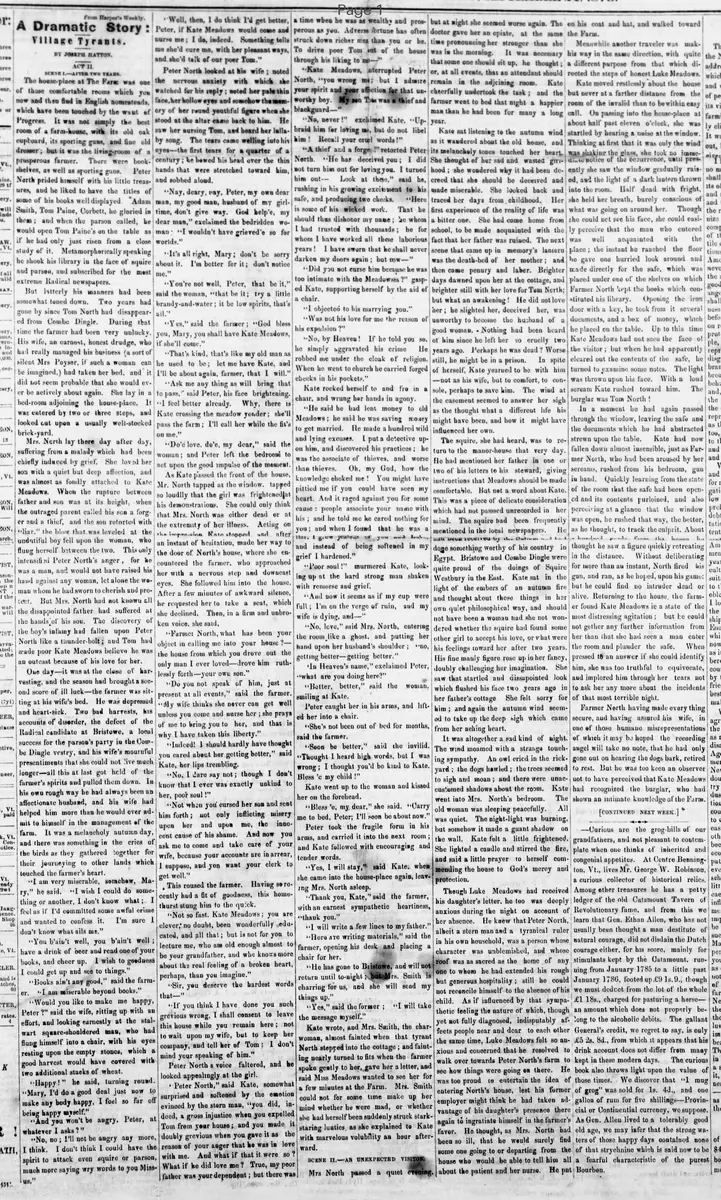
The house-place at The Farm was one of those comfortable rooms which you now and then find in English homesteads, which have been touched by the want of Progress. It was not simply the best room of a farm-house, with its old oak cupboard, its sporting guns, and fine old dresser; but it was the living-room of a prosperous farmer. There were book-shelves, as well as sporting guns. Peter North prided himself with his little treasures, and he liked to have the titles of some of his books well displayed Adam Smith, Tom Paine, Cobbett, he gloried in them; and when the parson called, he would open Tom Paine's on the table as if he had only just risen from a close study of it. Metaphorically speaking he shook his library in the face of squire and parson, and subscribed for the most extreme Radical newspapers.
But latterly his manners had been somewhat toned down. Two years had gone by since Tom North had disappeared from Combe Dingle. During that time the farmer had been very unlucky. His wife, an earnest, honest drudge, who had really managed his business (a sort of silent Mrs Poyser, if such a woman can be imagined.) had taken her bed, and it did not seem probable that she would ever be actively about again. She lay in a bed-room adjoining the house-place. It was entered by two or three steps, and looked out upon a usually well-stocked brick-yard.
Mrs. North lay there day after day, suffering from a malady which had been chiefly induced by grief. She loved her son with a quiet but deep affection, and was almost as fondly attached to Kate Meadows. When the rupture between father and son was at its height, when the outraged parent called his son a forger and a thief, and the son retorted with "liar." the blow that was leveled at the undutiful boy fell upon the woman, who flung herself between the two. This only intensified Peter North's anger, for he was a man, and would not have raised his hand against any woman, let alone the woman whom he had sworn to cherish and protect. But Mrs. North had not known all the disappointed father had suffered at the hands of his son. The discovery of the boy's infamy had fallen upon Peter North like a thunder-bolt; and Tom had made poor Kate Meadows believe he was an outcast because of his love for her.
One day--it was at the close of harvesting, and the season had brought a second score of ill luck--the farmer was sitting at his wife's bed. He was depressed and heart-sick. Two bad harvests, his accounts of disorder, the defeat of the Radical candidate at Bristowe, a local success for the parson's party in the Combe Dingle vestry, and his wife's mournful presentiments that she could not live much longer--all this at last got hold of the farmer's spirits and pulled them down. In his own rough way he had always been an affectionate husband, and his wife had helped him more than he would ever admit to himself in the management of the farm. It was a melancholy autumn day, and there was something in the cries of the birds as they gathered together for their journeying to other lands which touched the farmer's heart.
"I am very miserable, somehow, Mary," he said. "I wish I could do something or another, I don't know what; I feel as if I'd committed some awful crime and wanted to confess it. I'm sure I don't know what ails me."
"You b'ain't well, you b'ain't well; have a drink of beer and read one of your books, and cheer up. I wish to goodness I could get up and see to things."
"Books ain't any good," said the farmer.
"I am miserable beyond books."
"Would you like to make me happy, Peter?" said the wife, sitting up with an effort, and looking earnestly at the stalwart square-shouldered man, who had flung himself into a chair, with his eyes resting upon the empty stones, which a good harvest would have covered with two additional stacks of wheat.
"Happy!" he said, turning round.
"Mary, I'd do a good deal just now to make anybody happy, I feel so far off being happy myself."
"And you won't be angry, Peter, at whatever I ask?"
"No, no; I'll not be angry any more, I think. I don't think I could have the spirit to attack even squire or parson, much more saying wry words to you Miss us."
Well, then, I do think I'd get better, Peter, if Kate Meadows would come and nurse me; I do, indeed. Something tells me she'd cure me, with her pleasant ways, and she'd talk of our poor Tom."
Peter North looked at his wife; noted the nervous anxiety with which she watched for his reply; noted her pale thin face, her hollow eyes and somehow the memory of her round youthful figure when she stood at the altar came back to him. He saw her nursing Tom, and heard her lullaby song. The tears came welling into his eyes--the first tears for a quarter of a century; he bowed his head over the thin hands that were stretched toward him, and sobbed aloud.
"Nay, deary, nay, Peter, my own dear man, my good man, husband of my girl-time, don't give way. God help us, my dear man," exclaimed the bedridden woman: "I wouldn't have grieved you so for worlds."
"It's all right, Mary; don't be sorry about it. I'm better for it; don't notice me."
"You're not well, Peter, that be it," said the woman, "that be it; try a little brandy-and-water; it be low spirits, that's all."
"Yes," said the farmer; "God bless you, Mary, you shall have Kate Meadows, if she'll come."
"That's kind, that's like my old man as he used to be; let me have Kate, and I'll be about again, farmer, that I will."
"Ask me anything as will bring that to pass," said Peter, his face brightening.
"I feel better already. Why, there is Kate crossing the meadow yonder; she'll pass the farm; I'll call her while the fit's on me."
"Do'e, love, do'e, my dear," said the woman; and Peter left the bedroom to act upon the good impulse of the moment.
As Kate passed the front of the house. Mr. North tapped at the window, tapped so loudly that the girl was frightened at his demonstrations. She could only think that Mrs. North was either dead or at the extremity of her illness. Acting on the impression Kate stopped and after an instant of hesitation, made her way to the door of North's house, where she encountered the farmer, who approached her with a nervous step and downcast eyes. She followed him into the house.
After a few minutes of awkward silence, he requested her to take a seat, which she declined. Then, in a firm and unbroken voice, she said,
"Farmer North, what has been your object in calling me into your house?--the house from which you drove out the only man I ever loved--drove him ruthlessly forth--your own son."
"Do you not speak of him, just at present at all events," said the farmer.
"My wife thinks she never can get well unless you come and nurse her; she prays of me to bring you to her, and that is why I have taken this liberty."
"Indeed! I should hardly have thought you cared about her getting better," said Kate, her lips trembling.
"No, I dare say not; though I don't know that I ever was exactly unkind to her, poor soul!"
"Not when you cursed her son and sent him forth; not only inflicting misery upon her and upon me, the innocent cause of his shame. And now you ask me to come and take care of your wife, because your accounts are in arrear, I suppose, and you want your clerk to get well."
This roused the farmer. Having sorrowing had a fit of goodness, this home-thrust stung him to the quick.
"Not so fast, Kate Meadows; you are clever, no doubt, been wonderfully educated, and all that; but it is not for you to lecture me, who am old enough almost to be your grandfather, and who knows more about the real feeling of a broken heart, perhaps, than you imagine."
"Sir, you deserve the hardest words that--"
"If you think I have done you such grevious wrong, I shall consent to leave this house while you remain here; not to wait upon my wife, but to keep her company, and tell her of Tom: I don't mind your speaking of him."
Peter North's voice faltered, and he looked appealingly at the girl.
"Peter North," said Kate, somewhat surprised and softened by the emotion evinced by the stern man, "you did, indeed, a gross injustice when you expelled Tom from your house; and you made it doubly grevious when you gave it as the reason of your anger that he was in love with me. And what if that were so? What if he did love me? True, my poor father was your dependent; but there was a time when he was as wealthy and prosperous as you. Adverse fortune has often struck down richer men than you or he. To drive poor Tom out of the house through his liking to me--"
"Kate Meadows," interrupted Peter North, "you wrong me; but I admire your spirit and your affection for that unworthy boy. My son Tom was a thief and blackguard--"
"No, never!" exclaimed Kate. "Upbraid him for loving me, but do not libel him! Recall your cruel words!"
"A thief and a forger!" retorted Peter North. "He has deceived you; I did not turn him out for loving you. I turned him out-- Look at these," said he, rushing in his growing excitement to his safe, and producing two checks. "Here is some of his wicked work. That he should thus dishonor my name: he whom I had trusted with thousands; he for whom I have worked all these laborious years! I have sworn that he shall never darken my doors again: but now--"
"Did you not curse him because he was too intimate with the Meadows?" gasped Kate, supporting herself by the aid of a chair.
"I objected to his marrying you."
"Was not his love for me the reason of his expulsion?"
"No, by Heaven! If he told you so, he simply aggravated his crime He robbed me under the cloak of religion. When he went to church he carried forged checks in his pockets."
Kate rocked herself to and fro in a chair, and wrung her hands in agony.
"He said he had lent money to old Meadows; he said he was saving money to get married. He made a hundred wild and lying excuses. I put a detective upon him, and discovered his practices; he was the associate of thieves, and worse than thieves. Oh, my God, how the knowledge choked me! You might have pitied me if you could have seen my heart. And it raged against you for some cause: people associate your name with his; and he told me he cared nothing for you; and when I found that he was a liar, I grew jealous of you and Kate and instead of being softened in my grief I hardened."
"Poor soul!" murmured Kate, looking up at the hard strong man shaken with remorse and grief.
"And now it seems as if my cup were full; I'm on the verge of ruin, and my wife is dying, and--"
"No, love," said Mrs. North, entering the room like a ghost, and putting her hand upon her husband's shoulder; "no, getting better--getting better."
"In Heaven's name," exclaimed Peter, "what are you doing here?"
"Better, better," said the woman, smiling at Kate.
Peter caught her in his arms, and lifted her into a chair.
"She's not been out of bed for months," said the farmer.
"Soon be better," said the invalid.
"Thought I heard high words, but I was wrong; I thought you'd be kind to Kate. Bless you, my child!"
Kate went up to the woman and kissed her on the forehead.
"Bless you, my dear," she said. "Carry me to bed, Peter; I'll soon be about now."
Peter took the fragile form in his arms, and carried it into the next room; and Kate followed with encouraging and tender words.
Yes, I will stay," said Kate, when she came into the house-place again, leaving Mrs. North asleep.
"Thank you, Kate," said the farmer, with an earnest sympathetic heartiness, "thank you."
"I will write a few lines to my father."
"Here are writing materials," said the farmer, opening his desk and placing a chair for her.
"He has gone to Bristowe, and will not return until to-night; but Mrs. Smith is charring for us, and she will send my things up."
"Yes," said the farmer; "I will take the message myself."
Kate wrote, and Mrs. Smith, the char-woman, almost fainted when that tyrant North stepped into the cottage; and fainting nearly turned to fits when the farmer spoke gently to her, gave her a letter, and said Miss Meadows wanted to see her for a few minutes at the Farm. Mrs. Smith could not for some time make up her mind whether he were mad, or whether she had herself been suddenly struck stark-staring lunatics, as she explained to Kate with marvelous volubility an hour afterward.
SCENE II. AN UNEXPECTED VISITOR.
Mrs North passed a quiet evening but at night she seemed worse again. The doctor gave her an opiate, at the same time pronouncing her stronger than she was in the morning. It was necessary that some one should sit up, he thought; or, at all events, that an attendant should remain in the adjoining room. Kate cheerfully undertook the task: and the farmer went to bed that night a happier man than he had been for many a long year.
Kate sat listening to the autumn wind as it wandered about the old house, and its melancholy tones touched her heart. She thought of her sad and wasted girl-hood; she wondered why it had been decreed that she should be deceived and made miserable. She looked back and traced her days from childhood. Her first experience of the reality of life was a bitter one. She had come home from school, to be made acquainted with the fact that her father was ruined. The next scene that came up in memory's lantern was the death-bed of her mother; and then came penury and labor. Brighter days dawned upon her at the cottage, and brighter still with her love for Tom North; but what an awakening! He did not love her; he slighted her, deceived her, was unworthy to become the husband of a good woman. Nothing had been heard of him since he left her so cruelly two years ago. Perhaps he was dead? Worse still, he might be in a prison.
In spite of herself, Kate yearned to be with him --not as his wife, but to comfort, to console, perhaps to save him. The wind at the casement seemed to answer her sigh as the thought what a different life his might have been, and how it might have influenced her own.
The squire, she had heard, was to return to the manor-house that very day. He had mentioned her father in one or two of his letters to his steward, giving instructions that Meadows should be made comfortable. But not a word about Kate. This was a piece of delicate consideration which had not passed unrecorded in her mind. The squire had been frequently mentioned in the local newspapers. He had received by the last mail from his country somewhat not have been a woman had she not wondered whether the squire had found some other girl to accept his love, or what were his feelings toward her after two years. His fine manly figure rose up in her fancy, doubly challenging her imagination. She saw that startled and disappointed look in her father's cottage She felt sorry for him; and again the autumn wind seemed to take up the deep sigh which came from her aching heart.
It was altogether a sad kind of night. The wind moaned with a strange touching sympathy. An owl cried in the rick-yard; the dogs howled; the trees seemed to sigh and moan; and there were unaccustomed shadows about the room. Kate went into Mrs. North's bedroom, The old woman was sleeping peacefully. All was quiet. The night-light was burning, but somehow it made a giant shadow on the wall. Kate felt a little frightened. She lighted a candle and stirred the fire, and said a little prayer to herself commending the house to God's mercy and protection.
Though Luke Meadows had received his daughter's letter, he too was deeply anxious during the night on account of her absence. He knew that Peter North, albeit a stern man and a tyrannical ruler in his own household, was a person whose character was unblemished, and whose roof was as sacred as the home of any one to whom he had extended his rough but generous hospitality; still he could not reconcile himself to the absence of his child. As if influenced by that sympathetic feeling the nature of which, though yet not fully diagnosed, indisputably affects people near and dear to each other the same time, Luke Meadows felt so anxious and concerned that he resolved to walk over towards Peter North's farm to see how things were going on there. He was too proud to entertain the idea of entering North's house, lest his former employer might think he had taken advantage of his daughter's presence there again to ingratiate himself in the farmer's favor. He thought, as Mrs. North had been so ill, that he would surely find some one going to or departing from the house who would be able to tell him all about the patient and her nurse. He put on his coat and hat, and walked toward the Farm.
Meanwhile another traveler was making his way in the same direction, with quite a different purpose from that which directed the steps of honest Luke Meadows.
Kate moved restlessly about the house but never at a farther distance from the room of the invalid than to be within easy call. On passing into the house-place at about half past eleven o'clock, she was startled by hearing a noise at the window. Thinking at first that it was only the wind was shaking the glass, she took no immediate notice of the occurrence, until presently she saw the window gradually raised, and the light of a dark lantern thrown into the room. Half dead with fright, she held her breath, barely conscious of what was going on around her. Though she could not see his face, she could easily perceive that the man who entered was well acquainted with the place; the instant he reached the floor he gave one hurried look around and made directly for the safe, which was placed under one of the shelves on which Farmer North kept the books which constituted his library. Opening the iron door with a key, he took from it several documents, and a box of money, which he placed on the table. Up to this time Kate Meadows had not seen the face of the visitor; but when he had apparently cleared out the contents of the safe, he turned to examine some notes. The light was thrown upon his face. With a loud scream Kate rushed toward him. The burglar was Tom North!
In a moment he had again passed through the window, leaving the safe and the documents which he had abstracted strewn upon the table.
Kate had now fallen down almost insensible, just as Farmer North, who had been aroused by her screams, rushed from his bedroom, gun in hand. Quickly learning from the state of the room that the safe had been opened and its contents purloined, and also perceiving at a glance that the window was open, he rushed that way, the better, as he thought, to track the culprit. About hundred yards from the house he thought he saw a figure quickly retreating in the distance.
Without deliberating for more than an instant, North fired his gun, and ran, as he hoped, upon his game; but he could find no intruder dead or alive. Returning to the house, the farmer found Kate Meadows in a state of the most distressing agitation; but he could not gather any further information from her than that she had seen a man enter the room and plunder the safe. When pressed to an answer if she could identify him, she was too truthful to equivocate, and implored him through her tears not to ask her any more about the incidents of that most terrible night.
Farmer North having made every thing secure, and having assured his wife, in one of those humane misrepresentations of which it may be hoped the recording angel will take no note, that he had only gone out on hearing the dogs bark, retired to rest. But he was too keen an observer not to have perceived that Kate Meadows had recognized the burglar, who had shown an intimate knowledge of the Farm.
Village Tyrants.
BY JOSEPH HATTON.
ACT II
SCENE. LATER TWO YEARS.
The house-place at The Farm was one of those comfortable rooms which you now and then find in English homesteads, which have been touched by the want of Progress. It was not simply the best room of a farm-house, with its old oak cupboard, its sporting guns, and fine old dresser; but it was the living-room of a prosperous farmer. There were book-shelves, as well as sporting guns. Peter North prided himself with his little treasures, and he liked to have the titles of some of his books well displayed Adam Smith, Tom Paine, Cobbett, he gloried in them; and when the parson called, he would open Tom Paine's on the table as if he had only just risen from a close study of it. Metaphorically speaking he shook his library in the face of squire and parson, and subscribed for the most extreme Radical newspapers.
But latterly his manners had been somewhat toned down. Two years had gone by since Tom North had disappeared from Combe Dingle. During that time the farmer had been very unlucky. His wife, an earnest, honest drudge, who had really managed his business (a sort of silent Mrs Poyser, if such a woman can be imagined.) had taken her bed, and it did not seem probable that she would ever be actively about again. She lay in a bed-room adjoining the house-place. It was entered by two or three steps, and looked out upon a usually well-stocked brick-yard.
Mrs. North lay there day after day, suffering from a malady which had been chiefly induced by grief. She loved her son with a quiet but deep affection, and was almost as fondly attached to Kate Meadows. When the rupture between father and son was at its height, when the outraged parent called his son a forger and a thief, and the son retorted with "liar." the blow that was leveled at the undutiful boy fell upon the woman, who flung herself between the two. This only intensified Peter North's anger, for he was a man, and would not have raised his hand against any woman, let alone the woman whom he had sworn to cherish and protect. But Mrs. North had not known all the disappointed father had suffered at the hands of his son. The discovery of the boy's infamy had fallen upon Peter North like a thunder-bolt; and Tom had made poor Kate Meadows believe he was an outcast because of his love for her.
One day--it was at the close of harvesting, and the season had brought a second score of ill luck--the farmer was sitting at his wife's bed. He was depressed and heart-sick. Two bad harvests, his accounts of disorder, the defeat of the Radical candidate at Bristowe, a local success for the parson's party in the Combe Dingle vestry, and his wife's mournful presentiments that she could not live much longer--all this at last got hold of the farmer's spirits and pulled them down. In his own rough way he had always been an affectionate husband, and his wife had helped him more than he would ever admit to himself in the management of the farm. It was a melancholy autumn day, and there was something in the cries of the birds as they gathered together for their journeying to other lands which touched the farmer's heart.
"I am very miserable, somehow, Mary," he said. "I wish I could do something or another, I don't know what; I feel as if I'd committed some awful crime and wanted to confess it. I'm sure I don't know what ails me."
"You b'ain't well, you b'ain't well; have a drink of beer and read one of your books, and cheer up. I wish to goodness I could get up and see to things."
"Books ain't any good," said the farmer.
"I am miserable beyond books."
"Would you like to make me happy, Peter?" said the wife, sitting up with an effort, and looking earnestly at the stalwart square-shouldered man, who had flung himself into a chair, with his eyes resting upon the empty stones, which a good harvest would have covered with two additional stacks of wheat.
"Happy!" he said, turning round.
"Mary, I'd do a good deal just now to make anybody happy, I feel so far off being happy myself."
"And you won't be angry, Peter, at whatever I ask?"
"No, no; I'll not be angry any more, I think. I don't think I could have the spirit to attack even squire or parson, much more saying wry words to you Miss us."
Well, then, I do think I'd get better, Peter, if Kate Meadows would come and nurse me; I do, indeed. Something tells me she'd cure me, with her pleasant ways, and she'd talk of our poor Tom."
Peter North looked at his wife; noted the nervous anxiety with which she watched for his reply; noted her pale thin face, her hollow eyes and somehow the memory of her round youthful figure when she stood at the altar came back to him. He saw her nursing Tom, and heard her lullaby song. The tears came welling into his eyes--the first tears for a quarter of a century; he bowed his head over the thin hands that were stretched toward him, and sobbed aloud.
"Nay, deary, nay, Peter, my own dear man, my good man, husband of my girl-time, don't give way. God help us, my dear man," exclaimed the bedridden woman: "I wouldn't have grieved you so for worlds."
"It's all right, Mary; don't be sorry about it. I'm better for it; don't notice me."
"You're not well, Peter, that be it," said the woman, "that be it; try a little brandy-and-water; it be low spirits, that's all."
"Yes," said the farmer; "God bless you, Mary, you shall have Kate Meadows, if she'll come."
"That's kind, that's like my old man as he used to be; let me have Kate, and I'll be about again, farmer, that I will."
"Ask me anything as will bring that to pass," said Peter, his face brightening.
"I feel better already. Why, there is Kate crossing the meadow yonder; she'll pass the farm; I'll call her while the fit's on me."
"Do'e, love, do'e, my dear," said the woman; and Peter left the bedroom to act upon the good impulse of the moment.
As Kate passed the front of the house. Mr. North tapped at the window, tapped so loudly that the girl was frightened at his demonstrations. She could only think that Mrs. North was either dead or at the extremity of her illness. Acting on the impression Kate stopped and after an instant of hesitation, made her way to the door of North's house, where she encountered the farmer, who approached her with a nervous step and downcast eyes. She followed him into the house.
After a few minutes of awkward silence, he requested her to take a seat, which she declined. Then, in a firm and unbroken voice, she said,
"Farmer North, what has been your object in calling me into your house?--the house from which you drove out the only man I ever loved--drove him ruthlessly forth--your own son."
"Do you not speak of him, just at present at all events," said the farmer.
"My wife thinks she never can get well unless you come and nurse her; she prays of me to bring you to her, and that is why I have taken this liberty."
"Indeed! I should hardly have thought you cared about her getting better," said Kate, her lips trembling.
"No, I dare say not; though I don't know that I ever was exactly unkind to her, poor soul!"
"Not when you cursed her son and sent him forth; not only inflicting misery upon her and upon me, the innocent cause of his shame. And now you ask me to come and take care of your wife, because your accounts are in arrear, I suppose, and you want your clerk to get well."
This roused the farmer. Having sorrowing had a fit of goodness, this home-thrust stung him to the quick.
"Not so fast, Kate Meadows; you are clever, no doubt, been wonderfully educated, and all that; but it is not for you to lecture me, who am old enough almost to be your grandfather, and who knows more about the real feeling of a broken heart, perhaps, than you imagine."
"Sir, you deserve the hardest words that--"
"If you think I have done you such grevious wrong, I shall consent to leave this house while you remain here; not to wait upon my wife, but to keep her company, and tell her of Tom: I don't mind your speaking of him."
Peter North's voice faltered, and he looked appealingly at the girl.
"Peter North," said Kate, somewhat surprised and softened by the emotion evinced by the stern man, "you did, indeed, a gross injustice when you expelled Tom from your house; and you made it doubly grevious when you gave it as the reason of your anger that he was in love with me. And what if that were so? What if he did love me? True, my poor father was your dependent; but there was a time when he was as wealthy and prosperous as you. Adverse fortune has often struck down richer men than you or he. To drive poor Tom out of the house through his liking to me--"
"Kate Meadows," interrupted Peter North, "you wrong me; but I admire your spirit and your affection for that unworthy boy. My son Tom was a thief and blackguard--"
"No, never!" exclaimed Kate. "Upbraid him for loving me, but do not libel him! Recall your cruel words!"
"A thief and a forger!" retorted Peter North. "He has deceived you; I did not turn him out for loving you. I turned him out-- Look at these," said he, rushing in his growing excitement to his safe, and producing two checks. "Here is some of his wicked work. That he should thus dishonor my name: he whom I had trusted with thousands; he for whom I have worked all these laborious years! I have sworn that he shall never darken my doors again: but now--"
"Did you not curse him because he was too intimate with the Meadows?" gasped Kate, supporting herself by the aid of a chair.
"I objected to his marrying you."
"Was not his love for me the reason of his expulsion?"
"No, by Heaven! If he told you so, he simply aggravated his crime He robbed me under the cloak of religion. When he went to church he carried forged checks in his pockets."
Kate rocked herself to and fro in a chair, and wrung her hands in agony.
"He said he had lent money to old Meadows; he said he was saving money to get married. He made a hundred wild and lying excuses. I put a detective upon him, and discovered his practices; he was the associate of thieves, and worse than thieves. Oh, my God, how the knowledge choked me! You might have pitied me if you could have seen my heart. And it raged against you for some cause: people associate your name with his; and he told me he cared nothing for you; and when I found that he was a liar, I grew jealous of you and Kate and instead of being softened in my grief I hardened."
"Poor soul!" murmured Kate, looking up at the hard strong man shaken with remorse and grief.
"And now it seems as if my cup were full; I'm on the verge of ruin, and my wife is dying, and--"
"No, love," said Mrs. North, entering the room like a ghost, and putting her hand upon her husband's shoulder; "no, getting better--getting better."
"In Heaven's name," exclaimed Peter, "what are you doing here?"
"Better, better," said the woman, smiling at Kate.
Peter caught her in his arms, and lifted her into a chair.
"She's not been out of bed for months," said the farmer.
"Soon be better," said the invalid.
"Thought I heard high words, but I was wrong; I thought you'd be kind to Kate. Bless you, my child!"
Kate went up to the woman and kissed her on the forehead.
"Bless you, my dear," she said. "Carry me to bed, Peter; I'll soon be about now."
Peter took the fragile form in his arms, and carried it into the next room; and Kate followed with encouraging and tender words.
Yes, I will stay," said Kate, when she came into the house-place again, leaving Mrs. North asleep.
"Thank you, Kate," said the farmer, with an earnest sympathetic heartiness, "thank you."
"I will write a few lines to my father."
"Here are writing materials," said the farmer, opening his desk and placing a chair for her.
"He has gone to Bristowe, and will not return until to-night; but Mrs. Smith is charring for us, and she will send my things up."
"Yes," said the farmer; "I will take the message myself."
Kate wrote, and Mrs. Smith, the char-woman, almost fainted when that tyrant North stepped into the cottage; and fainting nearly turned to fits when the farmer spoke gently to her, gave her a letter, and said Miss Meadows wanted to see her for a few minutes at the Farm. Mrs. Smith could not for some time make up her mind whether he were mad, or whether she had herself been suddenly struck stark-staring lunatics, as she explained to Kate with marvelous volubility an hour afterward.
SCENE II. AN UNEXPECTED VISITOR.
Mrs North passed a quiet evening but at night she seemed worse again. The doctor gave her an opiate, at the same time pronouncing her stronger than she was in the morning. It was necessary that some one should sit up, he thought; or, at all events, that an attendant should remain in the adjoining room. Kate cheerfully undertook the task: and the farmer went to bed that night a happier man than he had been for many a long year.
Kate sat listening to the autumn wind as it wandered about the old house, and its melancholy tones touched her heart. She thought of her sad and wasted girl-hood; she wondered why it had been decreed that she should be deceived and made miserable. She looked back and traced her days from childhood. Her first experience of the reality of life was a bitter one. She had come home from school, to be made acquainted with the fact that her father was ruined. The next scene that came up in memory's lantern was the death-bed of her mother; and then came penury and labor. Brighter days dawned upon her at the cottage, and brighter still with her love for Tom North; but what an awakening! He did not love her; he slighted her, deceived her, was unworthy to become the husband of a good woman. Nothing had been heard of him since he left her so cruelly two years ago. Perhaps he was dead? Worse still, he might be in a prison.
In spite of herself, Kate yearned to be with him --not as his wife, but to comfort, to console, perhaps to save him. The wind at the casement seemed to answer her sigh as the thought what a different life his might have been, and how it might have influenced her own.
The squire, she had heard, was to return to the manor-house that very day. He had mentioned her father in one or two of his letters to his steward, giving instructions that Meadows should be made comfortable. But not a word about Kate. This was a piece of delicate consideration which had not passed unrecorded in her mind. The squire had been frequently mentioned in the local newspapers. He had received by the last mail from his country somewhat not have been a woman had she not wondered whether the squire had found some other girl to accept his love, or what were his feelings toward her after two years. His fine manly figure rose up in her fancy, doubly challenging her imagination. She saw that startled and disappointed look in her father's cottage She felt sorry for him; and again the autumn wind seemed to take up the deep sigh which came from her aching heart.
It was altogether a sad kind of night. The wind moaned with a strange touching sympathy. An owl cried in the rick-yard; the dogs howled; the trees seemed to sigh and moan; and there were unaccustomed shadows about the room. Kate went into Mrs. North's bedroom, The old woman was sleeping peacefully. All was quiet. The night-light was burning, but somehow it made a giant shadow on the wall. Kate felt a little frightened. She lighted a candle and stirred the fire, and said a little prayer to herself commending the house to God's mercy and protection.
Though Luke Meadows had received his daughter's letter, he too was deeply anxious during the night on account of her absence. He knew that Peter North, albeit a stern man and a tyrannical ruler in his own household, was a person whose character was unblemished, and whose roof was as sacred as the home of any one to whom he had extended his rough but generous hospitality; still he could not reconcile himself to the absence of his child. As if influenced by that sympathetic feeling the nature of which, though yet not fully diagnosed, indisputably affects people near and dear to each other the same time, Luke Meadows felt so anxious and concerned that he resolved to walk over towards Peter North's farm to see how things were going on there. He was too proud to entertain the idea of entering North's house, lest his former employer might think he had taken advantage of his daughter's presence there again to ingratiate himself in the farmer's favor. He thought, as Mrs. North had been so ill, that he would surely find some one going to or departing from the house who would be able to tell him all about the patient and her nurse. He put on his coat and hat, and walked toward the Farm.
Meanwhile another traveler was making his way in the same direction, with quite a different purpose from that which directed the steps of honest Luke Meadows.
Kate moved restlessly about the house but never at a farther distance from the room of the invalid than to be within easy call. On passing into the house-place at about half past eleven o'clock, she was startled by hearing a noise at the window. Thinking at first that it was only the wind was shaking the glass, she took no immediate notice of the occurrence, until presently she saw the window gradually raised, and the light of a dark lantern thrown into the room. Half dead with fright, she held her breath, barely conscious of what was going on around her. Though she could not see his face, she could easily perceive that the man who entered was well acquainted with the place; the instant he reached the floor he gave one hurried look around and made directly for the safe, which was placed under one of the shelves on which Farmer North kept the books which constituted his library. Opening the iron door with a key, he took from it several documents, and a box of money, which he placed on the table. Up to this time Kate Meadows had not seen the face of the visitor; but when he had apparently cleared out the contents of the safe, he turned to examine some notes. The light was thrown upon his face. With a loud scream Kate rushed toward him. The burglar was Tom North!
In a moment he had again passed through the window, leaving the safe and the documents which he had abstracted strewn upon the table.
Kate had now fallen down almost insensible, just as Farmer North, who had been aroused by her screams, rushed from his bedroom, gun in hand. Quickly learning from the state of the room that the safe had been opened and its contents purloined, and also perceiving at a glance that the window was open, he rushed that way, the better, as he thought, to track the culprit. About hundred yards from the house he thought he saw a figure quickly retreating in the distance.
Without deliberating for more than an instant, North fired his gun, and ran, as he hoped, upon his game; but he could find no intruder dead or alive. Returning to the house, the farmer found Kate Meadows in a state of the most distressing agitation; but he could not gather any further information from her than that she had seen a man enter the room and plunder the safe. When pressed to an answer if she could identify him, she was too truthful to equivocate, and implored him through her tears not to ask her any more about the incidents of that most terrible night.
Farmer North having made every thing secure, and having assured his wife, in one of those humane misrepresentations of which it may be hoped the recording angel will take no note, that he had only gone out on hearing the dogs bark, retired to rest. But he was too keen an observer not to have perceived that Kate Meadows had recognized the burglar, who had shown an intimate knowledge of the Farm.
What sub-type of article is it?
Prose Fiction
Dialogue
What themes does it cover?
Love Romance
Moral Virtue
Political
What keywords are associated?
Village Tyrants
Family Reconciliation
Forgery Deception
Burglary Attempt
Rural England
Radical Politics
Illness Grief
What entities or persons were involved?
By Joseph Hatton.
Literary Details
Title
Village Tyrants. Act Ii
Author
By Joseph Hatton.
Form / Style
Dramatic Scenes In Prose With Dialogue
Key Lines
"I Am Very Miserable, Somehow, Mary," He Said. "I Wish I Could Do Something Or Another, I Don't Know What; I Feel As If I'd Committed Some Awful Crime And Wanted To Confess It."
"Farmer North, What Has Been Your Object In Calling Me Into Your House? The House From Which You Drove Out The Only Man I Ever Loved Drove Him Ruthlessly Forth Your Own Son."
"A Thief And A Forger!" Retorted Peter North. "He Has Deceived You; I Did Not Turn Him Out For Loving You."
With A Loud Scream Kate Rushed Toward Him. The Burglar Was Tom North!