Thank you for visiting SNEWPapers!
Sign up free
Literary
November 15, 1839
Southern Christian Advocate
Charleston, Charleston County, South Carolina
What is this article about?
Excerpt from Rev. Thomas Ware's memoirs describing a 1780 Methodist lovefeast in East Jersey amid the Revolutionary War, where former enemies embraced in Christian forgiveness, sharing conversion stories of seeking the way to heaven.
Clipping
OCR Quality
95%
Excellent
Full Text
LOVEFEAST IN 1780
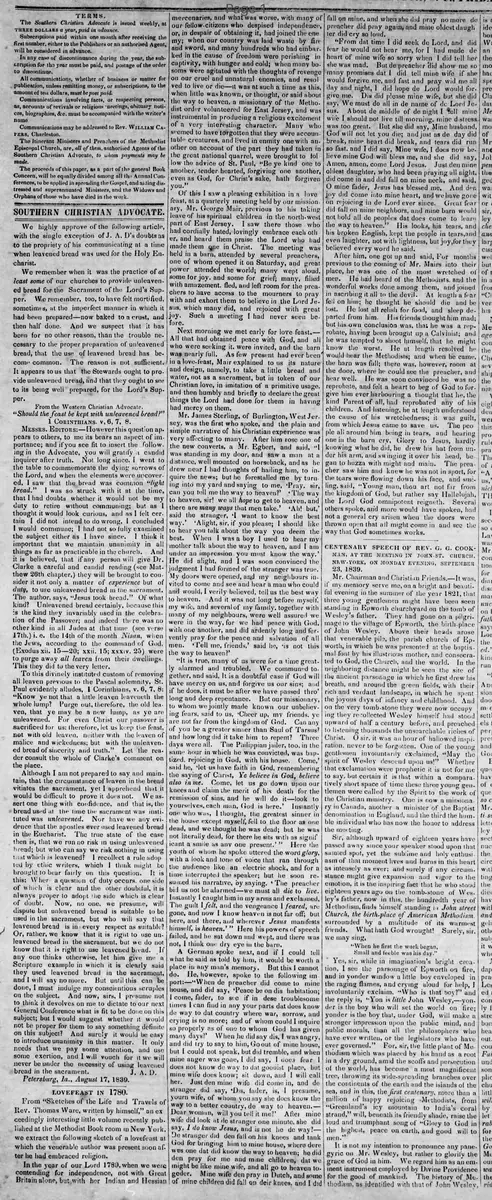
From "Sketches of the Life and Travels of Rev. Thomas Ware, written by himself," an exceedingly interesting little volume recently published at the Methodist Book room in New York. we extract the following sketch of a lovefeast at which the venerable author was present soon after he had embraced religion,
In the year of our Lord 1780, when we were contending for independence, not with Great Britain alone, but with her Indian and Hessian mercenaries, and what was worse, with many of our fellow-citizens who despised independence, or, in despair of obtaining it, had joined the enemy; when our country was laid waste by fire and sword, and many hundreds who had embarked in the cause of freedom were perishing in captivity, with hunger and cold; when many bosoms were agitated with the thoughts of revenge on our cruel and unnatural enemies, and resolved to live or die--it was at such a time as this, when little was known, or thought, or said about the way to heaven, a missionary of the Methodist order volunteered for East Jersey, and was instrumental in producing a religious excitement of a very interesting character. Many who seemed to have forgotten that they were accountable creatures, and lived in enmity one with another on account of the part they had taken in the great national quarrel, were brought to follow the advice of St. Paul, "Be ye kind one to another, tender hearted, forgiving one another, even as God, for Christ's sake, hath forgiven you."
Of this I saw a pleasing exhibition in a love feast, at a quarterly meeting held by our missionary, Mr. George Mair, previous to his taking leave of his spiritual children in the north-west part of East Jersey. I saw there those who had cordially hated, lovingly embrace each other, and heard them praise the Lord who had made them one in Christ. The meeting was held in a barn, attended by several preachers, one of whom opened it on Saturday, and great power attended the word; many wept aloud, some for joy. and some for grief; many, filled with amazement, fled, and left room for the preachers to have access to the mourners to pray with and exhort them to believe in the Lord Jesus, which many did, and rejoiced with great joy. Such a meeting I had never seen before.
Next morning we met early for love feast.— All that had obtained peace with God, and all who were seeking it. were invited, and the barn was nearly full. As few present had ever been in a love-feast, Mair explained to us its nature and design, namely, to take a little bread and water, not as a sacrament, but in token of our Christian love, in imitation of a primitive usage, and then humbly and briefly to declare the great things the Lord had done for them in having had mercy on them.
Mr. James Sterling, of Burlington, West Jersey, was the first who spoke, and the plain and simple narrative of his Christian experience was very affecting to many. After him rose one of the new converts, a Mr. Egbert, and said, "I was standing in my door, and saw a man at a distance, well mounted on horseback, and as he drew near I had thoughts of hailing him, to inquire the news; but he forestalled me by turning into my yard and saying to me, 'Pray, sir, can you tell me the way to heaven?' 'The way to heaven, sir! we all hope to get to heaven, and there are many ways that men take.' 'Ah! but,' said the stranger, 'I want to know the best way.' 'Alight, sir, if you please; I should like to hear you talk about the way you deem the best. When I was a boy I used to hear my mother talk about the way to heaven, and I am under an impression you must know the way.' He did alight, and I was soon convinced the judgment I had formed of the stranger was true. My doors were opened, and my neighbours invited to come and see and hear a man who could and would, I verily believed, tell us the best way to heaven. And it was not long before myself. my wife, and several of my family. together with many of my neighbours, were well assured we were in the way, for we had peace with God. with one another, and did ardently long and fervently pray for the peace and salvation of all men. Tell me, friends,' said he, is not this the way to heaven?'
"It is true, many of us were for a time greatly alarmed and troubled. We communed together, and said, It is a doubtful case if God will have mercy on us, and forgive us our sins; and if he does, it must be after we have passed thro' long and deep repentance. But our missionary, to whom we jointly made known our unbelieving fears, said to us, 'Cheer up, my friends. ye are not far from the kingdom of God. Can any of you be a greater sinner than Saul of Tarsus? and how long did it take him to repent? Three days were all. The Philippian jailer, too, in the same hour in which he was convicted, was baptized, rejoicing in God, with his house. Come, said he, 'let us have faith in God, remembering the saying of Christ, Ye believe in God, believe also in me. Come, let us go down upon our knees and claim the merit of his death for the remission of sins, and he will do it—look to yourselves, each man, God is here.' Instantly one who was, I thought, the greatest sinner in the house except myself, fell to the floor as one dead, and we thought he was dead; but he was not literally dead, for there he sits with as significant a smile as any one present.' " Here the youth of whom he spoke uttered the word glory. with a look and tone of voice that ran through the audience like an electric shock, and for a time interrupted the speaker; but he soon resumed his narrative, by saying. 'The preacher bid us not be alarmed—we must all die to live. Instantly I caught him in my arms and exclaimed, The guilt I felt, and the vengeance I feared, are gone, and now I know heaven is not far off; but here, and there, and wherever Jesus manifests himself, is heaven.'" Here his powers of speech failed, and he sat down and wept, and there was not, I think one dry eye in the barn.
A German spoke next, and if I could tell what he said as told by him, it would be worth a place in any man's memory. But this I cannot do. He, however, spoke to the following import:-"When de preacher did come to mine house, and did say, 'Peace be on dis habitation; I come, fader, to see if in dese troublesome times I can find in any your parts dat does know de way to dat country where war, sorrow, and crying is no more; and of whom could I inquire so properly as of one to whom God has given many days?' When he did say dis, I was angry, and did iry to say to him, Go out of mine house, but I could not speak, but did tremble, and when mine anger was gone, I did say, I does fear I does not know de way to dat goodist place, but mine wife does know; sit down, and I will call her. Just den mine wife did come in, and de stranger did say, Dis, fader, is, I presume, yourn wife, of whom you say she does know the way to a better country, de way to heaven.- Dear woman, will you tell it me?' After mine wife did look at de stranger one minute, she did say, I do know Jesus, and is not he de way?- De stranger did den fall on his knees and tank God for bringing him to mine house, where dere was one dat did know the way to heaven; he did den pray for me and mine children, dat we might be like mine wife, and all go to heaven togeder. Mine wife den pray in Dutch, and some of mine children did fall on deir knees, and I did all on mine, and when she did pray no more de preacher did pray again, and mine oldest daugh ter did cry so loud.
"From dat time I did seek de Lord, and did fear he would not hear me, for I had made de heart of mine wife so sorry when I did tell her she was mad. But de preacher did show me so many promises dat I did tell mine wife if she would forgive me, and fast and pray wid me all day and night, I did hope de Lord would forgive me. Dis did please mine wife, but she did say, We must do all in de name of de Lord Jesus. About de middle of de night I tell mine wife I should not live till morning. mine distress was too great. But she did say, Mine husband, God will not let you die; and just as de day did break, mine heart did break, and tears did run so fast, and I did say, Mine wife, I does now believe mine God will bless me, and she did say, Amen, amen, come Lord Jesus. Just den mine oldest daughter, who had been praying all night, did come in and did fall on mine neck, and said, O mine fader, Jesus has blessed me. And den joy did come into mine heart, and we have gone on rejoicing in de Lord ever since. Great fear did fall on mine neighbors, and mine barn would not hold all de peoples dat does come to learn the way to heaven." His looks, his tears, and his broken English, kept the people in tears, and even laughter, not with lightness, but joy, for they believed every word he said.
After him, one got up and said, For months previous to the coming of Mr. Mair's into their place, he was one of the most wretched of men. He had heard of the Methodists. and the wonderful works done among them, and joined in ascribing it all to the devil. At length a fear fell on him; he thought he should die and be lost. He lost all relish for food, and sleep departed from him. His friends thought him mad; but his own conclusion was, that he was a reprobate, having been brought up a Calvinist; and he was tempted to shoot himself, that he might know the worst. He at length resolved he would hear the Methodists; and when he came, the barn was full; there was, however, room at the door, where he could see the preacher, and hear well. He was soon convinced he was no reprobate, and felt a heart to beg of God to forgive him ever harbouring a thought that he, the kind Parent of all, had reprobated any of his children. And listening, he at length understood the cause of his wretchedness; it was guilt, from which Jesus came to save us. The people all around him being in tears, and hearing one in the barn cry, Glory to Jesus, hardly knowing what he did, he drew his hat from under his arm, and swinging it over his head, began to huzza with might and main. The preacher saw him and knew he was not in sport, for the tears were flowing down his face, and smiling, said, "Young man, thou art not far from the kingdom of God, but rather say Hallelujah, the Lord God omnipotent reigneth. Several others spoke, and more would have spoken, had not a general cry arisen when the doors were thrown open that all might come in and see the way that God sometimes works.
From "Sketches of the Life and Travels of Rev. Thomas Ware, written by himself," an exceedingly interesting little volume recently published at the Methodist Book room in New York. we extract the following sketch of a lovefeast at which the venerable author was present soon after he had embraced religion,
In the year of our Lord 1780, when we were contending for independence, not with Great Britain alone, but with her Indian and Hessian mercenaries, and what was worse, with many of our fellow-citizens who despised independence, or, in despair of obtaining it, had joined the enemy; when our country was laid waste by fire and sword, and many hundreds who had embarked in the cause of freedom were perishing in captivity, with hunger and cold; when many bosoms were agitated with the thoughts of revenge on our cruel and unnatural enemies, and resolved to live or die--it was at such a time as this, when little was known, or thought, or said about the way to heaven, a missionary of the Methodist order volunteered for East Jersey, and was instrumental in producing a religious excitement of a very interesting character. Many who seemed to have forgotten that they were accountable creatures, and lived in enmity one with another on account of the part they had taken in the great national quarrel, were brought to follow the advice of St. Paul, "Be ye kind one to another, tender hearted, forgiving one another, even as God, for Christ's sake, hath forgiven you."
Of this I saw a pleasing exhibition in a love feast, at a quarterly meeting held by our missionary, Mr. George Mair, previous to his taking leave of his spiritual children in the north-west part of East Jersey. I saw there those who had cordially hated, lovingly embrace each other, and heard them praise the Lord who had made them one in Christ. The meeting was held in a barn, attended by several preachers, one of whom opened it on Saturday, and great power attended the word; many wept aloud, some for joy. and some for grief; many, filled with amazement, fled, and left room for the preachers to have access to the mourners to pray with and exhort them to believe in the Lord Jesus, which many did, and rejoiced with great joy. Such a meeting I had never seen before.
Next morning we met early for love feast.— All that had obtained peace with God, and all who were seeking it. were invited, and the barn was nearly full. As few present had ever been in a love-feast, Mair explained to us its nature and design, namely, to take a little bread and water, not as a sacrament, but in token of our Christian love, in imitation of a primitive usage, and then humbly and briefly to declare the great things the Lord had done for them in having had mercy on them.
Mr. James Sterling, of Burlington, West Jersey, was the first who spoke, and the plain and simple narrative of his Christian experience was very affecting to many. After him rose one of the new converts, a Mr. Egbert, and said, "I was standing in my door, and saw a man at a distance, well mounted on horseback, and as he drew near I had thoughts of hailing him, to inquire the news; but he forestalled me by turning into my yard and saying to me, 'Pray, sir, can you tell me the way to heaven?' 'The way to heaven, sir! we all hope to get to heaven, and there are many ways that men take.' 'Ah! but,' said the stranger, 'I want to know the best way.' 'Alight, sir, if you please; I should like to hear you talk about the way you deem the best. When I was a boy I used to hear my mother talk about the way to heaven, and I am under an impression you must know the way.' He did alight, and I was soon convinced the judgment I had formed of the stranger was true. My doors were opened, and my neighbours invited to come and see and hear a man who could and would, I verily believed, tell us the best way to heaven. And it was not long before myself. my wife, and several of my family. together with many of my neighbours, were well assured we were in the way, for we had peace with God. with one another, and did ardently long and fervently pray for the peace and salvation of all men. Tell me, friends,' said he, is not this the way to heaven?'
"It is true, many of us were for a time greatly alarmed and troubled. We communed together, and said, It is a doubtful case if God will have mercy on us, and forgive us our sins; and if he does, it must be after we have passed thro' long and deep repentance. But our missionary, to whom we jointly made known our unbelieving fears, said to us, 'Cheer up, my friends. ye are not far from the kingdom of God. Can any of you be a greater sinner than Saul of Tarsus? and how long did it take him to repent? Three days were all. The Philippian jailer, too, in the same hour in which he was convicted, was baptized, rejoicing in God, with his house. Come, said he, 'let us have faith in God, remembering the saying of Christ, Ye believe in God, believe also in me. Come, let us go down upon our knees and claim the merit of his death for the remission of sins, and he will do it—look to yourselves, each man, God is here.' Instantly one who was, I thought, the greatest sinner in the house except myself, fell to the floor as one dead, and we thought he was dead; but he was not literally dead, for there he sits with as significant a smile as any one present.' " Here the youth of whom he spoke uttered the word glory. with a look and tone of voice that ran through the audience like an electric shock, and for a time interrupted the speaker; but he soon resumed his narrative, by saying. 'The preacher bid us not be alarmed—we must all die to live. Instantly I caught him in my arms and exclaimed, The guilt I felt, and the vengeance I feared, are gone, and now I know heaven is not far off; but here, and there, and wherever Jesus manifests himself, is heaven.'" Here his powers of speech failed, and he sat down and wept, and there was not, I think one dry eye in the barn.
A German spoke next, and if I could tell what he said as told by him, it would be worth a place in any man's memory. But this I cannot do. He, however, spoke to the following import:-"When de preacher did come to mine house, and did say, 'Peace be on dis habitation; I come, fader, to see if in dese troublesome times I can find in any your parts dat does know de way to dat country where war, sorrow, and crying is no more; and of whom could I inquire so properly as of one to whom God has given many days?' When he did say dis, I was angry, and did iry to say to him, Go out of mine house, but I could not speak, but did tremble, and when mine anger was gone, I did say, I does fear I does not know de way to dat goodist place, but mine wife does know; sit down, and I will call her. Just den mine wife did come in, and de stranger did say, Dis, fader, is, I presume, yourn wife, of whom you say she does know the way to a better country, de way to heaven.- Dear woman, will you tell it me?' After mine wife did look at de stranger one minute, she did say, I do know Jesus, and is not he de way?- De stranger did den fall on his knees and tank God for bringing him to mine house, where dere was one dat did know the way to heaven; he did den pray for me and mine children, dat we might be like mine wife, and all go to heaven togeder. Mine wife den pray in Dutch, and some of mine children did fall on deir knees, and I did all on mine, and when she did pray no more de preacher did pray again, and mine oldest daugh ter did cry so loud.
"From dat time I did seek de Lord, and did fear he would not hear me, for I had made de heart of mine wife so sorry when I did tell her she was mad. But de preacher did show me so many promises dat I did tell mine wife if she would forgive me, and fast and pray wid me all day and night, I did hope de Lord would forgive me. Dis did please mine wife, but she did say, We must do all in de name of de Lord Jesus. About de middle of de night I tell mine wife I should not live till morning. mine distress was too great. But she did say, Mine husband, God will not let you die; and just as de day did break, mine heart did break, and tears did run so fast, and I did say, Mine wife, I does now believe mine God will bless me, and she did say, Amen, amen, come Lord Jesus. Just den mine oldest daughter, who had been praying all night, did come in and did fall on mine neck, and said, O mine fader, Jesus has blessed me. And den joy did come into mine heart, and we have gone on rejoicing in de Lord ever since. Great fear did fall on mine neighbors, and mine barn would not hold all de peoples dat does come to learn the way to heaven." His looks, his tears, and his broken English, kept the people in tears, and even laughter, not with lightness, but joy, for they believed every word he said.
After him, one got up and said, For months previous to the coming of Mr. Mair's into their place, he was one of the most wretched of men. He had heard of the Methodists. and the wonderful works done among them, and joined in ascribing it all to the devil. At length a fear fell on him; he thought he should die and be lost. He lost all relish for food, and sleep departed from him. His friends thought him mad; but his own conclusion was, that he was a reprobate, having been brought up a Calvinist; and he was tempted to shoot himself, that he might know the worst. He at length resolved he would hear the Methodists; and when he came, the barn was full; there was, however, room at the door, where he could see the preacher, and hear well. He was soon convinced he was no reprobate, and felt a heart to beg of God to forgive him ever harbouring a thought that he, the kind Parent of all, had reprobated any of his children. And listening, he at length understood the cause of his wretchedness; it was guilt, from which Jesus came to save us. The people all around him being in tears, and hearing one in the barn cry, Glory to Jesus, hardly knowing what he did, he drew his hat from under his arm, and swinging it over his head, began to huzza with might and main. The preacher saw him and knew he was not in sport, for the tears were flowing down his face, and smiling, said, "Young man, thou art not far from the kingdom of God, but rather say Hallelujah, the Lord God omnipotent reigneth. Several others spoke, and more would have spoken, had not a general cry arisen when the doors were thrown open that all might come in and see the way that God sometimes works.
What sub-type of article is it?
Essay
Dialogue
What themes does it cover?
Religious
Political
Moral Virtue
What keywords are associated?
Lovefeast
Methodist Revival
Religious Conversion
Revolutionary War
Forgiveness
Testimonies
East Jersey
What entities or persons were involved?
Rev. Thomas Ware
Literary Details
Title
Lovefeast In 1780
Author
Rev. Thomas Ware
Subject
Lovefeast At A Quarterly Meeting In East Jersey During The Revolutionary War
Form / Style
Autobiographical Narrative Sketch With Conversion Testimonies
Key Lines
"Be Ye Kind One To Another, Tender Hearted, Forgiving One Another, Even As God, For Christ's Sake, Hath Forgiven You."
"Pray, Sir, Can You Tell Me The Way To Heaven?"
"The Guilt I Felt, And The Vengeance I Feared, Are Gone, And Now I Know Heaven Is Not Far Off; But Here, And There, And Wherever Jesus Manifests Himself, Is Heaven."
"Peace Be On Dis Habitation; I Come, Fader, To See If In Dese Troublesome Times I Can Find In Any Your Parts Dat Does Know De Way To Dat Country Where War, Sorrow, And Crying Is No More;"
"Young Man, Thou Art Not Far From The Kingdom Of God, But Rather Say Hallelujah, The Lord God Omnipotent Reigneth."