Thank you for visiting SNEWPapers!
Sign up free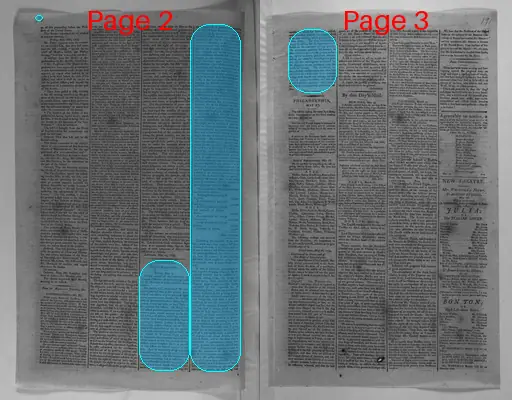
Gazette Of The United States & Evening Advertiser
Philadelphia, Philadelphia County, Pennsylvania
What is this article about?
On May 9, in the House of Representatives, Mr. Smith of South Carolina opposed striking out stamp duties, emphasizing the need for additional revenues to cover a deficit of over 1.4 million dollars due to increased appropriations for military preparations, fortifications, and foreign intercourse, amid concerns of potential war.
Merged-components note: Clear textual continuation of House of Representatives discussion on revenue and appropriations; ends with '(To be continued.)' and next component picks up seamlessly.
Clippings
1 of 2
OCR Quality
Full Text
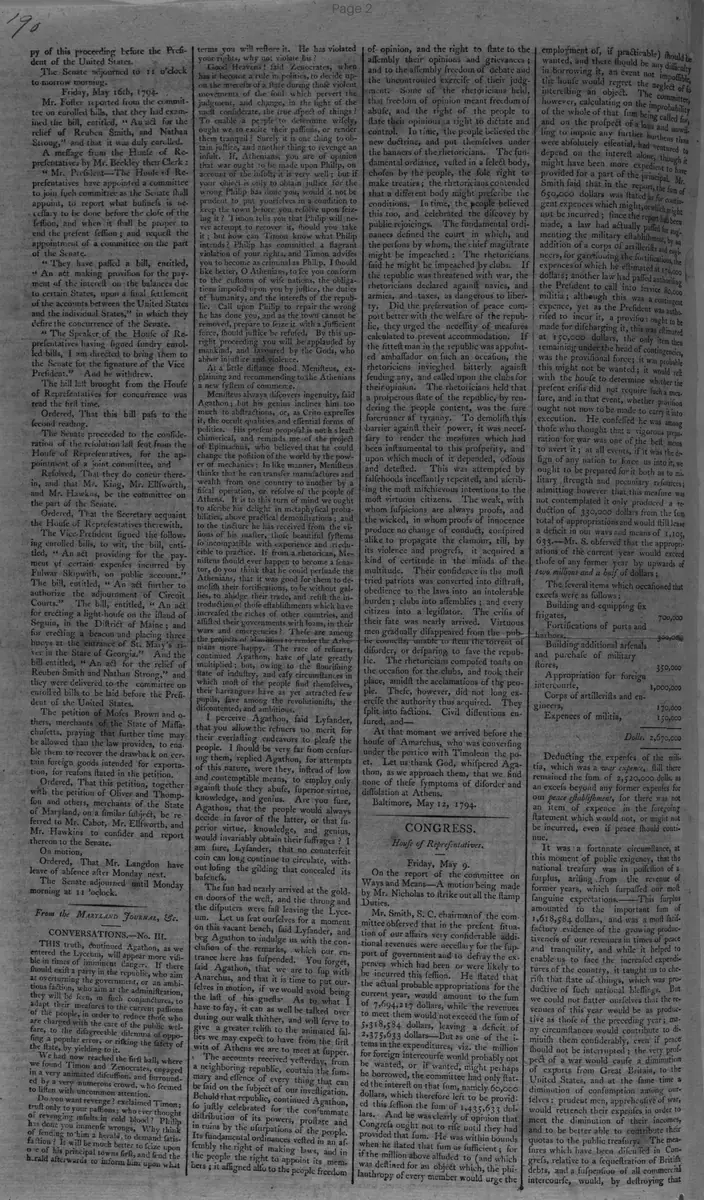
House of Representatives.
Friday, May 9.
On the report of the committee on Ways and Means—A motion being made by Mr. Nicholas to strike out all the stamp Duties.
Mr. Smith, S. C. chairman of the committee observed that in the present situation of our affairs very considerable additional revenues were necessary for the support of government and to defray the expenses which had been or were likely to be incurred this session. He stated that the actual probable appropriations for the current year, would amount to the sum of 7,694,217 dollars, while the revenues to meet them would not exceed the sum of 5,318,584 dollars, leaving a deficit of 2,375,633 dollars—But as one of the items in the expenditures, viz. the million for foreign intercourse would probably not be wanted, or if wanted, might perhaps be borrowed, the committee had only stated the interest on that Sum, namely 60,000 dollars, which therefore left to be provided this session the sum of 1,435,633 dollars. And he was clearly of opinion that Congress ought not to rise until they had provided that sum. He was within bounds when he stated that sum as sufficient; for if the million above alluded to (and which was destined for an object which, the philanthropy of every member would urge the employment of, if practicable) should be wanted, and there should be any difficulty in borrowing it, an event not impossible, the house would regret the neglect of so interesting an object.
The committee however, calculating on the improbability of the whole of that sum being called for, and on the prospect of a loan and unwilling to impose any further burthens than were absolutely essential, had ventured to depend on the interest alone, though it might have been more expedient to have provided for a part of the principal. Mr. Smith said that in the report, the sum of 650,000 dollars was stated as for contingent expenses which might, or which might not be incurred; since the report had been made, a law had actually passed for augmenting the military establishment, by a addition of a corps of artillerists and engineers, for garrisoning the fortifications, the expenses of which he estimated at 170,000 dollars; another law had passed authorizing the President to call into service 80,000 militia; although this was a contingent expense, yet as the President was authorized to incur it, a provision ought to be made for discharging it, this was estimated at 150,000 dollars, the only item then remaining under the head of contingencies, was the provisional force; it was probable this might not be wanted; it would rest with the house to determine whether the present crisis did not require such a measure, and in that event, whether provision ought not now to be made to carry it into execution. He confessed he was among those who thought that a vigorous preparation for war was one of the best means to avert it; at all events, if it was the design of any nation to force us into it, we ought to be prepared for it both as to military strength and pecuniary resources; admitting however that this measure was not contemplated it only produced a reduction of 330,000 dollars from the sum total of appropriations and would still leave a deficit in our ways and means of 1,105,633.—Mr. S. observed that the appropriations of the current year would exceed those of any former year by upwards of two millions and a half of dollars;
The several items which occasioned that excess were as follows:
Building and equipping six frigates, 700,000
Fortifications of ports and harbors, 300,000
Building additional arsenals and purchase of military stores, 350,000
Appropriation for foreign intercourse, 1,000,000
Corps of artillerists and engineers, 170,000
Expenses of militia, 150,000
Dolls. 2,670,000
Deducting the expenses of the militia, which was a war expense, still there remained the sum of 2,520,000 dolls. as an excess beyond any former expenses for our peace establishment, for there was not an item of expense in the foregoing statement which would not, or might not be incurred, even if peace should continue.
It was a fortunate circumstance, at this moment of public exigency, that the national treasury was in possession of a surplus, arising from the revenue of former years, which surpassed our most sanguine expectations. This surplus amounted to the important sum of 1,618,584 dollars, and was a most satisfactory evidence of the growing productiveness of our revenues in times of peace and tranquility, and while it helped to enable us to face the increased expenditures of the country, it taught us to cherish that state of things, which was productive of such national blessings. But we could not flatter ourselves that the revenues of this year would be as productive as those of the preceding year; many circumstances would contribute to diminish them considerably, even if peace should not be interrupted; the very prospect of a war would cause a diminution of exports from Great Britain, to the United States, and at the same time a diminution of consumption among ourselves: prudent men, apprehensive of war, would retrench their expenses in order to meet the diminution of their incomes, and to be better able to contribute their quotas to the public treasury. The measures which have been discussed in Congress, relative to a sequestration of British debts, and a suspension of all commercial intercourse, would, by destroying that
confidence which has heretofore existed.
Unquestionably diminish our importations from that country, which principally furnishes them. To these circumstances might be added, the derangements occasioned to the commerce of this port by the unfortunate epidemic last summer, to that of all the ports by the present embargo, by the extensive depredations committed on our vessels by the belligerent powers, and the interruption occasioned by the Algerines to our commerce with the south of Europe. The committee, taking all these considerations into view had calculated on a defalcation in the revenue arising from impost and tonnage for this year, of 1,300,000 dollars, and had estimated it at only 3,300,000 dollars whereas, that of 1793 produced 4,600,000 dollars.
(To be continued.)
What sub-type of article is it?
What keywords are associated?
What entities or persons were involved?
Domestic News Details
Event Date
Friday, May 9.
Key Persons
Outcome
debate on motion to strike out stamp duties; highlighted deficit of 1,435,633 dollars needing provision; increased appropriations totaling over 2.5 million dollars for military and defense items.
Event Details
Mr. Smith, chairman of the Ways and Means committee, argued for additional revenues due to rising expenditures on military establishments, fortifications, frigates, and foreign intercourse, amid potential war risks and revenue shortfalls from various factors including embargoes and epidemics.