Thank you for visiting SNEWPapers!
Sign up free
Story
October 10, 1908
The San Juan Islander
Friday Harbor, San Juan County, Washington
What is this article about?
Article contrasts the modern cowboy's mundane, hardworking life with romanticized Wild West stereotypes, highlighting changes due to railroads, stock companies, and regulations, while emphasizing retained horsemanship skills on Southwestern ranges.
Clipping
OCR Quality
100%
Excellent
Full Text
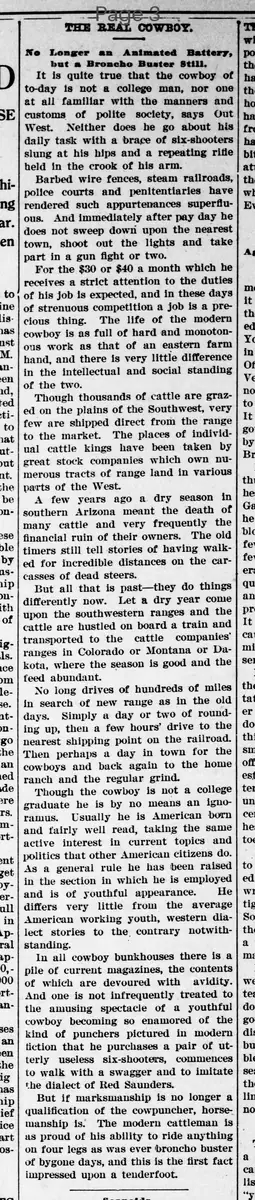
THE REAL COWBOY
No Longer an Animated Battery but a Broncho Buster Still,
It is quite true that the cowboy of to-day is not a college man, nor one at all familiar with the manners and customs of polite society, says Out West. Neither does he go about his daily task with a brace of six-shooters slung at his hips and a repeating rifle held in the crook of his arm.
Barbed wire fences, steam railroads, police courts and penitentiaries have rendered such appurtenances superfluous. And immediately after pay day he does not sweep down upon the nearest town, shoot out the lights and take part in a gun fight or two.
For the $30 or $40 a month which he receives a strict attention to the duties of his job is expected, and in these days of strenuous competition a job is a precious thing. The life of the modern cowboy is as full of hard and monotonous work as that of an eastern farm hand, and there is very little difference in the intellectual and social standing of the two.
Though thousands of cattle are grazed on the plains of the Southwest, very few are shipped direct from the range to the market. The places of individual cattle kings have been taken by great stock companies which own numerous tracts of range land in various parts of the West.
A few years ago a dry season in southern Arizona meant the death of many cattle and very frequently the financial ruin of their owners. The old timers still tell stories of having walked for incredible distances on the carcasses of dead steers.
But all that is past; they do things differently now. Let a dry year come upon the southwestern ranges and the cattle are hustled on board a train and transported to the cattle companies' ranges in Colorado or Montana or Dakota, where the season is good and the feed abundant.
No long drives of hundreds of miles in search of new range as in the old days. Simply a day or two of rounding up, then a few hours' drive to the nearest shipping point on the railroad. Then perhaps a day in town for the cowboys and back again to the home ranch and the regular grind.
Though the cowboy is not a college graduate he is by no means an ignoramus. Usually he is American born and fairly well read, taking the same active interest in current topics and politics that other American citizens do.
As a general rule he has been raised in the section in which he is employed and is of youthful appearance. He differs very little from the average American working youth, western dialect stories to the contrary notwithstanding.
In all cowboy bunkhouses there is a pile of current magazines, the contents of which are devoured with avidity. And one is not infrequently treated to the amusing spectacle of a youthful cowboy becoming so enamored of the kind of punchers pictured in modern fiction that he purchases a pair of utterly useless six-shooters, commences to walk with a swagger and to imitate the dialect of Red Saunders.
But if marksmanship is no longer a qualification of the cowpuncher, horsemanship is. The modern cattleman is as proud of his ability to ride anything on four legs as was ever broncho buster of bygone days, and this is the first fact impressed upon a tenderfoot.
No Longer an Animated Battery but a Broncho Buster Still,
It is quite true that the cowboy of to-day is not a college man, nor one at all familiar with the manners and customs of polite society, says Out West. Neither does he go about his daily task with a brace of six-shooters slung at his hips and a repeating rifle held in the crook of his arm.
Barbed wire fences, steam railroads, police courts and penitentiaries have rendered such appurtenances superfluous. And immediately after pay day he does not sweep down upon the nearest town, shoot out the lights and take part in a gun fight or two.
For the $30 or $40 a month which he receives a strict attention to the duties of his job is expected, and in these days of strenuous competition a job is a precious thing. The life of the modern cowboy is as full of hard and monotonous work as that of an eastern farm hand, and there is very little difference in the intellectual and social standing of the two.
Though thousands of cattle are grazed on the plains of the Southwest, very few are shipped direct from the range to the market. The places of individual cattle kings have been taken by great stock companies which own numerous tracts of range land in various parts of the West.
A few years ago a dry season in southern Arizona meant the death of many cattle and very frequently the financial ruin of their owners. The old timers still tell stories of having walked for incredible distances on the carcasses of dead steers.
But all that is past; they do things differently now. Let a dry year come upon the southwestern ranges and the cattle are hustled on board a train and transported to the cattle companies' ranges in Colorado or Montana or Dakota, where the season is good and the feed abundant.
No long drives of hundreds of miles in search of new range as in the old days. Simply a day or two of rounding up, then a few hours' drive to the nearest shipping point on the railroad. Then perhaps a day in town for the cowboys and back again to the home ranch and the regular grind.
Though the cowboy is not a college graduate he is by no means an ignoramus. Usually he is American born and fairly well read, taking the same active interest in current topics and politics that other American citizens do.
As a general rule he has been raised in the section in which he is employed and is of youthful appearance. He differs very little from the average American working youth, western dialect stories to the contrary notwithstanding.
In all cowboy bunkhouses there is a pile of current magazines, the contents of which are devoured with avidity. And one is not infrequently treated to the amusing spectacle of a youthful cowboy becoming so enamored of the kind of punchers pictured in modern fiction that he purchases a pair of utterly useless six-shooters, commences to walk with a swagger and to imitate the dialect of Red Saunders.
But if marksmanship is no longer a qualification of the cowpuncher, horsemanship is. The modern cattleman is as proud of his ability to ride anything on four legs as was ever broncho buster of bygone days, and this is the first fact impressed upon a tenderfoot.
What sub-type of article is it?
Biography
Historical Event
What themes does it cover?
Social Manners
Fortune Reversal
What keywords are associated?
Modern Cowboy
Cowboy Life
Wild West Myth
Cattle Ranching
Horsemanship
Stock Companies
Southwestern Ranges
Where did it happen?
Plains Of The Southwest
Story Details
Location
Plains Of The Southwest
Event Date
To Day
Story Details
The modern cowboy leads a life of hard, monotonous work similar to an eastern farm hand, without the romantic elements of guns and gunfights, due to modernization like railroads and stock companies; old challenges like dry seasons are managed by transporting cattle, and cowboys remain skilled horsemen while being well-read Americans.