Thank you for visiting SNEWPapers!
Sign up free
Editorial
April 28, 1838
New Hampshire Statesman And State Journal
Concord, Merrimack County, New Hampshire
What is this article about?
This editorial passionately advocates for establishing a public asylum for the insane in New Hampshire, decrying the cruel treatment of the approximately 350 insane individuals, many confined inhumanely. It emphasizes insanity as a curable disease, cites successes in other states, and calls for private subscriptions of $10-12,000 supplemented by state aid to fund the $25,000 needed, with an association formed to lead the effort.
Clipping
OCR Quality
95%
Excellent
Full Text
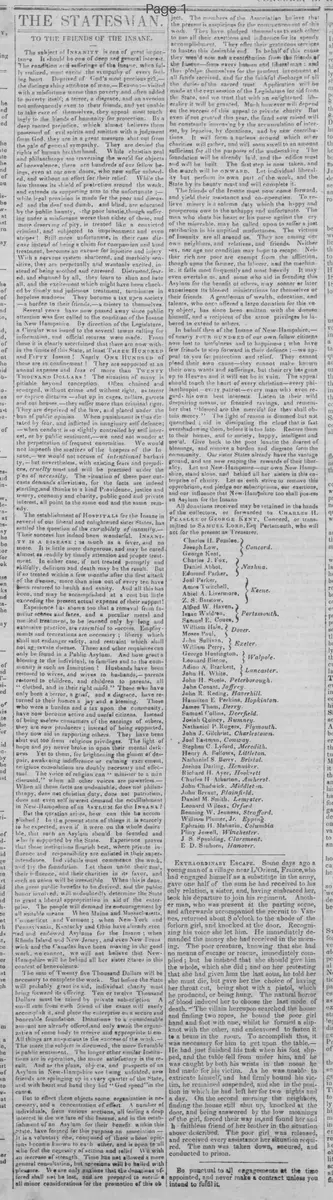
THE STATESMAN.
TO THE FRIENDS OF THE INSANE.
The subject of Insanity is one of great importance. It should be one of deep and general interest. The condition and sufferings of the insane, when fully realized, must excite the sympathy of every feeling heart. Deprived of God's most precious gift,—the distinguishing attribute of man,—Reason; visited with a misfortune worse than poverty, and often added to poverty itself; a terror, a disgrace, and an aversion not unfrequently even to their friends, and yet unable to take care of themselves, they appeal most touchingly to the friends of humanity for protection. By a deep rooted prejudice, which almost believes them possessed of evil spirits and smitten with a judgment from God, they are in a great measure shut out from the pale of general sympathy. They are denied the rights of human brotherhood. While christian zeal and philanthropy are traversing the world for objects of benevolence, there are hundreds of our fellow beings, even at our own doors, who now suffer unheeded and without an effort for their relief. While the law throws its shield of protection around the weak, and extends its supporting arm to the unfortunate;—while legal provision is made for the poor and diseased and the deaf and dumb, and blind, are educated by the public bounty,—the poor lunatic, though suffering under a misfortune worse than either of these, and more deserving of pity, is treated like a convicted criminal, and subjected to imprisonment and even stripes! Still more unfortunate, in their case disease instead of being a claim for compassion and kind treatment, becomes an excuse for injustice and injury. With a nervous system shattered, and morbidly sensitive, they are perpetually and wantonly excited, instead of being soothed and caressed. Distrusted, feared, and shunned by all, they learn to shun and hate all, and the excitement which might have been checked by timely and judicious treatment, terminates in hopeless madness. They become a tax upon society—a burden to their friends—a misery to themselves.
Several years have now passed away since public attention was first called to the condition of the Insane in New Hampshire. By direction of the Legislature, a circular was issued to the several towns calling for information, and official returns were made. From these it is clearly ascertained that there are now within the limits of this State, at least THREE HUNDRED and FIFTY Insane! Nearly ONE HUNDRED of these are in confinement! They are supported at an annual expense and loss of more than TWENTY THOUSAND DOLLARS! The situation of many is pitiable beyond conception. Often chained and scourged, without crime and without right, as terror or caprice dictates—shut up in cages, cellars, garrets and out houses—they suffer more than criminal rigor. They are deprived of the law, and placed under the ban of public opinion. When punishment is thus dictated by fear, and inflicted in imaginary self defence;—when conduct is so slightly controlled by self interest, or by public sentiment,—we need not wonder at the perpetration of frequent enormities. We would not impeach the motives of the keepers of the Insane,—we would not accuse of intentional barbarity,—but nevertheless, with existing fears and prejudices, cruelty must and will be practised under the plea of necessity. The situation of these poor outcasts demands alleviation, for the facts are indeed startling, and thanks to a kind Providence, justice and mercy, economy and charity, public good and private interest, all point to the same end and the same remedy.
The establishment of HOSPITALS for the Insane in several of our liberal and enlightened sister States, has settled the question of the curability of insanity.—Their success has indeed been wonderful. INSANITY Is A DISEASE; as much as a fever, and no more. It is little more dangerous, and may be cured almost as readily by timely attention and proper treatment. In either case, if not treated promptly and skilfully, delirium and death may be the result. But if so treated within a few months after the first attack of the disease, more than nine out of every ten have been restored to health and sanity. And all this has been, and may be accomplished at a cost but little exceeding the present actual expense of their support! Experience has shown too that a removal from familiar scenes and faces, and a peculiar moral and medical treatment, to be learned only by long and extensive practice, are essential to success. Employments and recreations are necessary; liberty which shall not endanger safety, and restraint which shall not aggravate disease. These and other requisites can only be found in a Public Asylum. And how great a blessing to the individual, to families and to the community is such an Institution! Husbands have been restored to wives, and wives to husbands,—parents restored to children, and children to parents, all "clothed, and in their right mind." Those who have only been a terror, a grief, and a disgrace, have returned to their homes a joy and a blessing. Those who were a burden and a tax upon the community, have now become active and useful citizens. Instead of being useless consumers of the earnings of others, they are now producers; instead of being supported, they now aid in supporting others. They have been shut out too from religious privileges. The light of hope and joy never broke in upon their mental darkness. Yet to them, for brightening the gloom of despair, awakening indifference or calming excitement, religious consolations are doubly necessary and effectual. The voice of religion can "minister to a mind diseased," when all other voices are powerless—
When all these facts are undeniable, does not philanthropy, does not christian duty, does not patriotism, does not even self interest demand the establishment in New-Hampshire of an ASYLUM for the INSANE?
But the question arises, how can this be accomplished? In the present state of things it is scarcely to be expected, even if it were on the whole desirable, that such an Asylum should be founded and wholly supported by the State. Experience proves that those institutions flourish best, where private influence and responsibility are enlisted in their superintendence. Individuals must commence the work, and lay the foundation. Let them unite their zeal, their influence, and their charities in its favor, and such an union will be irresistible. When this is done, the great public benefits to be derived, and the public honor involved, will undoubtedly determine the State to grant a liberal appropriation in aid of the enterprise. The people will demand its encouragement by all suitable means. When Maine and Massachusetts, Connecticut and Vermont; when New York and Pennsylvania, Kentucky and Ohio have already erected and endowed Asylums for the Insane; when Rhode Island and New-Jersey, and even New Brunswick and the Canadas have been moving in the good work, we cannot, we will not believe that New-Hampshire will be behind all her sister States in this contest of benevolence.
The sum of Twenty five Thousand Dollars will be necessary to complete the work. But before the State will probably grant its aid, individual charity must bring forward its offering. Ten or twelve Thousand Dollars must be raised by private subscription. A small sum from each friend of the cause will easily accomplish it, and place the enterprise on a secure and honorable foundation. Donations to a considerable amount are already offered, and only await the organization of some body to receive and appropriate them. All things are auspicious to the success of the work.—The more the subject is discussed, the more favorable is public sentiment. The longer other similar Institutions are in operation, the more satisfactory is the result. And as the plans, objects, and prospects of an Asylum in New-Hampshire are being unfolded, new friends are springing up in every quarter of the State, and with heart and hand they bid "God speed" in the cause.
But to effect these objects some organization is necessary, and a concentration of effort. A number of individuals, from various sections, all feeling a deep interest in the welfare of the Insane, and in the establishment of an Asylum for their benefit within this State, have formed for this purpose an association—It is a voluntary one, composed of those whose opinions become known to each other, and is open to all who feel the necessity of action and relief. We wish an increase of strength. Time has not allowed a more general consultation, but accessions will be hailed with pleasure. We are only anxious that the donations offered shall not be lost, and are prepared to sacrifice all minor considerations for the promotion of this object. The members of the Association believe that the present is auspicious for the commencement of this work. They have pledged themselves to each other to use all their exertions and influence for its speedy accomplishment. They offer their gratuitous services to hasten this desirable end. In behalf of this cause they would now ask a contribution from the friends of the Insane—from every humane and liberal man: and they pledge themselves for the prudent investment of all funds received, and for the faithful discharge of all the duties of the sacred trust. Application will be made at the next session of the Legislature for aid from the State, and we trust that with an enlightened liberality it will be granted. Much however will depend on the success of this appeal to private charity. But even if not granted this year, the fund now raised will be constantly increasing by the accumulation of interest, by legacies, by donations, and by new contributions. It will form a nucleus around which other charities will gather, and will soon swell to an amount sufficient for all the purposes of the undertaking. The foundation will be already laid, and the edifice must and will be built. The first step is now taken, and the march will be onward. Let individual liberality but perform its own part of the work, and the State by its bounty must and will complete it.
The friends of the Insane must now come forward, and yield their assistance and co-operation. To relieve misery is a solemn duty which the happy and prosperous owe to the unhappy and unfortunate. The man who shuts his heart or his purse against the cry of the miserable, may be called upon to suffer a just retribution in his unpitied misfortunes. The victims of Insanity are all around us. They are among our own neighbors, and relatives, and friends. Neither sex, nor age nor condition may hope to escape. Neither rich nor poor are exempt from the affliction, though upon the farmer, the laborer, and the mechanic, it falls most frequently and most heavily. It may even overtake us, and some who aid in founding this Asylum for the benefit of others, may sooner or later experience its blessed ministrations for themselves or their friends. A gentleman of wealth, education, and talents, who once offered a large donation for this very object, has since been smitten with the disease himself, and a recipient of the same privileges he labored to extend to others.
In behalf then of the Insane of New-Hampshire,—of nearly FOUR HUNDRED of our own fellow citizens now lost to usefulness and to happiness; who have few friends to step forward in their defence;—we appeal to you for protection and relief. They cannot plead their own cause—they cannot make known their own wants and sufferings, but their cry has gone up to Heaven and it will not be in vain. The appeal should touch the heart of every christian—every philanthropist—every patriot—every man who even regards his own best interests. Listen to their wild despairing moans, or frenzied ravings, and remember that "blessed are the merciful for they shall obtain mercy." The light of reason is dimmed but not quenched; aid in dissipating the cloud that is fast overshadowing them, before it is too late. Restore them to their homes, and to society, happy, intelligent and useful. Give back to the poor lunatic the dearest of blessings, and remove a burden and disgrace from the community. Our sister States already have the vantage ground, and are now reaping the rewards of their liberality. Let not New-Hampshire—our own New Hampshire, stand alone, and behind all her sisters in this enterprise of charity. Let us each strive to remove this opprobrium, and pledge our subscriptions, our exertions, and our influence that New-Hampshire too shall possess an Asylum for the Insane.
All donations received may be retained in the hands of the collectors, or forwarded to CHARLES H. PEASLEE or George KENT, Concord, or transmitted to Samuel Lord, Esq. Portsmouth, who will act for the present as Treasurer.
Charles H. Peaslee,
Joseph Low,
Concord.
George Kent,
Charles J. Fox,
Daniel Abbot.
Nashua.
Edmund Parker,
Joel Parker,
Amos Twitchell.
Abiel A. Livermore,
Keene.
Z. S. Barstow,
Alfred W. Haven,
Isaac Waldron,
Portsmouth.
Samuel E. Coues,
William Hale,
Dover.
Moses Paul,
John Sullivan,
Exeter.
William Perry,
George Huntington,
Walpole.
Leonard Biscoe,
Adino N. Brackett,
Lancaster.
John H. White,
John H. Steele, Peterborough.
John Conant, Jaffrey
John R. Reding, Haverhill.
Hamilton E. Perkins, Hopkinton.
James Thom, Derry.
Samuel Collins, Deerfield.
Josiah Quincy, Rumney.
Nathaniel P. Rogers, Plymouth.
John J. Gilchrist, Charlestown.
Joel Eastman, Conway.
Stephen C. Lyford, Meredith.
Henry A. Bellows, Littleton.
Nathaniel S. Berry, Bristol.
Joshua Darling, Henniker.
Richard H. Ayer, Hooksett
Charles H. Atherton, Amherst.
John Chadwick, Middleton.
John Bryant, Plainfield,
Daniel M. Smith, Leominster.
Leonard Wilcox, Orford
Benning W. Jenness, Strafford.
William Plumer, Jr. Epping
Ephraim H. Mahurin, Columbia
Pliny Jewell, Winchester.
J. S. Spaulding, Claremont.
E. D. Sanborn, Hanover.
TO THE FRIENDS OF THE INSANE.
The subject of Insanity is one of great importance. It should be one of deep and general interest. The condition and sufferings of the insane, when fully realized, must excite the sympathy of every feeling heart. Deprived of God's most precious gift,—the distinguishing attribute of man,—Reason; visited with a misfortune worse than poverty, and often added to poverty itself; a terror, a disgrace, and an aversion not unfrequently even to their friends, and yet unable to take care of themselves, they appeal most touchingly to the friends of humanity for protection. By a deep rooted prejudice, which almost believes them possessed of evil spirits and smitten with a judgment from God, they are in a great measure shut out from the pale of general sympathy. They are denied the rights of human brotherhood. While christian zeal and philanthropy are traversing the world for objects of benevolence, there are hundreds of our fellow beings, even at our own doors, who now suffer unheeded and without an effort for their relief. While the law throws its shield of protection around the weak, and extends its supporting arm to the unfortunate;—while legal provision is made for the poor and diseased and the deaf and dumb, and blind, are educated by the public bounty,—the poor lunatic, though suffering under a misfortune worse than either of these, and more deserving of pity, is treated like a convicted criminal, and subjected to imprisonment and even stripes! Still more unfortunate, in their case disease instead of being a claim for compassion and kind treatment, becomes an excuse for injustice and injury. With a nervous system shattered, and morbidly sensitive, they are perpetually and wantonly excited, instead of being soothed and caressed. Distrusted, feared, and shunned by all, they learn to shun and hate all, and the excitement which might have been checked by timely and judicious treatment, terminates in hopeless madness. They become a tax upon society—a burden to their friends—a misery to themselves.
Several years have now passed away since public attention was first called to the condition of the Insane in New Hampshire. By direction of the Legislature, a circular was issued to the several towns calling for information, and official returns were made. From these it is clearly ascertained that there are now within the limits of this State, at least THREE HUNDRED and FIFTY Insane! Nearly ONE HUNDRED of these are in confinement! They are supported at an annual expense and loss of more than TWENTY THOUSAND DOLLARS! The situation of many is pitiable beyond conception. Often chained and scourged, without crime and without right, as terror or caprice dictates—shut up in cages, cellars, garrets and out houses—they suffer more than criminal rigor. They are deprived of the law, and placed under the ban of public opinion. When punishment is thus dictated by fear, and inflicted in imaginary self defence;—when conduct is so slightly controlled by self interest, or by public sentiment,—we need not wonder at the perpetration of frequent enormities. We would not impeach the motives of the keepers of the Insane,—we would not accuse of intentional barbarity,—but nevertheless, with existing fears and prejudices, cruelty must and will be practised under the plea of necessity. The situation of these poor outcasts demands alleviation, for the facts are indeed startling, and thanks to a kind Providence, justice and mercy, economy and charity, public good and private interest, all point to the same end and the same remedy.
The establishment of HOSPITALS for the Insane in several of our liberal and enlightened sister States, has settled the question of the curability of insanity.—Their success has indeed been wonderful. INSANITY Is A DISEASE; as much as a fever, and no more. It is little more dangerous, and may be cured almost as readily by timely attention and proper treatment. In either case, if not treated promptly and skilfully, delirium and death may be the result. But if so treated within a few months after the first attack of the disease, more than nine out of every ten have been restored to health and sanity. And all this has been, and may be accomplished at a cost but little exceeding the present actual expense of their support! Experience has shown too that a removal from familiar scenes and faces, and a peculiar moral and medical treatment, to be learned only by long and extensive practice, are essential to success. Employments and recreations are necessary; liberty which shall not endanger safety, and restraint which shall not aggravate disease. These and other requisites can only be found in a Public Asylum. And how great a blessing to the individual, to families and to the community is such an Institution! Husbands have been restored to wives, and wives to husbands,—parents restored to children, and children to parents, all "clothed, and in their right mind." Those who have only been a terror, a grief, and a disgrace, have returned to their homes a joy and a blessing. Those who were a burden and a tax upon the community, have now become active and useful citizens. Instead of being useless consumers of the earnings of others, they are now producers; instead of being supported, they now aid in supporting others. They have been shut out too from religious privileges. The light of hope and joy never broke in upon their mental darkness. Yet to them, for brightening the gloom of despair, awakening indifference or calming excitement, religious consolations are doubly necessary and effectual. The voice of religion can "minister to a mind diseased," when all other voices are powerless—
When all these facts are undeniable, does not philanthropy, does not christian duty, does not patriotism, does not even self interest demand the establishment in New-Hampshire of an ASYLUM for the INSANE?
But the question arises, how can this be accomplished? In the present state of things it is scarcely to be expected, even if it were on the whole desirable, that such an Asylum should be founded and wholly supported by the State. Experience proves that those institutions flourish best, where private influence and responsibility are enlisted in their superintendence. Individuals must commence the work, and lay the foundation. Let them unite their zeal, their influence, and their charities in its favor, and such an union will be irresistible. When this is done, the great public benefits to be derived, and the public honor involved, will undoubtedly determine the State to grant a liberal appropriation in aid of the enterprise. The people will demand its encouragement by all suitable means. When Maine and Massachusetts, Connecticut and Vermont; when New York and Pennsylvania, Kentucky and Ohio have already erected and endowed Asylums for the Insane; when Rhode Island and New-Jersey, and even New Brunswick and the Canadas have been moving in the good work, we cannot, we will not believe that New-Hampshire will be behind all her sister States in this contest of benevolence.
The sum of Twenty five Thousand Dollars will be necessary to complete the work. But before the State will probably grant its aid, individual charity must bring forward its offering. Ten or twelve Thousand Dollars must be raised by private subscription. A small sum from each friend of the cause will easily accomplish it, and place the enterprise on a secure and honorable foundation. Donations to a considerable amount are already offered, and only await the organization of some body to receive and appropriate them. All things are auspicious to the success of the work.—The more the subject is discussed, the more favorable is public sentiment. The longer other similar Institutions are in operation, the more satisfactory is the result. And as the plans, objects, and prospects of an Asylum in New-Hampshire are being unfolded, new friends are springing up in every quarter of the State, and with heart and hand they bid "God speed" in the cause.
But to effect these objects some organization is necessary, and a concentration of effort. A number of individuals, from various sections, all feeling a deep interest in the welfare of the Insane, and in the establishment of an Asylum for their benefit within this State, have formed for this purpose an association—It is a voluntary one, composed of those whose opinions become known to each other, and is open to all who feel the necessity of action and relief. We wish an increase of strength. Time has not allowed a more general consultation, but accessions will be hailed with pleasure. We are only anxious that the donations offered shall not be lost, and are prepared to sacrifice all minor considerations for the promotion of this object. The members of the Association believe that the present is auspicious for the commencement of this work. They have pledged themselves to each other to use all their exertions and influence for its speedy accomplishment. They offer their gratuitous services to hasten this desirable end. In behalf of this cause they would now ask a contribution from the friends of the Insane—from every humane and liberal man: and they pledge themselves for the prudent investment of all funds received, and for the faithful discharge of all the duties of the sacred trust. Application will be made at the next session of the Legislature for aid from the State, and we trust that with an enlightened liberality it will be granted. Much however will depend on the success of this appeal to private charity. But even if not granted this year, the fund now raised will be constantly increasing by the accumulation of interest, by legacies, by donations, and by new contributions. It will form a nucleus around which other charities will gather, and will soon swell to an amount sufficient for all the purposes of the undertaking. The foundation will be already laid, and the edifice must and will be built. The first step is now taken, and the march will be onward. Let individual liberality but perform its own part of the work, and the State by its bounty must and will complete it.
The friends of the Insane must now come forward, and yield their assistance and co-operation. To relieve misery is a solemn duty which the happy and prosperous owe to the unhappy and unfortunate. The man who shuts his heart or his purse against the cry of the miserable, may be called upon to suffer a just retribution in his unpitied misfortunes. The victims of Insanity are all around us. They are among our own neighbors, and relatives, and friends. Neither sex, nor age nor condition may hope to escape. Neither rich nor poor are exempt from the affliction, though upon the farmer, the laborer, and the mechanic, it falls most frequently and most heavily. It may even overtake us, and some who aid in founding this Asylum for the benefit of others, may sooner or later experience its blessed ministrations for themselves or their friends. A gentleman of wealth, education, and talents, who once offered a large donation for this very object, has since been smitten with the disease himself, and a recipient of the same privileges he labored to extend to others.
In behalf then of the Insane of New-Hampshire,—of nearly FOUR HUNDRED of our own fellow citizens now lost to usefulness and to happiness; who have few friends to step forward in their defence;—we appeal to you for protection and relief. They cannot plead their own cause—they cannot make known their own wants and sufferings, but their cry has gone up to Heaven and it will not be in vain. The appeal should touch the heart of every christian—every philanthropist—every patriot—every man who even regards his own best interests. Listen to their wild despairing moans, or frenzied ravings, and remember that "blessed are the merciful for they shall obtain mercy." The light of reason is dimmed but not quenched; aid in dissipating the cloud that is fast overshadowing them, before it is too late. Restore them to their homes, and to society, happy, intelligent and useful. Give back to the poor lunatic the dearest of blessings, and remove a burden and disgrace from the community. Our sister States already have the vantage ground, and are now reaping the rewards of their liberality. Let not New-Hampshire—our own New Hampshire, stand alone, and behind all her sisters in this enterprise of charity. Let us each strive to remove this opprobrium, and pledge our subscriptions, our exertions, and our influence that New-Hampshire too shall possess an Asylum for the Insane.
All donations received may be retained in the hands of the collectors, or forwarded to CHARLES H. PEASLEE or George KENT, Concord, or transmitted to Samuel Lord, Esq. Portsmouth, who will act for the present as Treasurer.
Charles H. Peaslee,
Joseph Low,
Concord.
George Kent,
Charles J. Fox,
Daniel Abbot.
Nashua.
Edmund Parker,
Joel Parker,
Amos Twitchell.
Abiel A. Livermore,
Keene.
Z. S. Barstow,
Alfred W. Haven,
Isaac Waldron,
Portsmouth.
Samuel E. Coues,
William Hale,
Dover.
Moses Paul,
John Sullivan,
Exeter.
William Perry,
George Huntington,
Walpole.
Leonard Biscoe,
Adino N. Brackett,
Lancaster.
John H. White,
John H. Steele, Peterborough.
John Conant, Jaffrey
John R. Reding, Haverhill.
Hamilton E. Perkins, Hopkinton.
James Thom, Derry.
Samuel Collins, Deerfield.
Josiah Quincy, Rumney.
Nathaniel P. Rogers, Plymouth.
John J. Gilchrist, Charlestown.
Joel Eastman, Conway.
Stephen C. Lyford, Meredith.
Henry A. Bellows, Littleton.
Nathaniel S. Berry, Bristol.
Joshua Darling, Henniker.
Richard H. Ayer, Hooksett
Charles H. Atherton, Amherst.
John Chadwick, Middleton.
John Bryant, Plainfield,
Daniel M. Smith, Leominster.
Leonard Wilcox, Orford
Benning W. Jenness, Strafford.
William Plumer, Jr. Epping
Ephraim H. Mahurin, Columbia
Pliny Jewell, Winchester.
J. S. Spaulding, Claremont.
E. D. Sanborn, Hanover.
What sub-type of article is it?
Social Reform
Moral Or Religious
Science Or Medicine
What keywords are associated?
Insane Asylum
Mental Health Reform
New Hampshire
Humane Treatment
Curability Of Insanity
Private Charity
State Funding
Philanthropy
What entities or persons were involved?
New Hampshire Legislature
Association For The Insane Asylum
Charles H. Peaslee
George Kent
Samuel Lord
Sister States (Maine, Massachusetts, Etc.)
Editorial Details
Primary Topic
Establishment Of An Asylum For The Insane In New Hampshire
Stance / Tone
Strong Advocacy For Humane Treatment And Institutional Reform
Key Figures
New Hampshire Legislature
Association For The Insane Asylum
Charles H. Peaslee
George Kent
Samuel Lord
Sister States (Maine, Massachusetts, Etc.)
Key Arguments
Insanity Is A Curable Disease Like Fever, Treatable With Timely Medical And Moral Care
Current Treatment In New Hampshire Is Cruel, With 350 Insane, Nearly 100 Confined Inhumanely At $20,000 Annual Cost
Asylums In Other States Restore 9/10 Patients To Sanity At Similar Cost, Benefiting Individuals, Families, And Society
Private Subscriptions Of $10 12,000 Needed To Start, Followed By State Aid For Total $25,000
Philanthropy, Christian Duty, Patriotism, And Self Interest Demand Action
Voluntary Association Formed To Organize Efforts And Receive Donations