Thank you for visiting SNEWPapers!
Sign up free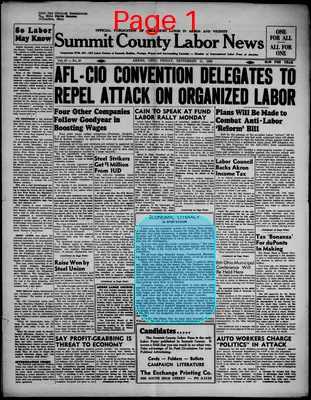
Editorial
September 11, 1959
Summit County Labor News
Akron, Summit County, Ohio
What is this article about?
Ruth Taylor advocates for 'economic literacy' as essential understanding of why America has a high standard of living, high wages, low prices, and global knowledge exchange. She contrasts it with political illiteracy and emphasizes interdependence for prosperity and security.
Clipping
OCR Quality
100%
Excellent
Full Text
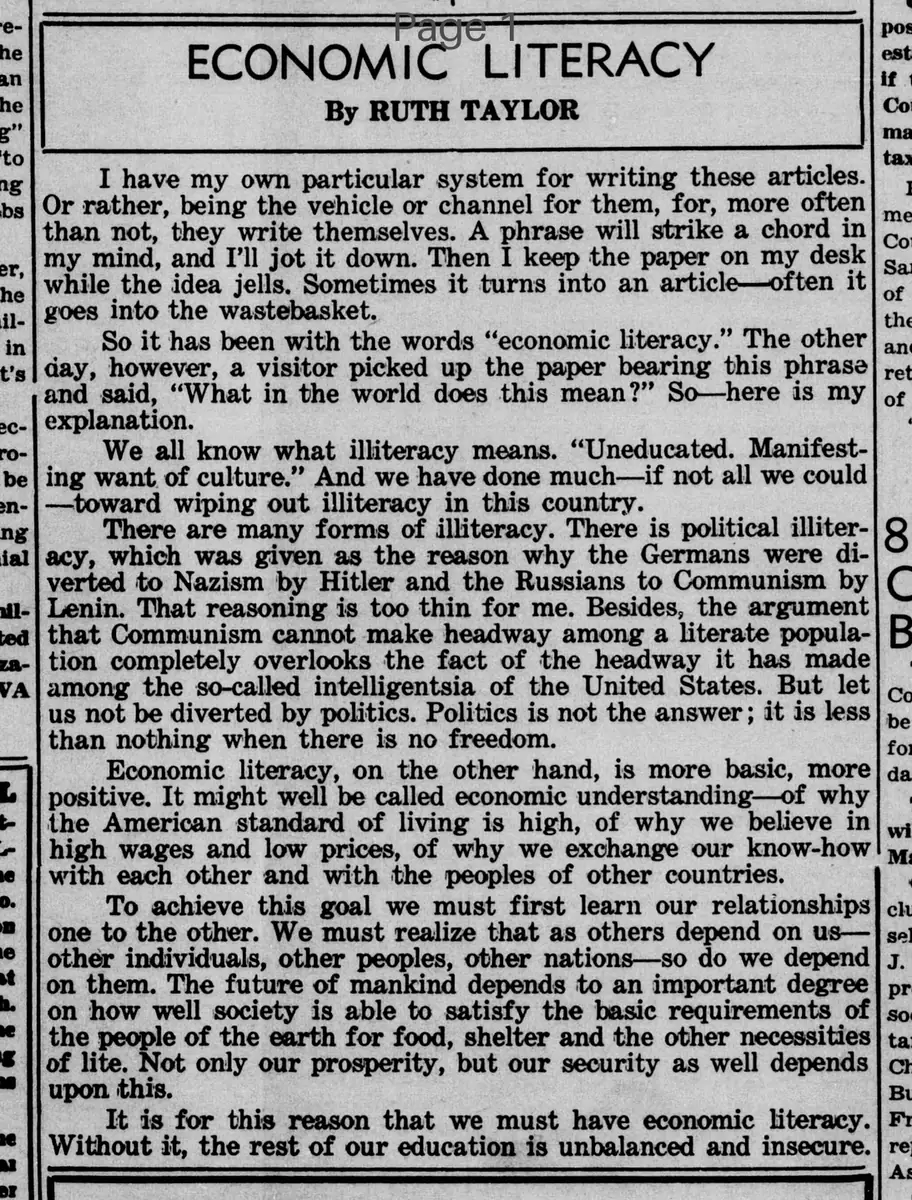
ECONOMIC LITERACY
By RUTH TAYLOR
I have my own particular system for writing these articles. Or rather, being the vehicle or channel for them, for, more often than not, they write themselves. A phrase will strike a chord in my mind, and I'll jot it down. Then I keep the paper on my desk while the idea jells. Sometimes it turns into an article often it goes into the wastebasket.
So it has been with the words "economic literacy." The other day, however, a visitor picked up the paper bearing this phrase and said, "What in the world does this mean?" So here is my explanation.
We all know what illiteracy means. "Uneducated. Manifesting want of culture." And we have done much-if not all we could--toward wiping out illiteracy in this country.
There are many forms of illiteracy. There is political illiteracy, which was given as the reason why the Germans were diverted to Nazism by Hitler and the Russians to Communism by Lenin. That reasoning is too thin for me. Besides, the argument that Communism cannot make headway among a literate population completely overlooks the fact of the headway it has made among the so-called intelligentsia of the United States. But let us not be diverted by politics. Politics is not the answer; it is less than nothing when there is no freedom.
Economic literacy, on the other hand, is more basic, more positive. It might well be called economic understanding--of why the American standard of living is high, of why we believe in high wages and low prices, of why we exchange our know-how with each other and with the peoples of other countries.
To achieve this goal we must first learn our relationships one to the other. We must realize that as others depend on us-- other individuals, other peoples, other nations-so do we depend on them. The future of mankind depends to an important degree on how well society is able to satisfy the basic requirements of the people of the earth for food, shelter and the other necessities of life. Not only our prosperity, but our security as well depends upon this.
It is for this reason that we must have economic literacy. Without it, the rest of our education is unbalanced and insecure.
By RUTH TAYLOR
I have my own particular system for writing these articles. Or rather, being the vehicle or channel for them, for, more often than not, they write themselves. A phrase will strike a chord in my mind, and I'll jot it down. Then I keep the paper on my desk while the idea jells. Sometimes it turns into an article often it goes into the wastebasket.
So it has been with the words "economic literacy." The other day, however, a visitor picked up the paper bearing this phrase and said, "What in the world does this mean?" So here is my explanation.
We all know what illiteracy means. "Uneducated. Manifesting want of culture." And we have done much-if not all we could--toward wiping out illiteracy in this country.
There are many forms of illiteracy. There is political illiteracy, which was given as the reason why the Germans were diverted to Nazism by Hitler and the Russians to Communism by Lenin. That reasoning is too thin for me. Besides, the argument that Communism cannot make headway among a literate population completely overlooks the fact of the headway it has made among the so-called intelligentsia of the United States. But let us not be diverted by politics. Politics is not the answer; it is less than nothing when there is no freedom.
Economic literacy, on the other hand, is more basic, more positive. It might well be called economic understanding--of why the American standard of living is high, of why we believe in high wages and low prices, of why we exchange our know-how with each other and with the peoples of other countries.
To achieve this goal we must first learn our relationships one to the other. We must realize that as others depend on us-- other individuals, other peoples, other nations-so do we depend on them. The future of mankind depends to an important degree on how well society is able to satisfy the basic requirements of the people of the earth for food, shelter and the other necessities of life. Not only our prosperity, but our security as well depends upon this.
It is for this reason that we must have economic literacy. Without it, the rest of our education is unbalanced and insecure.
What sub-type of article is it?
Education
Economic Policy
What keywords are associated?
Economic Literacy
Standard Of Living
High Wages
Low Prices
Interdependence
Education Balance
What entities or persons were involved?
Ruth Taylor
Hitler
Lenin
Editorial Details
Primary Topic
Importance Of Economic Literacy
Stance / Tone
Advocacy For Economic Understanding
Key Figures
Ruth Taylor
Hitler
Lenin
Key Arguments
Economic Literacy Means Understanding High American Standard Of Living, High Wages, Low Prices, And Knowledge Exchange.
Interdependence With Others Is Crucial For Satisfying Basic Needs Like Food And Shelter.
Without Economic Literacy, Education Is Unbalanced And Insecure.
Political Illiteracy Is Insufficient Explanation For Rise Of Nazism Or Communism.
Communism Has Gained Traction Among Literate Us Intelligentsia.