Thank you for visiting SNEWPapers!
Sign up free
The Producers News
Plentywood, Sheridan County, Montana
What is this article about?
The American Newspaper Guild has curbed frequent firings on seven major Hearst newspapers through dismissal bonuses and ongoing negotiations, leading to doubled salaries for some employees and increased membership.
Clipping
OCR Quality
Full Text
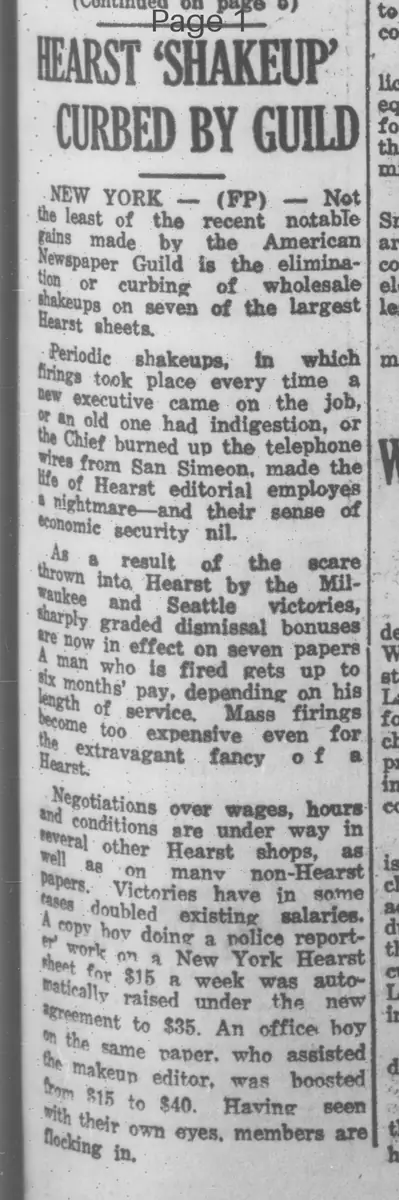
NEW YORK - (FP) - Not the least of the recent notable gains made by the American Newspaper Guild is the elimination or curbing of wholesale shakeups on seven of the largest Hearst sheets.
Periodical shakeups, in which firings took place every time a new executive came on the job, or an old one had indigestion, or the Chief burned up wires from San Simeon, the telephone made the life of Hearst editorial employes a nightmare and their sense of economic security nil.
As a result of the scare thrown into Hearst by the Milwaukee and Seattle victories, sharply graded dismissal bonuses are now in effect on seven papers.
A man who is fired gets six months' pay, depending on his length of service. Mass firings become too expensive even for the extravagant fancy of a Hearst.
Negotiations over wages, hours and conditions are under way in several other Hearst shops, as well as on many non-Hearst papers.
Victories have in some cases doubled salaries. A copy who doing work on a New York Hearst sheat for $15 a week was automatically raised under the new agreement to $35. An office boy who assisted the makeup editor, was boosted from $15 to $40.
Having seen with their own eyes, members are flocking in.
What sub-type of article is it?
What keywords are associated?
What entities or persons were involved?
Where did it happen?
Domestic News Details
Primary Location
New York
Key Persons
Outcome
sharply graded dismissal bonuses in effect on seven papers, with fired employees receiving six months' pay depending on service length; victories doubled some salaries, e.g., copy from $15 to $35 per week, office boy from $15 to $40.
Event Details
The American Newspaper Guild has eliminated or curbed wholesale shakeups on seven largest Hearst newspapers, ending frequent firings due to executive changes or Hearst's directives; this resulted from Milwaukee and Seattle victories, making mass firings expensive; negotiations on wages, hours, and conditions ongoing in other Hearst and non-Hearst papers; members flocking to join after seeing gains.