Thank you for visiting SNEWPapers!
Sign up free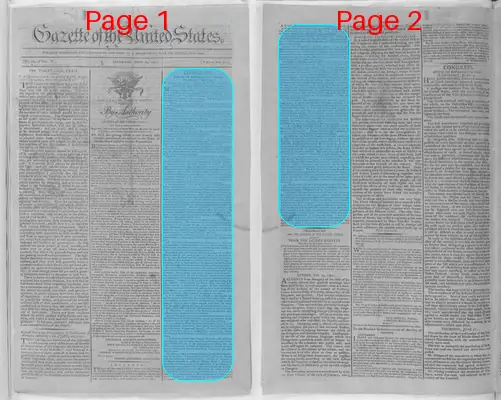
Gazette Of The United States
New York, New York County, New York
What is this article about?
On May 25, in the U.S. House of Representatives, Mr. Sherman advocated for the federal assumption of state debts incurred for the Union's benefit, part of Treasury Secretary Hamilton's funding plan. He outlined arguments for justice and policy, refuting objections on settlements, novelty, and taxation impacts.
Merged-components note: Continuation of congressional debate on assumption of state debts across pages.
Clippings
1 of 2
OCR Quality
Full Text
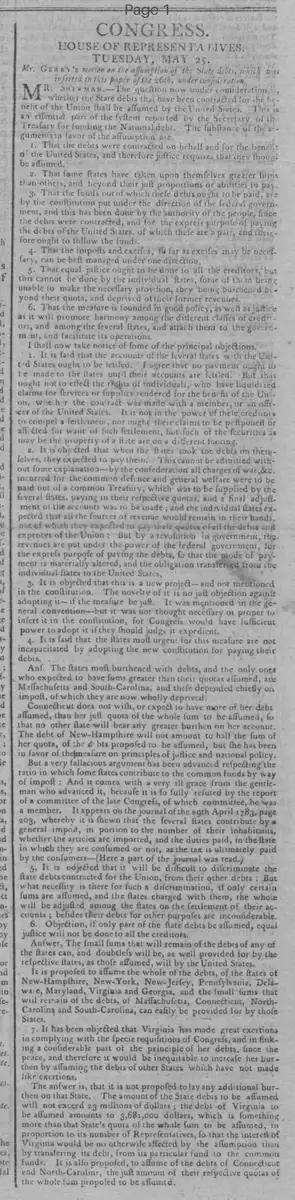
HOUSE OF REPRESENTATIVES.
TUESDAY, MAY 25.
Mr. Gerry's motion on the assumption of the State debts, which was inserted in this paper of the 25th, under consideration.
MR. SHERMAN.—The question now under consideration is, whether the State debts that have been contracted for the benefit of the Union shall be assumed by the United States. This is an essential part of the system reported by the Secretary of the Treasury for funding the National debt. The substance of the arguments in favor of the assumption are
1. That the debts were contracted on behalf of and for the benefit of the United States, and therefore justice requires that they should be assumed.
2. That some states have taken upon themselves greater sums than others, and beyond their just proportions or abilities to pay.
3. That the funds out of which these debts ought to be paid, are by the constitution put under the direction of the federal government, and this has been done by the authority of the people, since the debts were contracted, and for the express purpose of paying the debts of the United States, of which these are a part, and therefore ought to follow the funds.
4. That the imposts and excises, so far as excises may be necessary, can be best managed under one direction,
5. That equal justice ought to be done to all the creditors, but this cannot be done by the individual states, some of them being unable to make the necessary provision, they being burdened beyond their quota, and deprived of their former revenues.
6. That the measure is founded in good policy, as well as justice, as it will promote harmony among the different classes of creditors, and among the several states, and attach them to the government, and facilitate its operations.
I shall now take notice of some of the principal objections.
1. It is said that the accounts of the several states with the United States ought to be settled. I agree that no payment ought to be made to the states until their accounts are settled. But that ought not to affect the rights of individuals, who have liquidated claims for services or supplies rendered for the benefit of the Union, whether the contract was made with a member, or an officer of the United States. It is not in the power of these creditors to compel a settlement, nor ought their claims to be postponed or affected for want of such settlement, but such of the securities as may be the property of a state are on a different footing.
2. It is objected that when the states took the debts on themselves, they expected to pay them. This cannot be admitted without some explanation—by the confederation all charges of war, &c. incurred for the common defence and general welfare were to be paid out of a common Treasury, which was to be supplied by the several states, paying in their respective quotas, and a final adjustment of the accounts was to be made; and the individual states expected that all the sources of revenue would remain in their hands, out of which they expected to pay their quotas of all the debts and expenses of the Union: But by a revolution in government, the revenues are put under the power of the federal government, for the express purpose of paying the debts, so that the mode of payment is materially altered, and the obligation transferred from the individual states to the United States,
3. It is objected that this is a new project— and not mentioned in the constitution. The novelty of it is no just objection against adopting it— if the measure be just. It was mentioned in the general convention—but it was not thought necessary or proper to insert it in the constitution, for Congress would have sufficient power to adopt it if they should judge it expedient.
4. It is said that the states most urgent for this measure are not incapacitated by adopting the new constitution for paying their debts.
Ans. The states most burdened with debts, and the only ones who expected to have sums greater than their quotas assumed, are Massachusetts and South-Carolina, and these depended chiefly on impost, of which they are now wholly deprived.
Connecticut does not wish, or expect to have more of her debt assumed, than her just quota of the whole sum to be assumed, so that no other state will bear any greater burden on her account.
The debt of New-Hampshire will not amount to half the sum of her quota, of the debts proposed to be assumed, but she has been in favor of the measure on principles of justice and national policy.
But a very fallacious argument has been advanced respecting the ratio in which some states contribute to the common funds by way of impost : And it comes with a very ill grace from the gentleman who advanced it, because it is so fully refuted by the report of a committee of the late Congress, of which committee, he was a member. It appears on the journal of the 25th April 1783, page 203, whereby it is shewn that the several states contribute by a general impost, in proportion to the number of their inhabitants, whether the articles are imported, and the duties paid, in the state in which they are consumed or not, as the tax is ultimately paid by the consumers—(Here a part of the journal was read.)
5, It is objected that it will be difficult to discriminate the state debts contracted for the Union, from their other debts : But what necessity is there for such a discrimination, if only certain sums are assumed, and the states charged with them, the whole will be adjusted among the states on the settlement of their accounts ; besides their debts for other purposes are inconsiderable.
6. Objection, if only part of the state debts be assumed, equal justice will not be done to all the creditors.
Answer, The small sums that will remain of the debts of any of the states can, and doubtless will be, as well provided for by the respective states, as those assumed, will by the United States.
It is proposed to assume the whole of the debts, of the states of New-Hampshire, New-York, New-Jersey, Pennsylvania, Delaware, Maryland, Virginia and Georgia, and the small sums that will remain of the debts, of Massachusetts, Connecticut, North-Carolina and South-Carolina, can easily be provided for by those States.
7. It has been objected that Virginia has made great exertions in complying with the specie requisitions of Congress, and in sinking a considerable part of the principle of her debts, since the peace, and therefore it would be inequitable to increase her burden by assuming the debts of other States which have not made like exertions.
The answer is, that it is not proposed to lay any additional burden on that State. The amount of the State debts to be assumed will not exceed 25 millions of dollars ; the debt of Virginia to be assumed amounts to 3,681,000 dollars, which is something more than that State's quota of the whole sum to be assumed, in proportion to its number of Representatives, so that the interest of Virginia would be no otherwise affected by the assumption than by transferring its debt, from its particular fund to the common funds. It is also proposed, to assume of the debts of Connecticut and North-Carolina, the just amount of their respective quotas of the whole sum proposed to be assumed.
8. It is objected, that the debts of Georgia are not on interest.
9. If any thing to the purpose can be inferred from this objection, it is in favor of the assumption; for, if the debts are just, they ought immediately to be paid, or put on interest.
9. It is objected, that the debt of the United States will be so increased by the assumption of the State debts, as to make direct taxes or excises necessary to be laid by Congress, which would be odious to the people.
Answer, The assumption of the State debts is a part of the plan reported by the Secretary of the Treasury. He does not propose direct taxes, nor excises, further than those that have already been adopted by the house; and I think some reliance ought to be had on the opinion of the officer whom government have placed at the head of the department of finance.
The whole of the debts must be paid by the citizens of the United States; they do now exist, and government is under obligation to do justice to all the creditors. The people have put all the sources of revenue in the power of Congress, for that purpose, and will doubtless be satisfied with their administration of them.
The resources of the nation will be abundantly sufficient, if prudently managed, to pay the annual interest of the debt, and gradually to discharge the principal within a reasonable time. The Western territory, if properly disposed of, will sink a considerable part of the national debt. It was observed that excises are the most expensive taxes to collect, but Dr. Smith, on the wealth of nations, says, that in Britain the collection of excises costs at the rate of but 5 per cent. but that imports cost at the rate of 10 per cent. this is according to my best recollection. I have not the book now before me.
10. It is objected, that the securities will probably center in large towns, or get into the hands of foreigners. I think it is probable that the securities, will center in the hands of such citizens in the several States, as shall choose to live on the interest of their capital; and in the hands of corporate bodies instituted to promote science and other useful purposes; but the securities will not get out of the possession of the original owners without their consent, nor (if well funded) will they be induced to part with them for less than their just value, and it is reasonable that they should be left at liberty to dispose of their own property.
11. It is objected, that funds are not to be provided for the State debts this session, and we do not know what may be the opinions of our successors. Answer, The provision is proposed to be made by the present Congress at their next session.
12. Objection, the house are divided in sentiment, and it will be safer to negative the proposition, than to adopt it by a small majority. It appears to me that the greatest safety will be on the other side, there is no dispute about the justice of the claims of the creditors, the only point in dispute is, which would be the most expedient mode of payment, and which would be most agreeable to the public opinion. My reasons for supposing that it will be safer to adopt the measure by a small majority than to negative it, is, because people are more influenced by their feelings, than by speculative reasonings, or nice calculations. If the debts are assumed, what inconveniences will the people feel from it? and, if they reason upon it, they will find that no injustice will ultimately take place, but all will be set right by a liquidation of the accounts. But if the state debts are not assumed and the creditors are not provided for by the states, or if the states are subjected to heavy direct taxes in making the provision, these evils will be severely felt; and must create uneasiness and complaints which may prove very prejudicial to the administration of government.
13. It is said that 'several of the legislatures have lately been in session and have not applied to Congress or instructed their representatives to obtain an assumption of the state debts.'
I think their opinions cannot be inferred from their silence on the subject. In matters that concern only the particular interest of a state, the state may properly instruct their representatives, who in such case would act only as agents for the state; but in matters which concern the Union in general, such interference might be of dangerous tendency, for all the members ought to be at perfect liberty to act by their best and unbiased judgment, upon public measures, according to the light and information that may be obtained by a public discussion of them in the house which may not be known to the legislatures of the particular states. I have endeavored briefly to give the reasons which have induced me to be in favor of this measure, and to obviate the objections that have been made to it, which I submit to the opinion of the committee, without troubling them with any observations.
What sub-type of article is it?
What keywords are associated?
What entities or persons were involved?
Domestic News Details
Event Date
Tuesday, May 25
Key Persons
Event Details
Mr. Sherman delivered a speech in the House of Representatives supporting Mr. Gerry's motion for the federal assumption of state debts contracted for the Union's benefit, as part of the Treasury Secretary's funding plan for the national debt. He presented arguments based on justice, policy, and constitutional authority, and systematically addressed and refuted principal objections including account settlements, expectations under the Confederation, novelty, state capacities, discrimination of debts, equity to creditors, Virginia's exertions, Georgia's debts, taxation needs, security concentrations, funding timing, divided sentiments, and legislative silence.