Thank you for visiting SNEWPapers!
Sign up free
Editorial
March 27, 1790
Gazette Of The United States
New York, New York County, New York
What is this article about?
An allegorical letter from 'Virginia' to northern and Carolina states defends against criticisms of debt, untaxed farms, and slavery policies, highlighting shared Revolutionary sacrifices, public debt contributions, land access restrictions, and the benefits of gradual emancipation under masters.
Clipping
OCR Quality
98%
Excellent
Full Text
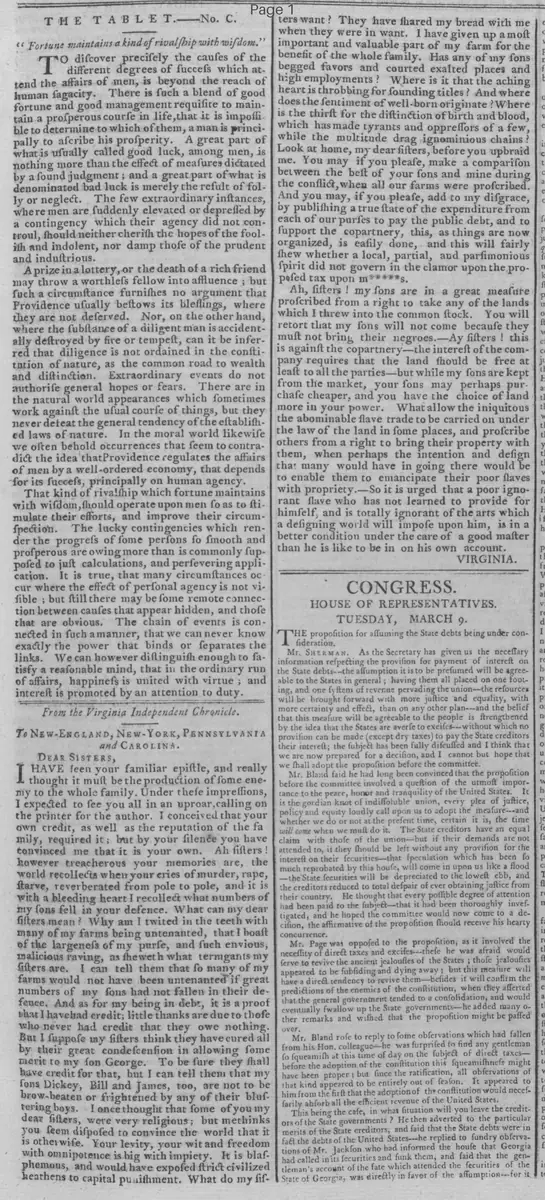
From the Virginia Independent Chronicle.
To New-England, New-York, Pennsylvania and CAROLINA.
DEAR SISTERS,
I HAVE seen your familiar epistle, and really thought it must be the production of some enemy to the whole family. Under these impressions, I expected to see you all in an uproar, calling on the printer for the author. I conceived that your own credit, as well as the reputation of the family, required it; but by your silence you have convinced me that it is your own. Ah sisters! however treacherous your memories are, the world recollects when your cries of murder, rape, starve, reverberated from pole to pole, and it is with a bleeding heart I recollect what numbers of my sons fell in your defence. What can my dear sisters mean? Why am I twitted in the teeth with many of my farms being untenanted, that I boast of the largeness of my purse, and such envious, malicious raving, as showeth what termagants my sisters are. I can tell them that so many of my farms would not have been untenanted if great numbers of my sons had not fallen in their defence. And as for my being in debt, it is a proof that I have had credit: little thanks are due to those who never had credit that they owe nothing.
But I suppose my sisters think they have cured all by their great condescension in allowing some merit to my son George. To be sure they shall have credit for that, but I can tell them that my sons Dickey, Bill and James, too, are not to be brow-beaten or frightened by any of their blustering boys. I once thought that some of you my dear sisters, were very religious; but methinks you seem disposed to convince the world that it is otherwise. Your levity, your wit and freedom with omnipotence is big with impiety. It is blasphemous, and would have exposed strict civilized heathens to capital punishment. What do my sisters want? They have shared my bread with me when they were in want. I have given up a most important and valuable part of my farm for the benefit of the whole family. Has any of my sons begged favors and courted exalted places and high employments? Where is it that the aching heart is throbbing for sounding titles? And where does the sentiment of well-born originate? Where is the thirst for the distinction of birth and blood, which has made tyrants and oppressors of a few, while the multitude drag ignominious chains?
Look at home, my dear sisters, before you upbraid me. You may if you please, make a comparison between the best of your sons and mine during the conflict, when all our farms were proscribed. And you may, if you please, add to my disgrace, by publishing a true state of the expenditure from each of our purses to pay the public debt, and to support the copartnery, this, as things are now organized, is easily done, and this will fairly show whether a local, partial, and parsimonious spirit did not govern in the clamor upon the proposed tax upon m*****s.
Ah, sisters! my sons are in a great measure proscribed from a right to take any of the lands which I threw into the common stock. You will retort that my sons will not come because they must not bring their negroes.—Ay sisters! this is against the copartnery—the interest of the company requires that the land should be free at least to all the parties—but while my sons are kept from the market, your sons may perhaps purchase cheaper, and you have the choice of land more in your power. What allow the iniquitous the abominable slave trade to be carried on under the law of the land in some places, and proscribe others from a right to bring their property with them, when perhaps the intention and design that many would have in going there would be to enable them to emancipate their poor slaves with propriety. So it is urged that a poor ignorant slave who has not learned to provide for himself, and is totally ignorant of the arts which a designing world will impose upon him, is in a better condition under the care of a good master than he is like to be in on his own account.
To New-England, New-York, Pennsylvania and CAROLINA.
DEAR SISTERS,
I HAVE seen your familiar epistle, and really thought it must be the production of some enemy to the whole family. Under these impressions, I expected to see you all in an uproar, calling on the printer for the author. I conceived that your own credit, as well as the reputation of the family, required it; but by your silence you have convinced me that it is your own. Ah sisters! however treacherous your memories are, the world recollects when your cries of murder, rape, starve, reverberated from pole to pole, and it is with a bleeding heart I recollect what numbers of my sons fell in your defence. What can my dear sisters mean? Why am I twitted in the teeth with many of my farms being untenanted, that I boast of the largeness of my purse, and such envious, malicious raving, as showeth what termagants my sisters are. I can tell them that so many of my farms would not have been untenanted if great numbers of my sons had not fallen in their defence. And as for my being in debt, it is a proof that I have had credit: little thanks are due to those who never had credit that they owe nothing.
But I suppose my sisters think they have cured all by their great condescension in allowing some merit to my son George. To be sure they shall have credit for that, but I can tell them that my sons Dickey, Bill and James, too, are not to be brow-beaten or frightened by any of their blustering boys. I once thought that some of you my dear sisters, were very religious; but methinks you seem disposed to convince the world that it is otherwise. Your levity, your wit and freedom with omnipotence is big with impiety. It is blasphemous, and would have exposed strict civilized heathens to capital punishment. What do my sisters want? They have shared my bread with me when they were in want. I have given up a most important and valuable part of my farm for the benefit of the whole family. Has any of my sons begged favors and courted exalted places and high employments? Where is it that the aching heart is throbbing for sounding titles? And where does the sentiment of well-born originate? Where is the thirst for the distinction of birth and blood, which has made tyrants and oppressors of a few, while the multitude drag ignominious chains?
Look at home, my dear sisters, before you upbraid me. You may if you please, make a comparison between the best of your sons and mine during the conflict, when all our farms were proscribed. And you may, if you please, add to my disgrace, by publishing a true state of the expenditure from each of our purses to pay the public debt, and to support the copartnery, this, as things are now organized, is easily done, and this will fairly show whether a local, partial, and parsimonious spirit did not govern in the clamor upon the proposed tax upon m*****s.
Ah, sisters! my sons are in a great measure proscribed from a right to take any of the lands which I threw into the common stock. You will retort that my sons will not come because they must not bring their negroes.—Ay sisters! this is against the copartnery—the interest of the company requires that the land should be free at least to all the parties—but while my sons are kept from the market, your sons may perhaps purchase cheaper, and you have the choice of land more in your power. What allow the iniquitous the abominable slave trade to be carried on under the law of the land in some places, and proscribe others from a right to bring their property with them, when perhaps the intention and design that many would have in going there would be to enable them to emancipate their poor slaves with propriety. So it is urged that a poor ignorant slave who has not learned to provide for himself, and is totally ignorant of the arts which a designing world will impose upon him, is in a better condition under the care of a good master than he is like to be in on his own account.
What sub-type of article is it?
Partisan Politics
Taxation
Slavery Abolition
What keywords are associated?
Interstate Rivalry
Revolutionary Sacrifices
Public Debt
Tax On Militia
Northwest Lands
Slave Trade
Emancipation
What entities or persons were involved?
Virginia
New England
New York
Pennsylvania
Carolina
Son George
Sons Dickey, Bill And James
Editorial Details
Primary Topic
Virginia Defending Against Sister States' Criticisms On Debt, Taxes, Land, And Slavery
Stance / Tone
Defensive And Accusatory
Key Figures
Virginia
New England
New York
Pennsylvania
Carolina
Son George
Sons Dickey, Bill And James
Key Arguments
Virginia's Sons Died Defending Sister States During The War
Virginia's Debt Shows It Had Credit To Support The Family
Sister States Shared Virginia's Bread In Want And Virginia Gave Land For Common Benefit
Compare Sons' Merits And Expenditures On Public Debt To Show Parsimony In Tax Opposition
Proscription Of Slaves Hinders Virginia Sons From Accessing Common Lands, Aiding Emancipation
Slaves Better Under Good Masters Than Free And Ignorant