Thank you for visiting SNEWPapers!
Sign up free
The Massachusetts Spy
Worcester, Worcester County, Massachusetts
What is this article about?
Ongoing controversy in Southern Gazettes between Mr. Jefferson and 'A Native of Virginia' over Jefferson's receipt of $1100 from the Treasury in 1820 for a bill drawn over 30 years earlier, allegedly paid twice. The newspaper editor questions Jefferson's explanation.
Clipping
OCR Quality
Full Text
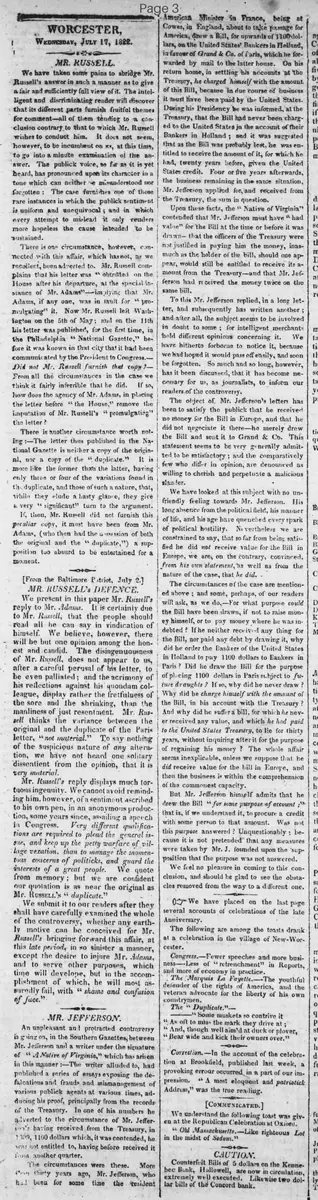
An unpleasant and protracted controversy is going on, in the Southern Gazettes, between Mr. Jefferson and a writer under the signature of "A Native of Virginia," which has arisen in this manner:--The writer alluded to, had published a series of essays exposing the defalcations and frauds and mismanagement of various public agents at various times, adducing his proof, principally from the records of the Treasury. In one of his numbers he adverted to the circumstance of Mr. Jefferson's having received from the Treasury, in 1820, 1100 dollars which, it was contended, he was not entitled to, having before received it from another quarter.
The circumstances were these. More than thirty years ago, Mr. Jefferson, who had been for some time the resident American Minister in France, being at Cowes, in England, about to take passage for America, drew a Bill, for upwards of 1100 dollars, on the United States' Bankers in Holland, in favour of Grand & Co. of Paris, which he forwarded by mail to the latter house. On his return home, in settling his accounts at the Treasury, he charged himself with the amount of this Bill, because in due course of business it must have been paid by the United States. During his Presidency he was informed, at the Treasury, that the Bill had never been charged to the United States in the account of their Bankers in Holland; and it was suggested that as the Bill was probably lost, he was entitled to receive the amount of it, for which he had, twenty years before, given the United States credit. Four or five years afterwards, the business remaining in the same situation, Mr. Jefferson applied for, and received from the Treasury, the sum in question.
Upon these facts, the "Native of Virginia" contended that Mr. Jefferson must have "had value" for the Bill at the time or before it was drawn- that the officers of the Treasury were not justified in paying him the money, inasmuch as the holder of the bill, should one appear, would still be entitled to receive its amount from the Treasury-and that Mr. Jefferson had received the money twice on the same bill.
To this Mr. Jefferson replied, in a long letter, and subsequently has written another; and after all, the subject seems to be involved in doubt to some; for intelligent merchants hold different opinions concerning it. We have hitherto forborne to notice it, because we had hoped it would pass off easily, and soon be forgotten. So much and so long, however, has it been discussed, that it has become necessary for us, as journalists, to inform our readers of the controversy.
The object of Mr. Jefferson's letters has been to satisfy the public that he received no money for the Bill in Europe, and that he did not negotiate it there-he merely drew the Bill and sent it to Grand & Co. This statement seems to be very generally admitted to be satisfactory; and the comparatively few who differ in opinion, are denounced as willing to cherish and perpetuate a malicious slander.
We have looked at this subject with no unfriendly feeling towards Mr. Jefferson. His long absence from the political field, his manner of life, and his age have quenched every spark of political hostility. Nevertheless we are constrained to say, that so far from being satisfied he did not receive value for the Bill in Europe, we are, on the contrary, convinced, from his own statement, as well as from the nature of the case, that he did.
The circumstances of the case are mentioned above; and some, perhaps, of our readers will ask, as we do,--For what purpose could the Bill have been drawn, if not to raise money himself, or to pay money where he was indebted? If he neither received any thing for the Bill, nor paid any debt by drawing it, why did he order the Bankers of the United States in Holland to pay 1100 dollars to Bankers in Paris? Did he draw the Bill for the purpose of placing 1100 dollars in Paris subject to future draughts? If so, why did he never draw? Why did he charge himself with the amount of the Bill, in his account with the Treasury? And why did he suffer a bill, for which he never received any value, and which he had paid to the United States Treasury, to lie for thirty years, without inquiring after it for the purpose of regaining his money? The whole affair seems inexplicable, unless we suppose that he did receive value for the bill in Europe, and then the business is within the comprehension of the commonest capacity.
But Mr. Jefferson himself admits that he drew the Bill "for some purpose of account;" that is, if we understand it, to procure a credit with some person to that amount. Was not this purpose answered? Unquestionably; because it is not pretended that any measures were taken by Mr. J. founded upon the supposition that the purpose was not answered.
We feel no pleasure in coming to this conclusion, and should be glad to see the obstacles removed from the way to a different one. We have placed on the last page several accounts of celebrations of the late Anniversary.
What sub-type of article is it?
What keywords are associated?
What entities or persons were involved?
Where did it happen?
Domestic News Details
Primary Location
Southern Gazettes
Event Date
1820
Key Persons
Outcome
controversy ongoing with differing opinions; newspaper editor convinced jefferson received value for the bill in europe.
Event Details
Protracted newspaper debate in Southern Gazettes over Mr. Jefferson receiving $1100 from U.S. Treasury in 1820 for a bill drawn over 30 years earlier on U.S. bankers in Holland in favor of Grand & Co. in Paris. 'A Native of Virginia' alleges double payment and fraud; Jefferson defends in letters, claiming no value received in Europe. Editor doubts Jefferson's explanation based on circumstances.