Thank you for visiting SNEWPapers!
Sign up free
Daily National Intelligencer
Washington, District Of Columbia
What is this article about?
Benjamin Franklin's letter to William Strahan from Passy, August 19, 1784, excuses delay in reply, recommends his grandson, reflects on British misjudgments in the American Revolution, credits victory to justice and divine providence, and jests about their printing successes.
Clipping
OCR Quality
Full Text
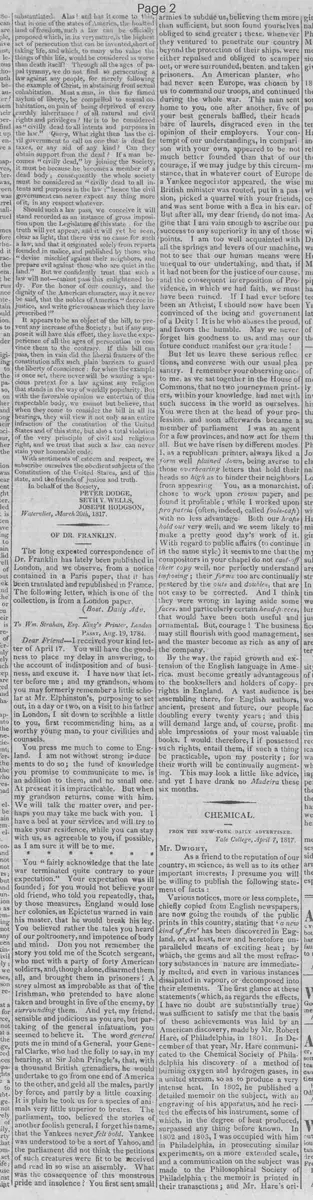
The long expected correspondence of Dr. Franklin has lately been published in London, and we observe, from a notice contained in a Paris paper, that it has been translated and republished in France. The following letter, which is one of the collection, is from a London paper.
(Bost. Daily Adv.
To Wm. Strahan, Esq. King's Printer, London
Passy, Aug. 19, 1784.
Dear Friend—I received your kind letter of April 17. You will have the goodness to place my delay in answering, to the account of indisposition and of business, and excuse it. I have now that letter before me; and my grandson, whom you may formerly remember a little scholar at Mr. Elphinston's, purposing to set out, in a day or two, on a visit to his father in London, I sit down to scribble a little to you, first recommending him, as a worthy young man, to your civilities and counsels.
You press me much to come to England. I am not without strong inducements to do so; the fund of knowledge you promise to communicate to me, is an addition to them, and no small one. At present it is impracticable. But when my grandson returns, come with him. We will talk the matter over, and perhaps you may take me back with you. I have a bed at your service, and will try to make your residence, while you can stay with us, as agreeable to you, if possible, as I am sure it will be to me.
You "fairly acknowledge that the late war terminated quite contrary to your expectation." Your expectation was ill founded; for you would not believe your old friend, who told you repeatedly, that, by those measures, England would lose her colonies, as Epictetus warned in vain his master, that he would break his leg. You believed rather the tales you heard of our poltroonery, and impotence of body and mind. Do you not remember the story you told me of the Scotch sergeant, who met with a party of forty American soldiers, and, though alone, disarmed them all, and brought them in prisoners! A story almost as improbable as that of the Irishman, who pretended to have alone taken and brought in five of the enemy, by surrounding them. And yet, my friend, sensible and judicious as you are, but partaking of the general infatuation, you seemed to believe it. The word general puts me in mind of a General, your General Clarke, who had the folly to say, in my hearing, at Sir John Pringle's, that, with a thousand British grenadiers, he would undertake to go from one end of America to the other, and geld all the males, partly by force, and partly by a little coaxing. It is plain he took us for a species of animals very little superior to brutes. The parliament, too, believed the stories of another foolish general, I forget his name, that the Yankees never felt bold. Yankee was understood to be a sort of Yahoo, and the parliament did not think the petitions of such creatures were fit to be received and read in so wise an assembly. What was the consequence of this monstrous pride and insolence? You first sent small armies to subdue us, believing them more than sufficient, but soon found yourselves obliged to send greater; these, whenever they ventured to penetrate our country beyond the protection of their ships, were either repulsed and obliged to scamper out, or were surrounded, beaten, and taken prisoners. An American planter, who had never seen Europe, was chosen by us to command our troops, and continued during the whole war. This man sent home to you, one after another, five of your best generals baffled, their heads bare of laurels, disgraced even in the opinion of their employers. Your contempt of our understandings, in comparison with your own, appeared to be not much better founded than that of our courage, if we may judge by this circumstance, that in whatever court of Europe a Yankee negociator appeared, the wise British minister was routed, put in a passion, picked a quarrel with your friends and was sent home with a flea in his ear. But after all, my dear friend, do not imagine that I am vain enough to ascribe our success to any superiority in any of those points. I am too well acquainted with all the springs and levers of our machine, not to see that our human means were unequal to our undertaking, and that, if it had not been for the justice of our cause, and the consequent interposition of Providence, in which we had faith, we must have been ruined. If I had ever before been an Atheist, I should now have been convinced of the being and government of a Deity! It is he who abases the proud, and favors the humble. May we never forget his goodness to us, and may our future conduct manifest our gratitude! But let us leave these serious reflections, and converse with our usual pleasantry. I remember your observing once, as we sat together in the House of Commons, that no two journeymen printers, within your knowledge, had met with such success in the world as ourselves. You were then at the head of your profession, and soon afterwards became a member of parliament. I was an agent for a few provinces, and now act for them all. But we have risen by different modes. I, as a republican printer, always liked a form well planed down, being averse to those overbearing letters that hold their heads so high as to hinder their neighbors from appearing. You, as a monarchist, chose to work upon crown paper, and found it profitable; while I worked upon pro patria (often, indeed, called fools-cap) with no less advantage. Both our heads hold out very well, and we seem likely to make a pretty good day's work of it. With regard to public affairs (to continue in the same style) it seems to me that the compositors in your chapel do not cast-off their copy well, nor perfectly understand imposing; their forms too are continually pestered by the outs and doubles, that are not easy to be corrected. And I think they were wrong in laying aside some faces, and particularly certain head-pieces, that would have been both useful and ornamental. But, courage! The business may still flourish with good management, and the master become as rich as any of the company. By the way, the rapid growth and extension of the English language in America, must become greatly advantageous to the booksellers and holders of copyrights in England. A vast audience is assembling there, for English authors, ancient, present and future, our people doubling every twenty years; and this will demand large and, of course, profitable impressions of your most valuable books. I would, therefore, if possessed such rights, entail them, if such a thing be practicable, upon my posterity; for their worth will be continually augmenting. This may look a little like advice, and yet I have drank no Madeira these six months.
What sub-type of article is it?
What themes does it cover?
What keywords are associated?
What entities or persons were involved?
Where did it happen?
Story Details
Key Persons
Location
Passy, France; London, England; America
Event Date
Aug. 19, 1784
Story Details
Franklin excuses delay in replying to Strahan, recommends his grandson visiting London, invites Strahan to visit, reflects on British underestimation of American resolve during the Revolution leading to their defeat, credits American success to the justice of their cause and divine providence, and humorously compares their printing careers and offers advice on English copyrights in growing America.