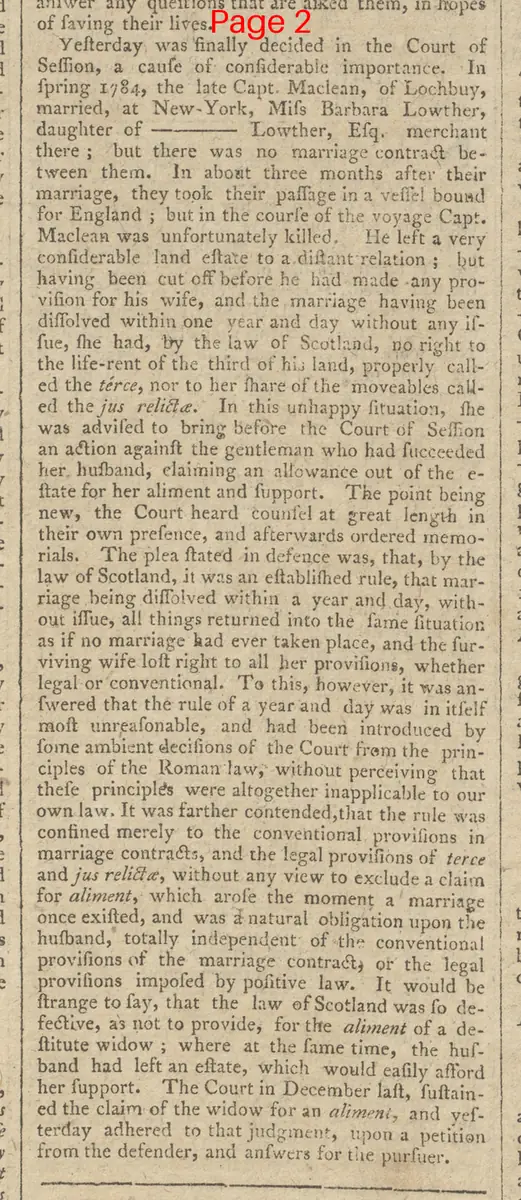
Yesterday was finally decided in the Court of Session, a cause of considerable importance. In spring 1784, the late Capt. Maclean, of Lochbuy, married, at New-York, Miss Barbara Lowther, daughter of - Lowther, Esq. merchant there; but there was no marriage contract between them. In about three months after their marriage, they took their passage in a vessel bound for England; but in the course of the voyage Capt. Maclean was unfortunately killed. He left a very considerable land estate to a distant relation; but having been cut off before he had made any provision for his wife, and the marriage having been dissolved within one year and day without any issue, she had, by the law of Scotland, no right to the life-rent of the third of his land, properly called the terce, nor to her share of the moveables called the jus relictae. In this unhappy situation, she was advised to bring before the Court of Session an action against the gentleman who had succeeded her husband, claiming an allowance out of the estate for her aliment and support. The point being new, the Court heard counsel at great length in their own presence, and afterwards ordered memorials. The plea stated in defence was, that, by the law of Scotland, it was an established rule, that marriage being dissolved within a year and day, without issue, all things returned into the same situation as if no marriage had ever taken place, and the surviving wife lost right to all her provisions, whether legal or conventional. To this, however, it was answered that the rule of a year and day was in itself most unreasonable, and had been introduced by some ancient decisions of the Court from the principles of the Roman law, without perceiving that these principles were altogether inapplicable to our own law. It was farther contended, that the rule was confined merely to the conventional provisions in marriage contracts, and the legal provisions of terce and jus relictae, without any view to exclude a claim for aliment, which arose the moment a marriage once existed, and was a natural obligation upon the husband, totally independent of the conventional provisions of the marriage contract, or the legal provisions imposed by positive law. It would be strange to say, that the law of Scotland was so defective, as not to provide, for the aliment of a destitute widow; where at the same time, the husband had left an estate, which would easily afford her support. The Court in December last, sustained the claim of the widow for an aliment, and yesterday adhered to that judgment, upon a petition from the defender, and answers for the pursuer.