Thank you for visiting SNEWPapers!
Sign up free
Poem
January 6, 1820
Richmond Enquirer
Richmond, Richmond County, Virginia
What is this article about?
Patriotic song by John M'Crary, based on a Revolutionary War event where Mrs. Motte of South Carolina provided a bow to American forces under Marion to burn her fortified house, compelling British surrender. Lyrics praise her heroism and rally for liberty.
Clipping
OCR Quality
85%
Good
Full Text
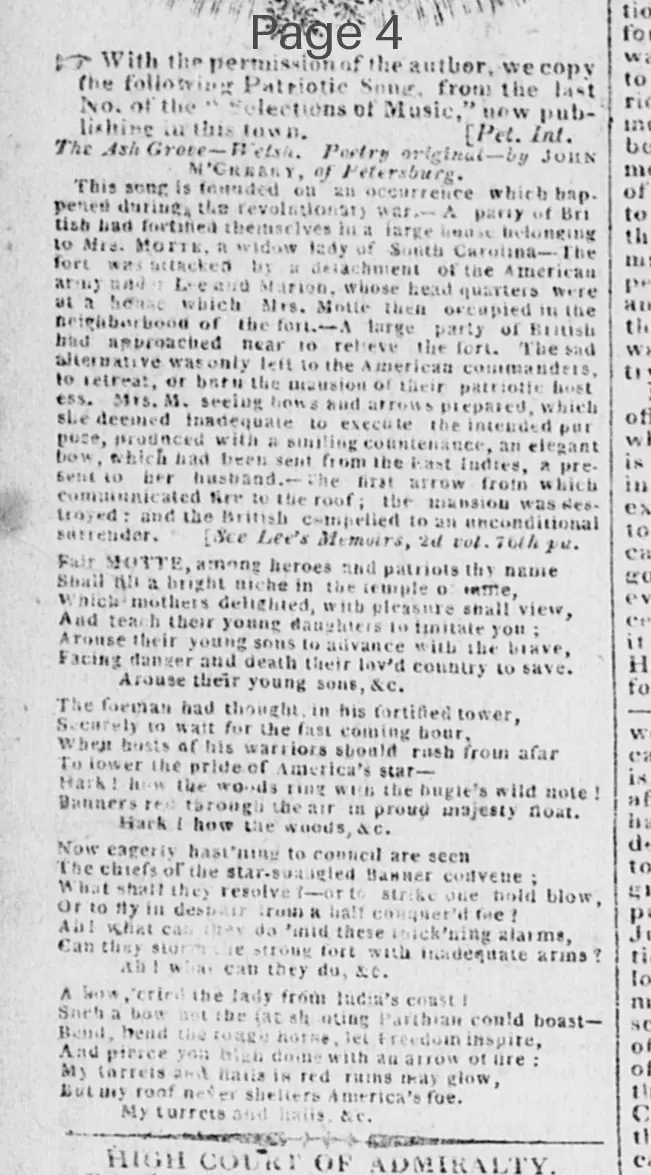
With the permission of the author, we copy the following Patriotic Song, from the last "Selections of Music," now publishing in this town.
Pet. Int.
The Ash Grove—Bells. Poetry original—by John M'CRary, of Petersburg.
This song is founded on an occurrence which happened during the revolutionary war,—party of British had fortified themselves in a large house belonging to Mrs. Motte, a widow lady of South Carolina—The fort was attacked by a detachment of the American army and Marion, whose head quarters were at a house which Mrs. Motte then occupied in the neighborhood of the fort,—A large party of British had approached near to relieve the fort. The sad alternative was only left to the American commanders, to retreat, or burn the mansion of their patriotic hostess. Mrs. M. seeing bows and arrows prepared, which she deemed inadequate to execute the intended purpose, introduced with a smiling countenance, an elegant bow, which had been sent from the East Indies, a present to her husband.—The first arrow from it communicated fire to the roof, the mansion was destroyed: and the British compelled to an unconditional surrender,
(See Lee's Memoirs, 2d vol. p. 107.)
Fair Motte, among heroes and patriots thy name
Shall live with a bright niche in the temple of fame,
Which mothers delighted, with pleasure shall view,
And teach their young daughters to imitate you;
Arouse their young sons to advance with the brave,
Facing danger and death their lov'd country to save.
Arouse their young sons, &c.
The foeman had thought, in his fortified tower,
Securely to wait for the fast coming hour.
When hosts of his warriors should rush from afar
To lower the pride of America's star—
Hark! how the woods ring with the bugle's wild note!
Banners float through the air in proud majesty float.
Hark! how the woods, &c.
Now eager hastening to council are seen
The chiefs of the star-spangled Banner convene ;
What shall they resolve —or strike one bold blow,
Or to fly in dismay from a half conqur'd foe?
Ah! what can they do 'mid these tickling alarms,
Can they storm strong fort with inadequate arms?
Ah! what can they do, &c.
A bow, cried the lady from lady's soft breast!
Such a bow at the far shooting Parthian could boast—
Bend, bend the strong bow, let freedom inspire,
And pierce you British foe with arrow of fire:
My turrets and walls in red ruins may glow,
But my roof ne'er shall shelter America's foe.
My turrets and walls &c.
Pet. Int.
The Ash Grove—Bells. Poetry original—by John M'CRary, of Petersburg.
This song is founded on an occurrence which happened during the revolutionary war,—party of British had fortified themselves in a large house belonging to Mrs. Motte, a widow lady of South Carolina—The fort was attacked by a detachment of the American army and Marion, whose head quarters were at a house which Mrs. Motte then occupied in the neighborhood of the fort,—A large party of British had approached near to relieve the fort. The sad alternative was only left to the American commanders, to retreat, or burn the mansion of their patriotic hostess. Mrs. M. seeing bows and arrows prepared, which she deemed inadequate to execute the intended purpose, introduced with a smiling countenance, an elegant bow, which had been sent from the East Indies, a present to her husband.—The first arrow from it communicated fire to the roof, the mansion was destroyed: and the British compelled to an unconditional surrender,
(See Lee's Memoirs, 2d vol. p. 107.)
Fair Motte, among heroes and patriots thy name
Shall live with a bright niche in the temple of fame,
Which mothers delighted, with pleasure shall view,
And teach their young daughters to imitate you;
Arouse their young sons to advance with the brave,
Facing danger and death their lov'd country to save.
Arouse their young sons, &c.
The foeman had thought, in his fortified tower,
Securely to wait for the fast coming hour.
When hosts of his warriors should rush from afar
To lower the pride of America's star—
Hark! how the woods ring with the bugle's wild note!
Banners float through the air in proud majesty float.
Hark! how the woods, &c.
Now eager hastening to council are seen
The chiefs of the star-spangled Banner convene ;
What shall they resolve —or strike one bold blow,
Or to fly in dismay from a half conqur'd foe?
Ah! what can they do 'mid these tickling alarms,
Can they storm strong fort with inadequate arms?
Ah! what can they do, &c.
A bow, cried the lady from lady's soft breast!
Such a bow at the far shooting Parthian could boast—
Bend, bend the strong bow, let freedom inspire,
And pierce you British foe with arrow of fire:
My turrets and walls in red ruins may glow,
But my roof ne'er shall shelter America's foe.
My turrets and walls &c.
What sub-type of article is it?
Song
Ballad
What themes does it cover?
Patriotism
War Military
Liberty Independence
What keywords are associated?
Patriotic Song
Mrs Motte
Revolutionary War
British Surrender
American Heroism
Francis Marion
South Carolina
What entities or persons were involved?
By John M'crary, Of Petersburg
Poem Details
Title
Patriotic Song
Author
By John M'crary, Of Petersburg
Subject
On Mrs. Motte's Sacrifice During The Revolutionary War
Form / Style
Stanzaic Song With Repeating Refrains
Key Lines
Fair Motte, Among Heroes And Patriots Thy Name
Shall Live With A Bright Niche In The Temple Of Fame,
A Bow, Cried The Lady From Lady's Soft Breast!
Such A Bow At The Far Shooting Parthian Could Boast—
Bend, Bend The Strong Bow, Let Freedom Inspire,
And Pierce You British Foe With Arrow Of Fire: