Thank you for visiting SNEWPapers!
Sign up free
Atlanta Daily World
Atlanta, Fulton County, Georgia
What is this article about?
On May 22, 1956, the Alabama Supreme Court reversed the conviction of Matthew Knox under a 1951 anti-communist registration law, ruling that possession of communist literature alone was insufficient evidence of contributing to the party. Defended by Arthur D. Shores in Birmingham.
Clipping
OCR Quality
Full Text
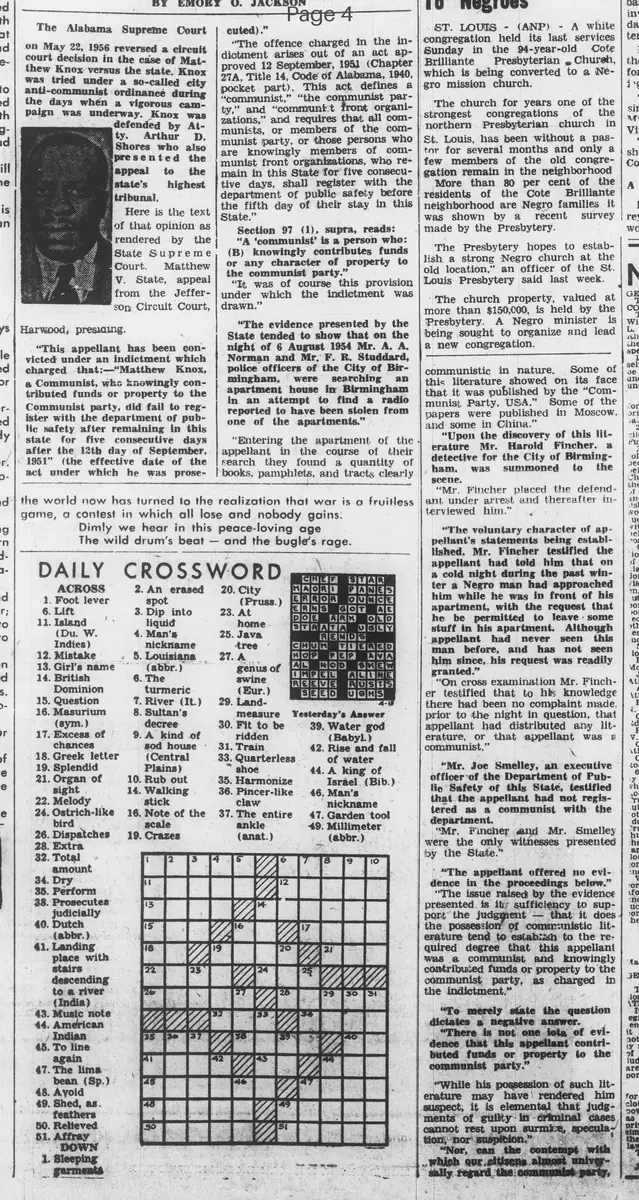
Here is the text of that opinion as rendered by the State Supreme Court.
Matthew V. State, appeal from the Jefferson Circuit Court, Harwood, presiding.
"This appellant has been convicted under an indictment which charged that:-"Matthew Knox, a Communist, who knowingly contributed funds or property to the Communist party. did fail to register with the department of public safety after remaining in this state for five consecutive days after the 12th day of September. 1951" (the effective date of the act under which he was prosecuted)."
"The offence charged in the indictment arises out of an act approved 12 September, 1951 (Chapter 27A, Title 14, Code of Alabama, 1940, pocket part). This act defines a "communist," "the communist party," and "communist front organizations," and requires that all communists, or members of the communist party, or those persons who are knowingly members of communist front organizations, who remain in this State for five consecutive days, shall register with the department of public safety before the fifth day of their stay in this State."
Section 97 (1), supra, reads: "A 'communist' is a person who: (B) knowingly contributes funds or any character of property to the communist party."
It was of course this provision under which the indictment was drawn.
"The evidence presented by the State tended to show that on the night of 6 August 1954 Mr. A. A. Norman and Mr. F. R. Studdard, police officers of the City of Birmingham, were searching an apartment house in Birmingham in an attempt to find a radio reported to have been stolen from one of the apartments."
"Entering the apartment of the appellant in the course of their search they found a quantity of books, pamphlets, and tracts clearly communistic in nature. Some of this literature showed on its face that it was published by the "Communist Party. USA." Some of the papers were published in Moscow. and some in China."
"Upon the discovery of this literature Mr. Harold Fincher, a detective for the City of Birmingham, was summoned to the scene."
"Mr. Fincher placed the defendant under arrest and thereafter interviewed him."
"The voluntary character of appellant's statements being established, Mr. Fincher testified the appellant had told him that on a cold night during the past winter a Negro man had approached him while he was in front of his apartment. with the request that he be permitted to leave·some stuff in his apartment. Although appellant had never seen this man before, and has not seen him since, his request was readily granted."
"On cross examination Mr. Fincher testified that to his knowledge there had been no complaint made. prior to the night in question, that appellant had distributed any literature, or that appellant was a communist."
"Mr. Joe Smelley, an executive officer of the Department of Public Safety of this State, testified that the appellant had not registered as a communist with the department."
Mr. Fincher and Mr. Smelley were the only witnesses presented by the State.
"The appellant offered no evidence in the proceedings below."
"The issue raised by the evidence presented is it sufficiency to support the judgment i- that it does the possession of communistic literature tend to establish to the required degree that this appellant was a communist and knowingly contributed funds or property to the communist party, as charged in the indictment."
"To merely state the question dictates a negative answer.
There is not one iota of evidence that this appellant contributed funds or property to the communist party."
While his possession of such literature may have rendered him suspect, it is elemental that judgments of guilty in criminal cases cannot rest upon surmise, speculation,nor suspicion.
"Nor, can the contempt with which our citizens almost universally regard the communist party,"
satiating its appetite among the stubble, burning itself out in black patches.
What sub-type of article is it?
What keywords are associated?
What entities or persons were involved?
Where did it happen?
Domestic News Details
Primary Location
Birmingham, Alabama
Event Date
May 22, 1956
Key Persons
Outcome
the alabama supreme court reversed the circuit court decision convicting matthew knox under the anti-communist ordinance.
Event Details
Matthew Knox was convicted for failing to register as a communist after remaining in Alabama for five consecutive days following the effective date of the act on September 12, 1951. The conviction was based on possession of communistic literature found in his apartment during a search on August 6, 1954. The Supreme Court ruled that possession of such literature does not constitute evidence of knowingly contributing funds or property to the communist party, and the evidence was insufficient to support the judgment.