Thank you for visiting SNEWPapers!
Sign up free
Richmond Enquirer
Richmond, Richmond County, Virginia
What is this article about?
US Secretary of State instructs envoy Gallatin on responding to Britain's refusal to negotiate colonial trade, defending US positions on reciprocal commerce with British colonies and reviewing past treaties and talks from 1794-1824. (187 characters)
Clipping
OCR Quality
Full Text
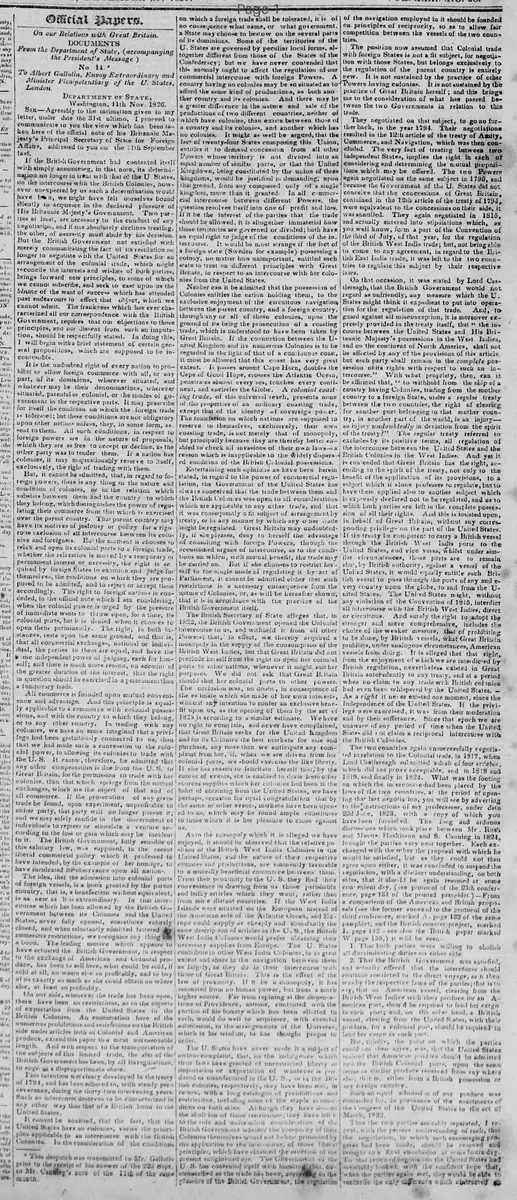
On our Relations with Great Britain.
DOCUMENTS
From the Department of State, (accompanying the President's Message)
No 14.*
To Albert Gallatin, Envoy Extraordinary and Minister Plenipotentiary of the U. States, London.
Department of State,
Washington, 11th Nov. 1826.
Sir—Agreeably to the intimation given in my letter, under date the 31st ultimo, I proceed to communicate to you the view which has been taken here of the official note of his Britannic Majesty's Principal Secretary of State for Foreign Affairs, addressed to you on the 11th September last.
If the British Government had contented itself with simply announcing, in that note, its determination no longer to treat with that of the U States, on the intercourse with the British Colonies, however unexpected by us such a determination would have been, we might have felt ourselves bound silently to acquiesce in the declared pleasure of His Britannic Majesty's Government. Two parties at least, are necessary to the conduct of any negotiation, and if one absolutely declines treating. the other, of necessity must abide by his decision.
But the British Government not satisfied with merely communicating the fact of its resolution no longer to negotiate with the United States for an arrangement of the colonial trade, which might reconcile the interests and wishes of both parties, brings forward new principles, to some of which we cannot subscribe, and seek to cast upon us the blame of the want of success: which has attended past endeavours to effect that object, which we cannot admit. The frankness which has ever characterized all our correspondence with the British Government, requires that our objections to those principles, and our dissent from such an imputation, should be respectfully stated. In doing this, I will begin with a brief statement of certain general propositions, which are supposed to be incontestable.
It is the undoubted right of every nation to prohibit or allow foreign commerce with all, or any part, of its dominions, wherever situated, and whatever may be their denominations, wherever situated, parental or colonial, or the modes of government in the respective parts. It may prescribe for itself the condition on which the foreign trade is tolerated; but these conditions are not obligatory upon other nations unless, they, in some form, assent to them. All such conditions, in respect to foreign powers are in the nature of proposals, which they are as free to accept or decline, as the other party was to tender them. If a nation has colonies, it may unquestionably reserve to itself, exclusively, the right of trading with them.
But, it cannot be admitted, that, in regard to foreign powers, there is any thing in the nature and condition of colonies, or in the relation which subsists between them and the country to which they belong, which distinguishes the power of regulating their commerce from that which is exercised over the parent country. That parent country may have its motives of jealousy or policy for a rigorous exclusion of all intercourse between its colonies and foreigners. But the moment it chooses to relax and open its colonial ports to a foreign trade, whether the relaxation is moved by a temporary or permanent interest or necessity, the right is acquired by foreign States to examine and judge for themselves, the conditions on which they are proposed to be admitted, and to reject or accept them accordingly. This right to foreign nations is conceded, in the official note which I am considering, when the colonial power is urged by the pressure of immediate wants to throw open, for a time, its colonial ports, but it is denied when it chooses to open them permanently. The right, in both instances, rests upon the same ground, and that is, that all commercial exchanges, national or individual, the parties to them are equal, and have the same independent power of judging, each for himself; and there is much more reason, on account of the greater duration of the interest, that the right in question should be exercised in a permanent than a temporary trade.
All commerce is founded upon mutual convenience and advantage. And this principle is equally applicable to a commerce with colonial possessions, and with the country to which they belong. or to any other country. In trading with any colonies, we have no more imagined that a privilege had been gratuitously conceded to us, than that we had made such a concession to the colonial power, in allowing its colonies to trade with the U. S. It cannot, therefore, be admitted that any other compensation is due from the U.S. to Great Britain, for the permission to trade with her colonies. than that which springs from the mutual exchanges, which are the object of that and of all commerce. If the prosecution of any given trade be found, upon experiment, unprofitable to either party, that party will no longer pursue it, and we may safely confide in the discernment of individuals to repress or stimulate a venture according to the loss or gain which may be incident to it. The British Government, fully sensible of this salutary law, was supposed, in the recent liberal commercial policy which it professed to have intended, by the example of her tonnage, to have inculcated its observance upon all nations.
The idea, that the admission into colonial ports of foreign vessels, is a boon granted by the parent country, that is, a benefaction without equivalent, is as new as it is extraordinary. In that intercourse which has been allowed by the British Government between its Colonies and the United States, never fully opened, sometimes entirely closed, and when reluctantly admitted fettered by numerous restrictions, we recognise any thing but a boon. The leading motive which appears to have actuated the British Government, in respect to the exchange of American and Colonial produce, has been to sell here, what could be sold, if sold at all, no where else so profitably, and to buy of us exactly so much as she could obtain no where else, at least so profitably.
On our side, whenever the trade has been open, there have been no restrictions, as to the objects of exportation from the United States to the British Colonies. An enumeration here of the numerous prohibitions and restrictions on the British side under articles both of Colonial and American produce, extend this paper to a most unreasonable length. And with respect to the transportation of the subjects of this limited trade, the aim of the British Government has been, by all its regulations, to engross a disproportionate share.
This intention was clearly developed in the treaty of 1794, and has been adhered to, with steady perseverance, during the thirty-two intervening years. Such an intercourse deserves to be characterized in any other way than that of a British boon to the United States.
It cannot be admitted, that the fact, that the United States have no colonies, varies the principles applicable to an intercourse with the British Colonies. In the consideration of the conditions on which a foreign trade shall be tolerated, it is of no consequence what name, or what government, a State may choose to bestow on the several parts of its dominions. Some of the territories of the U. States are governed by peculiar local forms. altogether different from those of the States of the Confederacy; but we have never contended that this anomaly ought to affect the regulation of our commercial intercourse with foreign Powers. A country having no colonies may be so situated as to afford the same kind of productions, as both another country and its colonies. And there may be a greater difference in the nature and sale of the productions of two different countries, neither of which have colonies. than exists between. those of a country and its colonies, and another which has no colonies. It might as well be argued, that the fact of twenty-four States composing this Union, entitles it to demand concession from all other Powers whose territory is not divided into an equal number of similar parts, or that the United Kingdom, being constituted by the union of three kingdoms, would be justified in demanding, upon that ground, from any composed only of a single kingdom, more than it granted. In all commercial intercourse between different Powers. the question resolves itself into one of profit and loss. If it be the interest of the parties that the trade should be allowed, it is altogether immaterial how those territories are governed or divided; both have an equal right to judge of the conditions of the intercourse. It would be most strange if the fact of a foreign state (Sweden for example) possessing a colony, no matter how unimportant, entitled such state to treat on different principles with Great Britain, in respect to an intercourse with her colonies from the United States.
Neither can it be admitted that the possession of Colonies entitles the nation holding them, to the exclusive enjoyment of the circuitous navigation between the parent country, and a foreign country, through any or all of those colonies, upon the ground of its being the prosecution of a coasting trade, which is understood to have been taken by Great Britain. If the connection between the United Kingdom and its numerous Colonies is to be regarded in the light of that of a continuous coast, it must be allowed that this coast has very great extent. It passes around Cape Horn, doubles the Cape of Good Hope, crosses the Atlantic Ocean, penetrates almost every sea, touches every continent, and encircles the Globe. A colonial coasting trade, of this universal reach, presents none of the properties of an ordinary coasting trade, except that of the identity of sovereign power.
The foundation on which nations are supposed to reserve to themselves, exclusively, their own coasting trade, is not merely that of monopoly, but principally because they are thereby better enabled to check all invasions of their own laws—a reason which is inapplicable to the widely dispersed condition of the British Colonial possessions.
Entertaining such opinions as have been herein stated, in regard to the power of commercial regulation, the Government of the United States has always conceived that the trade between them and the British Colonies was open to all considerations which are applicable to any other trade, and that it was consequently a fit subject of arrangement by treaty, or in any manner by which any other trade might be regulated. Great Britain may undoubtedly, if she pleases, deny to herself the advantage of consulting with foreign Powers, through the accustomed organs of intercourse, as to the conditions on which, with mutual benefit, the trade may be carried on. But if she chooses to restrict herself to the single mode of regulating it by act of Parliament, it cannot be admitted either that such restrictions is a necessary consequence from the nature of Colonies, or, as will be hereafter shown, that it is in accordance with the practice of the British Government itself.
The British Secretary of State alleges that, in 1822, the British Government opened the Colonial intercourse to us, and withheld it from all other Powers; that, in effect, we thereby acquired a monopoly in the supply of the consumption of the British West Indies, but that Great Britain did not preclude herself from the right to open her colonial ports to other nations, whenever it might suit her purposes. We did not ask that Great Britain should shut her colonial ports to other powers. The seclusion was, no doubt, in consequence of the estimate which she made of her own interests, without any intention to confer an exclusive benefit upon us, as the opening of them by the act of 1825 is according to a similar estimate. We have no right to complain, and never have complained, that Great Britain seeks for the United Kingdom and for its Colonies the best markets for sale and purchase, any more than we anticipate any complaint from her, if, when we are driven from her colonial ports, we should exercise the like liberty. If she has reason to felicitate herself that, by the course of events, she is enabled to draw from other sources supplies which her colonies had been in the habit of obtaining from the United States, we have perhaps, occasion for equal congratulation that by the same or other events, markets have been opened to us. which may be found ample substitutes to those which it is her pleasure to close against us.
As to the monopoly which it is alleged we have enjoyed, it should be observed that the relative position of the British West India Colonies to the United States, and the nature of their respective climates and productions, are eminently favorable to a mutually beneficial commerce between them. From their proximity to the U. S. they find their convenience in drawing from us those perishable and bulky articles which they want, rather than from more distant countries. If the West India Islands were situated on the European instead of the American side of the Atlantic Ocean, and Europe could supply as cheaply and abundantly the same description of articles as the U. S., the British West India Colonies would prefer obtaining their necessary supplies from Europe. The U. States contribute to other West India Colonies, in as great extent and share in the navigation between them as largely, as they do in their intercourse with those of Great Britain. This is the effect of the law of proximity. If it be a monopoly, it has emanated from no human power, but from a much higher source. Far from repining at the dispensations of Providence, nations, contented with the portion of his bounty which has been allotted to each, would do well to acquiesce, with cheerful submission, in the arrangements of the Universe, which in his wisdom, he has thought proper to order.
The U. States have never made it a subject of serious complaint, that, for the indulgence which their laws have granted of unrestricted liberty of importation or exportation of whatever is produced or manufactured in the U. S., or in the British colonies, respectively, they have been met, in return, with a long catalogue of prohibitions and restrictions, including some of the staple commodities on both sides. Although they have desired the abolition of those restrictions, they have left to the cool and undisturbed consideration of the British Government whether the prosperity of their Colonies themselves would not be best promoted by the application to the intercourse, of those liberal principles, which have obtained the sanction of the present enlightened age. The Government of The U. S. has contented itself with insisting that, circumscribed as the trade has been, according to the pleasure of the British Government, the regulation of the navigation employed in it should be founded on principles of reciprocity, so as to allow fair competition between the vessels of the two countries.
The position now assumed that Colonial trade with foreign States is not a fit subject, for negotiation with those States, but belongs exclusively to the regulation of the parent country is entirely new. It is not sustained by the practice of other Powers having colonies. It is not sustained by the practice of Great Britain herself; and this brings me to the consideration of what has passed between the two Governments in relation to this trade.
They negotiated on that subject, to go no further back, in the year 1794. Their negotiations resulted in the 12th article of the treaty of Amity, Commerce, and Navigation, which was then concluded. The very act of treating between two independent States, implies the right in each of considering and determining the mutual propositions which may be offered. The two Powers again negotiated on the same subject in 1807, and because the Government of the U. States did not conceive that the concessions of Great Britain, contained in the 12th article of the treaty of 1794, were equivalent to the concessions on their side, it was annulled. They again negotiated in 1815, and actually entered into stipulations which, as you well know, form a part of the Convention of the third of July, of that year, for the regulation of the British West India trade; but, not being able to come to any agreement, in regard to the British East India trade, it was left to the two countries to regulate this subject by their respective laws.
On that occasion, it was stated by Lord Castlereagh, that the British Government would not regard as unfriendly, any measure which the U. States might think it expedient to put into operation for the regulation of that trade. And, to guard against all misconception, it is moreover expressly provided in the treaty itself, that " the intercourse between the United States and His Britannic Majesty's possessions in the West Indies, and on the continent of North America, shall not be affected by any of the provisions of this article but each party shall remain in the complete possession of its rights with respect to such an intercourse." With what propriety, then, can it be affirmed that, " to withhold from the ship of a country having Colonies, trading from the mother country to a foreign State, under a regular treaty between the two countries, the right of clearing for another port belonging to that mother country, in another part of the world, is an injury—an injury undoubtedly in deviation from the spirit of the treaty?" The regular treaty referred to excludes by its positive terms, all regulation of the intercourse between the United States and the British Colonies in the West Indies. And yet it is contended that Great Britain has the right, according to the spirit of the treaty, not only to the benefit of the application of its provisions, to a subject which it alone professes to regulate, but to have them applied also to another subject which is expressly declared not to be regulated, and as to which both parties are left in the complete possession of all their rights. And this is insisted upon, in behalf of Great Britain, without any corresponding privilege on the part of the United States.
If the treaty be competent to carry a British vessel through the British West India ports to the United States, and vice versa, whilst under similar circumstances, those ports are to remain shut, by British authority, against a vessel of the United States, it would equally entitle such British vessel to pass through the ports of any and every country upon the globe, to and from the United States. The United States might, without any violation of the Convention of 1815, interdict all intercourse with the British West Indies, direct or circuitous. And surely the right to adopt the stronger and more comprehensive, includes the choice of the weaker measure, that of prohibiting to be done, by British vessels, what Great Britain prohibits, under analogous circumstances, American vessels from doing. It is alleged that that right, from the enjoyment of which we are interdicted by British regulation, nevertheless existed in Great Britain antecedently to any treaty, and at a period when no claim to any trade with British colonies had even been whispered by the United States. — As a right it never existed one moment, since the Independence of the United States. If the privilege were exercised, it was from their moderation and by their sufferance. Since that epoch we are unaware of any period of time when the United States did not claim a reciprocal intercourse with the British Colonies.
The two countries again unsuccessfully negotiated in relation to the Colonial trade, in 1817, when Lord Castlereagh submitted a draft of four articles, which did not prove acceptable, and in 1818 and 1819, and finally in 1824. What was the footing on which the intercourse had been placed by the laws of the two countries, at the period of opening that last negotiation, you will see by adverting to the instructions of my predecessor, under date 23d June, 1823, with a copy of which you have been furnished. The long and arduous discussions which took place between Mr. Rush and Messrs. Huskisson and S. Canning in 1824, brought the parties very near together. Each exchanged with the other the proposal with which he would be satisfied, but as they could not then agree upon either, it was concluded to suspend the negotiation, with a distinct understanding, on both sides, that it should be again resumed at some convenient day, (see protocol of the 20th conference. page 181 of the printed pamphlet.)—From a comparison of the American and British proposals (-ee the former annexed to the protocol of the third conference, marked A. page 133 of the same pamphlet, and the British counter-project, marked L. page 142 -see also the British paper marked W. page 155.) it will be seen—
1 That both parties were willing to abolish all discriminating duties on either side.
2. That the British Government was satisfied, and actually offered that the intercourse should continue restricted to the direct voyage, as it then was by the respective laws of the parties; that is to say, that an American vessel, clearing from the British West Indies with their produce for an American port, should be required to land her cargo in such port; and, on the other hand, a British vessel, clearing from the United States, with their produce. for a colonial port, should be required to land her cargo in such port.
But, thirdly, the point on which the parties could not then agree, was, that the United States insisted that American produce should be admitted into the British Colonial ports, upon the same terms as similar produce received from any where else; that is, either from a British possession or any foreign country.
Such an equal admission of our produce was contended for, in pursuance of the sentiments of the Congress of the United States in the act of March. 1823,
Thus the two parties am only separated. I repeat, with the perfect understanding of each, that the negotiation, in which such encouraging progress had been made, should be re-opened and brought to a final conclusion at some future day.
To that renewed negotiation the United States had confidently looked, with the confident hope that. when the parties again met, they would be able to reconcile the only difference which obstructed a perfect arrangement of the whole subject.
This despatch was transmitted to Mr. Gallatin prior to the receipt of his answer of the 22d Sept. to Mr. Canning's note of the 11th of the same month.
What sub-type of article is it?
What keywords are associated?
What entities or persons were involved?
Where did it happen?
Foreign News Details
Primary Location
Great Britain
Event Date
1826 11 11
Key Persons
Outcome
ongoing negotiations suspended in 1824 with intent to resume; us insists on equal admission of produce to british colonies; no final agreement reached; britain refuses further negotiation on colonial trade.
Event Details
US Department of State dispatch to Albert Gallatin refutes British note declining further negotiations on US trade with British colonies, asserts equal rights in commercial intercourse, reviews historical negotiations from 1794 to 1824, and argues against British claims of exclusive regulation.