Thank you for visiting SNEWPapers!
Sign up free
Literary
July 6, 1805
Herald Of The United States
Warren, Bristol County, Rhode Island
What is this article about?
The Lay Preacher's first essay discusses the universal pursuit of happiness, arguing it lies in contentment and mental exercises like contemplating nature and Providence, not in external wealth or pleasures. It quotes poetry and biblical wisdom to emphasize self-satisfaction independent of worldly objects.
Merged-components note: Continuation of the same literary piece 'THE LAY PREACHER'; sequential reading order and coherent topic on happiness.
Clipping
OCR Quality
95%
Excellent
Full Text
FOR THE HERALD.
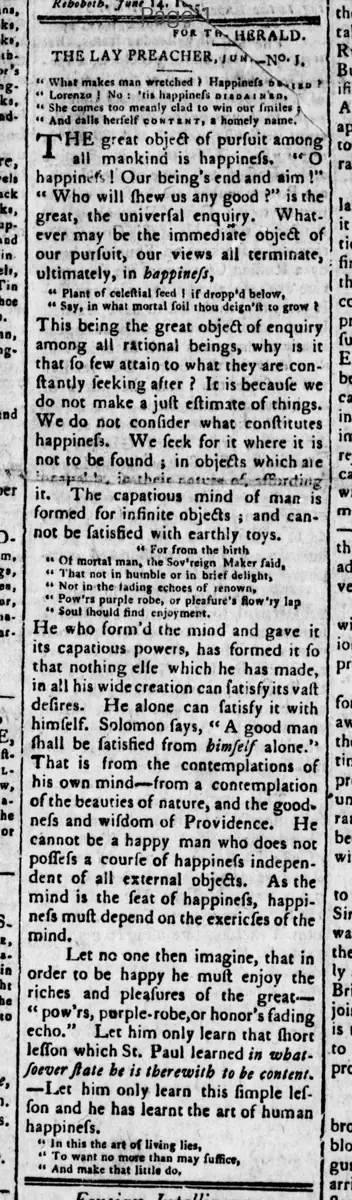
THE LAY PREACHER, JUN. NO. I.
"What makes man wretched? Happiness disdain'd?
Lorenzo! No: 'tis happiness Disdain'd,
She comes too meanly clad to win our Smiles
And calls herself content, a homely name."
THE great object of pursuit among all mankind is happiness. "O happiness! Our being's end and aim!" "Who will shew us any good?" is the great, the universal enquiry. Whatever may be the immediate object of our pursuit, our views all terminate, ultimately, in happiness,
"Plant of celestial seed! if dropp'd below,
Say, in what mortal soil thou deign'st to grow?"
This being the great object of enquiry among all rational beings, why is it that so few attain to what they are constantly seeking after? It is because we do not make a just estimate of things. We do not consider what constitutes happiness. We seek for it where it is not to be found; in objects which are incapable in their nature of, affording it. The capacious mind of man is formed for infinite objects; and cannot be satisfied with earthly toys.
"For from the birth
Of mortal man, the Sovereign Maker said,
That not in humble or in brief delight,
Not in the fading echoes of renown,
Pow'rs purple robe, or pleasure's flow'ry lap
Should find enjoyment."
He who form'd the mind and gave it its capacious powers, has formed it so that nothing else which he has made, in all his wide creation can satisfy its vast desires. He alone can satisfy it with himself. Solomon says, "A good man shall be satisfied from himself alone." That is from the contemplations of his own mind--from a contemplation of the beauties of nature, and the goodness and wisdom of Providence. He cannot be a happy man who does not possess a source of happiness independent of all external objects. As the mind is the seat of happiness, happiness must depend on the exercises of the mind.
Let no one then imagine, that in order to be happy he must enjoy the riches and pleasures of the great--- "pow'rs, purple-robe, or honor's fading echo." Let him only learn that short lesson which St. Paul learned in whatsoever state he is therewith to be content. --Let him only learn this simple lesson and he has learnt the art of human happiness.
"In this the art of living lies,
To want no more than may suffice,
And make that little do."
THE LAY PREACHER, JUN. NO. I.
"What makes man wretched? Happiness disdain'd?
Lorenzo! No: 'tis happiness Disdain'd,
She comes too meanly clad to win our Smiles
And calls herself content, a homely name."
THE great object of pursuit among all mankind is happiness. "O happiness! Our being's end and aim!" "Who will shew us any good?" is the great, the universal enquiry. Whatever may be the immediate object of our pursuit, our views all terminate, ultimately, in happiness,
"Plant of celestial seed! if dropp'd below,
Say, in what mortal soil thou deign'st to grow?"
This being the great object of enquiry among all rational beings, why is it that so few attain to what they are constantly seeking after? It is because we do not make a just estimate of things. We do not consider what constitutes happiness. We seek for it where it is not to be found; in objects which are incapable in their nature of, affording it. The capacious mind of man is formed for infinite objects; and cannot be satisfied with earthly toys.
"For from the birth
Of mortal man, the Sovereign Maker said,
That not in humble or in brief delight,
Not in the fading echoes of renown,
Pow'rs purple robe, or pleasure's flow'ry lap
Should find enjoyment."
He who form'd the mind and gave it its capacious powers, has formed it so that nothing else which he has made, in all his wide creation can satisfy its vast desires. He alone can satisfy it with himself. Solomon says, "A good man shall be satisfied from himself alone." That is from the contemplations of his own mind--from a contemplation of the beauties of nature, and the goodness and wisdom of Providence. He cannot be a happy man who does not possess a source of happiness independent of all external objects. As the mind is the seat of happiness, happiness must depend on the exercises of the mind.
Let no one then imagine, that in order to be happy he must enjoy the riches and pleasures of the great--- "pow'rs, purple-robe, or honor's fading echo." Let him only learn that short lesson which St. Paul learned in whatsoever state he is therewith to be content. --Let him only learn this simple lesson and he has learnt the art of human happiness.
"In this the art of living lies,
To want no more than may suffice,
And make that little do."
What sub-type of article is it?
Essay
What themes does it cover?
Moral Virtue
Temperance
Religious
What keywords are associated?
Happiness
Contentment
Moral Essay
Lay Preacher
Providence
Self Satisfaction
Literary Details
Title
The Lay Preacher, Jun. No. I.
Subject
On The Pursuit Of Happiness Through Contentment
Key Lines
"What Makes Man Wretched? Happiness Disdain'd?\Nlorenzo! No: 'Tis Happiness Disdain'd,\Nshe Comes Too Meanly Clad To Win Our Smiles\Nand Calls Herself Content, A Homely Name."
"O Happiness! Our Being's End And Aim!"
Solomon Says, "A Good Man Shall Be Satisfied From Himself Alone."
Let Him Only Learn That Short Lesson Which St. Paul Learned In Whatsoever State He Is Therewith To Be Content.
"In This The Art Of Living Lies,\Nto Want No More Than May Suffice,\Nand Make That Little Do."