Thank you for visiting SNEWPapers!
Sign up free
Keowee Courier
Walhalla, Pickens, Oconee County, Pickens County, South Carolina
What is this article about?
In a letter dated October 29, 1866, from Greenville, S.C., Hon. Benjamin F. Perry writes to Chas. W. Woodward in Philadelphia, vehemently opposing the 14th Amendment. He argues it would dishonor Southern states by granting unqualified citizenship and voting rights to African Americans, reducing Southern representation, and barring former Confederates from office, while asserting Southern resolve to reject it despite potential harsher consequences.
Clipping
OCR Quality
Full Text
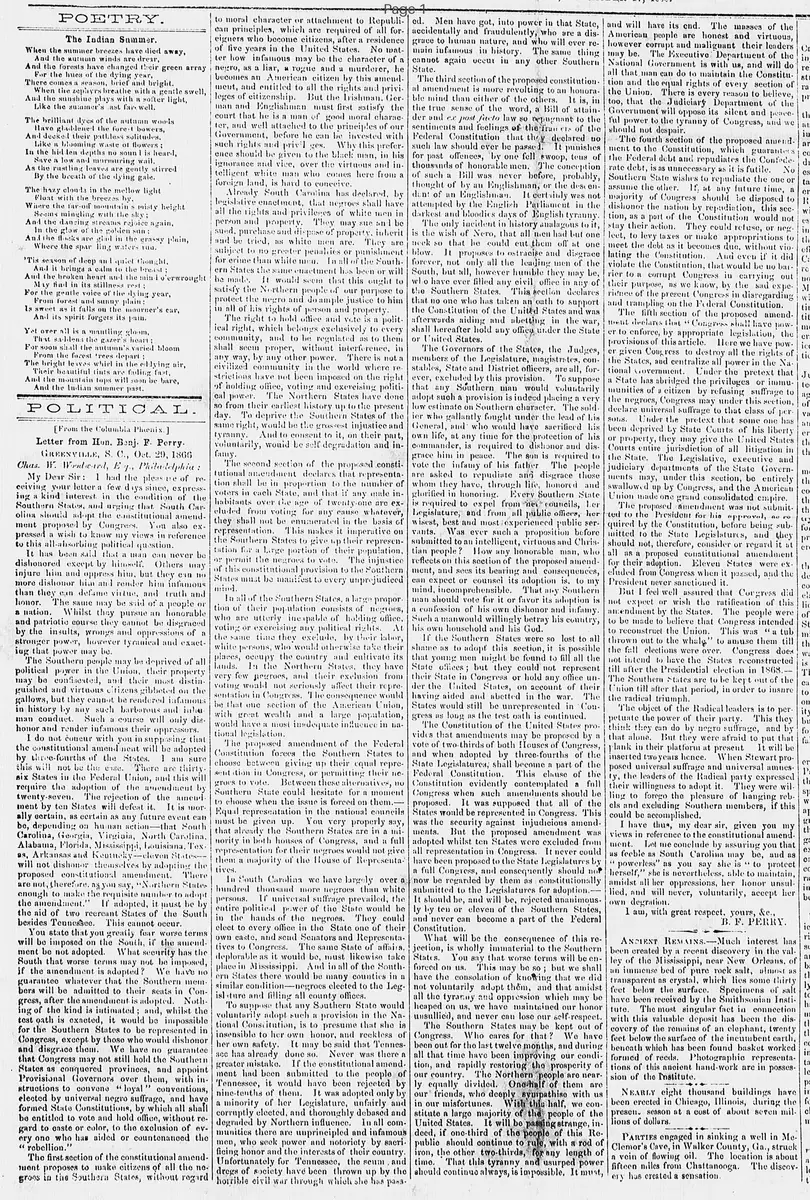
[From the Columbia Phoenix.]
Letter from Hon. Benj. F. Perry.
GREENVILLE, S. C., Oct. 29, 1866
Chas. W. Woodward, Esq., Philadelphia:
My Dear Sir: I had the pleasure of receiving your letter a few days since, expressing a kind interest in the condition of the Southern States, and urging that South Carolina should adopt the constitutional amendment proposed by Congress. You also expressed a wish to know my views in reference to this all-absorbing political question.
It has been said that a man can never be dishonored except by himself. Others may injure him and oppress him, but they can no more dishonor him and render him infamous than they can defeat virtue, and truth and honor. The same may be said of a people or a nation. Whilst they pursue an honorable and patriotic course they cannot be disgraced by the insults, wrongs and oppressions of a stronger power, however tyrannical and exacting that power may be.
The Southern people may be deprived of all political power in the Union, their property may be confiscated, and their most distinguished and virtuous citizens gibbeted on the gallows, but they cannot be rendered infamous in history by any such barbarous and inhuman conduct. Such a course will only dishonor and render infamous their oppressors.
I do not concur with you in supposing that the constitutional amendment will be adopted by three-fourths of the States. I am sure this will not be the case. There are thirty-six States in the Federal Union, and this will require the adoption of the amendment by twenty-seven. The rejection of the amendment by ten States will defeat it. It is morally certain, as certain as any future event can be, depending on human action—that South Carolina, Georgia, Virginia, North Carolina, Alabama, Florida, Mississippi, Louisiana, Texas, Arkansas and Kentucky—eleven States—will not dishonor themselves by adopting the proposed constitutional amendment. There are not, therefore, as you say, "Northern States enough to make the requisite number to adopt the amendment." If adopted, it must be by the aid of two recreant States of the South besides Tennessee. This cannot occur.
You state that you greatly fear worse terms will be imposed on the South, if the amendment be not adopted. What security has the South that worse terms may not be imposed, if the amendment is adopted? We have no guarantee whatever that the Southern members will be admitted to their seats in Congress, after the amendment is adopted. Nothing of the kind is intimated; and, whilst the test oath is exacted, it would be impossible for the Southern States to be represented in Congress, except by those who would dishonor and disgrace them. We have no guarantee that Congress may not still hold the Southern States as conquered provinces, and appoint Provisional Governors over them, with instructions to convene "loyal" conventions, elected by universal negro suffrage, and have formed State Constitutions, by which all shall be entitled to vote and hold office, without regard to caste or color, to the exclusion of every one who has aided or countenanced the "rebellion."
The first section of the constitutional amendment proposes to make citizens of all the negroes in the Southern States, without regard to moral character or attachment to Republican principles, which are required of all foreigners who become citizens, after a residence of five years in the United States. No matter how infamous may be the character of a negro, as a liar, a rogue and a murderer, he becomes an American citizen by this amendment, and entitled to all the rights and privileges of citizenship. But the Irishman, German and Englishman must first satisfy the court that he is a man of good moral character, and well attached to the principles of our Government, before he can be invested with such rights and privileges. Why this preference should be given to the black man, in his ignorance and vice, over the virtuous and intelligent white man who comes here from a foreign land, is hard to conceive.
Already South Carolina has declared, by legislative enactment, that negroes shall have all the rights and privileges of white men in person and property. They may sue and be sued, purchase and dispose of property, inherit and be tried, as white men are. They are subject to no greater penalties or punishment for crime than white men. In all of the Southern States the same enactment has been or will be made. It would seem that this ought to satisfy the Northern people of our purpose to protect the negro and do ample justice to him in all of his rights of person and property.
The right to hold office and vote is a political right, which belongs exclusively to every community, and to be regulated as to them shall seem proper, without interference in any way, by any other power. There is not a civilized community in the world where restrictions have not been imposed on the right of holding office, voting and exercising political power. The Northern States have done so from their earliest history up to the present day. To deprive the Southern States of the same right, would be the grossest injustice and tyranny. And to consent to it, on their part, voluntarily, would be self degradation and infamy.
The second section of the proposed constitutional amendment declares that representation shall be in proportion to the number of voters in each State, and that if any male inhabitants over the age of twenty-one are excluded from voting for any cause whatever, they shall not be enumerated in the basis of representation. This makes it imperative on the Southern States to give up their representation for a large portion of their population, or permit the negroes to vote. The injustice of this constitutional provision to the Southern States must be manifest to every unprejudiced mind.
In all of the Southern States, a large proportion of their population consists of negroes, who are utterly incapable of holding office, voting or exercising any political rights. At the same time they exclude, by their labor, white persons, who would otherwise take their places, occupy the country and cultivate its lands. In the Northern States, they have very few negroes, and their exclusion from voting would not seriously affect their representation in Congress. The consequence would be that one section of the American Union, with great wealth and a large population, would have a most inadequate influence in national legislation.
The proposed amendment of the Federal Constitution forces the Southern States to choose between giving up their equal representation in Congress, or permitting their negroes to vote. Between these alternatives, no Southern State could hesitate for a moment to choose when the issue is forced on them. Equal representation in the national councils must be given up. You very properly say, that already the Southern States are in a minority in both houses of Congress, and a full representation for their negroes would not give them a majority of the House of Representatives.
In South Carolina we have largely over a hundred thousand more negroes than white persons. If universal suffrage prevailed, the entire political power of the State would be in the hands of the negroes. They could elect to every office in the State one of their own caste, and send Senators and Representatives to Congress. The same state of affairs, deplorable as it would be, must likewise take place in Mississippi. And in all of the Southern States there would be many counties in a similar condition—negroes elected to the Legislature and filling all county offices.
To suppose that any Southern State would voluntarily adopt such a provision in the National Constitution, is to presume that she is insensible to her own honor, and reckless of her own safety. It may be said that Tennessee has already done so. Never was there a greater mistake. If the constitutional amendment had been submitted to the people of Tennessee, it would have been rejected by nine-tenths of them. It was adopted only by a minority of her Legislature, unfairly and corruptly elected, and thoroughly debased and degraded by Northern influence. In all communities there are unprincipled and infamous men, who seek power and notoriety by sacrificing honor and the interests of their country. Unfortunately for Tennessee, the scum and dregs of society have been thrown up by the horrible civil war through which she has passed.
Men have got into power in that State, accidentally and fraudulently, who are a disgrace to human nature, and who will ever remain infamous in history. The same thing cannot again occur in any other Southern State.
The third section of the proposed constitutional amendment is more revolting to an honorable mind than either of the others. It is, in the true sense of the word, a Bill of attainder and ex post facto law so repugnant to the sentiments and feelings of the framers of the Federal Constitution that they declared no such law should ever be passed. It punishes for past offences, by one fell swoop, tens of thousands of honorable men. The conception of such a Bill was never before, probably, thought of by an Englishman, or the descendant of an Englishman. It certainly was not attempted by the English Parliament in the darkest and bloodiest days of English tyranny.
The only incident in history analogous to it, is the wish of Nero, that all men had but one neck so that he could cut them off at one blow. It proposes to ostracise and disgrace forever, not only all the leading men of the South, but all, however humble they may be, who have ever filled any civil office in any of the Southern States. This section declares that no one who has taken an oath to support the Constitution of the United States and was afterwards aiding and abetting in the war, shall hereafter hold any office under the State or United States.
The Governors of the States, the Judges, members of the Legislature, magistrates, constables, State and District officers, are all, forever, excluded by this provision. To suppose that any Southern man would voluntarily adopt such a provision is indeed placing a very low estimate on Southern character. The soldier who gallantly fought under the lead of his General, and who would have sacrificed his own life, at any time for the protection of his commander, is required to dishonor and disgrace him in peace. The son is required to vote the infamy of his father. The people are asked to repudiate and disgrace those whom they have, through life, honored and glorified in honoring. Every Southern State is required to expel from her councils, her Legislature, and from all public offices, her wisest, best and most experienced public servants. Was ever such a proposition before submitted to an intelligent, virtuous and Christian people? How any honorable man, who reflects on this section of the proposed amendment, and sees its bearing and consequences, can expect or counsel its adoption is, to my mind, incomprehensible. That any Southern man should vote for it or favor its adoption is a confession of his own dishonor and infamy. Such a man would willingly betray his country, his own household and his God.
If the Southern States were so lost to all shame as to adopt this section, it is possible that young men might be found to fill all the State offices; but they could not represent their State in Congress or hold any office under the United States, on account of their having aided and abetted in the war. The States would still be unrepresented in Congress as long as the test oath is continued.
The Constitution of the United States provides that amendments may be proposed by a vote of two-thirds of both Houses of Congress, and when adopted by three-fourths of the State Legislatures, shall become a part of the Federal Constitution. This clause of the Constitution evidently contemplated a full Congress when such amendments should be proposed. It was supposed that all of the States would be represented in Congress. This was the security against injudicious amendments. But the proposed amendment was adopted whilst ten States were excluded from all representation in Congress. It never could have been proposed to the State Legislatures by a full Congress, and consequently should not now be regarded by them as constitutionally submitted to the Legislatures for adoption. It should be, and will be, rejected unanimously by ten or eleven of the Southern States, and never can become a part of the Federal Constitution.
What will be the consequence of this rejection, is wholly immaterial to the Southern States. You say that worse terms will be enforced on us. This may be so; but we shall have the consolation of knowing that we did not voluntarily adopt them, and that amidst all the tyranny and oppression which may be heaped on us, we have maintained our honor unsullied, and never can lose our self-respect.
The Southern States may be kept out of Congress. Who cares for that? We have been out for the last twelve months, and during all that time have been improving our condition, and rapidly restoring the prosperity of our country. The Northern people are nearly equally divided. One half of them are our friends, who deeply sympathize with us in our misfortunes. With this half, we constitute a large majority of the people of the United States. It will be passing strange, indeed, if one-third of the people of this Republic should continue to rule, with a rod of iron, the other two-thirds, for any length of time. That this tyranny and usurped power should continue always, is impossible. It must and will have its end. The masses of the American people are honest and virtuous, however corrupt and malignant their leaders may be. The Executive Department of the National Government is with us, and will do all that man can do to maintain the Constitution and the equal rights of every section of the Union. There is every reason to believe, too, that the Judiciary Department of the Government will oppose its silent and peaceful power to the tyranny of Congress, and we should not despair.
The fourth section of the proposed amendment to the Constitution, which guarantees the Federal debt and repudiates the Confederate debt, is as unnecessary as it is futile. No Southern State wishes to repudiate the one or assume the other. If, at any future time, a majority of Congress should be disposed to dishonor the nation by repudiation, this section, as a part of the Constitution would not stay their action. They could refuse, or neglect, to levy taxes or make appropriations to meet the debt as it becomes due, without violating the Constitution. And even if it did violate the Constitution, that would be no barrier to a corrupt Congress in carrying out their purpose, as we know, by the sad experience of the present Congress in disregarding and trampling on the Federal Constitution.
The fifth section of the proposed amendment declares that "Congress shall have power to enforce, by appropriate legislation, the provisions of this article." Here we have power given Congress to destroy all the rights of the States, and centralize all power in the National Government. Under the pretext that a State has abridged the privileges or immunities of a citizen by refusing suffrage to the negroes, Congress may under this section, declare universal suffrage to that class of persons. Under the pretext that some one has been deprived by State Courts of his liberty or property, they may give the United States Courts entire jurisdiction of all litigation in the State. The Legislative, executive and judiciary departments of the State Governments may, under this section, be entirely swallowed up by Congress, and the American Union made one grand consolidated empire.
The proposed amendment was not submitted to the President for his approval, as required by the Constitution, before being submitted to the State Legislatures, and they should not, therefore, consider or regard it at all as a proposed constitutional amendment for their adoption. Eleven States were excluded from Congress when it passed, and the President never sanctioned it.
But I feel well assured that Congress did not expect or wish the ratification of this amendment by the States. The people were to be made to believe that Congress intended to reconstruct the Union. This was "a tub thrown out to the whale" to amuse them till the fall elections were over. Congress does not intend to have the States reconstructed till after the Presidential election in 1868. The Southern States are to be kept out of the Union till after that period, in order to insure the radical triumph.
The object of the Radical leaders is to perpetuate the power of their party. This they think they can do by negro suffrage, and by that alone. But they were afraid to put that plank in their platform at present. It will be inserted two years hence. When Stewart proposed universal suffrage and universal amnesty, the leaders of the Radical party expressed their willingness to adopt it. They were willing to forego the pleasure of hanging rebels and excluding Southern members, if this could be accomplished.
I have thus, my dear sir, given you my views in reference to the constitutional amendment. Let me conclude by assuring you that as feeble as South Carolina may be, and as "powerless" as you say she is "to protect herself," she is nevertheless, able to maintain, amidst all her oppressions, her honor unsullied, and will never, voluntarily, accept her own degradation.
I am, with great respect, yours, &c.,
B. F. PERRY.
What sub-type of article is it?
What themes does it cover?
What keywords are associated?
What entities or persons were involved?
Letter to Editor Details
Author
B. F. Perry
Recipient
Chas. W. Woodward, Esq., Philadelphia
Main Argument
the proposed 14th amendment should be rejected by southern states as it would dishonor them by granting unqualified citizenship and voting rights to african americans, reducing southern congressional representation, barring former confederates from office, and centralizing power in congress, with no guarantee of readmission or better terms upon adoption.
Notable Details