Thank you for visiting SNEWPapers!
Sign up free
The Hattiesburg News
Hattiesburg, Forrest County, Perry County, Mississippi
What is this article about?
The income tax amendment's ratification enables Democrats to enact it alongside tariff revisions, potentially replacing lost import revenues with $100 million from the tax, amid debates on rates and its impact on U.S. fiscal policy.
Clipping
OCR Quality
Full Text
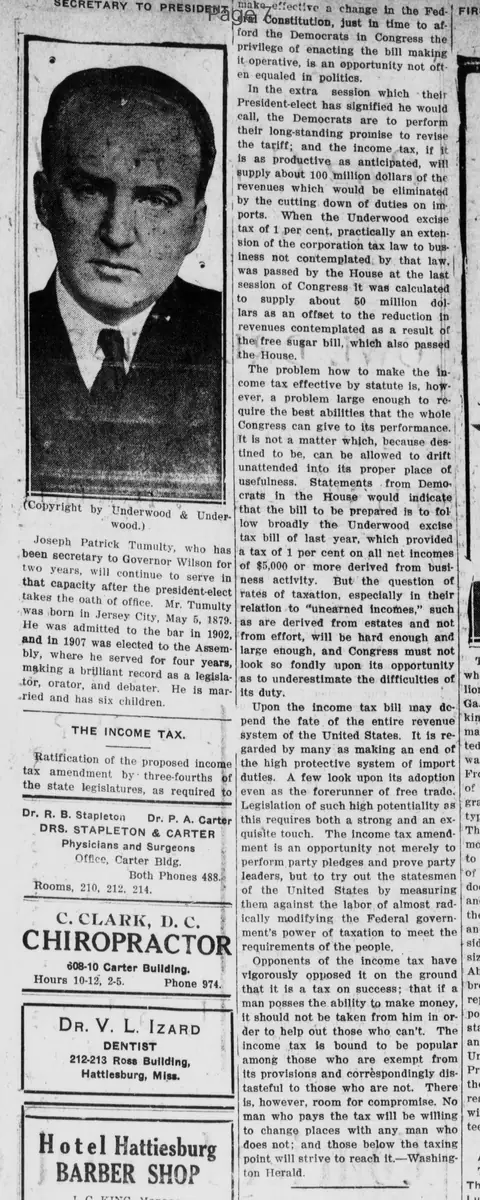
Ratification of the proposed income tax amendment by three-fourths of the state legislatures, as required to make it a part of the constitution, just in time to afford the Democrats in Congress the privilege of enacting the bill making it operative, is an opportunity not often equaled in politics.
In the extra session which their President-elect has signified he would call, the Democrats are to perform their long-standing promise to revise the tariff; and the income tax, if it is as productive as anticipated, will supply about 100 million dollars of the revenues which would be eliminated by the cutting down of duties on imports. When the Underwood excise tax of 1 per cent, practically an extension of the corporation tax law to business not contemplated by that law, was passed by the House at the last session of Congress it was calculated to supply about 50 million dollars as an offset to the reduction in revenues contemplated as a result of the free sugar bill, which also passed the House.
The problem how to make the income tax effective by statute is, however, a problem large enough to require the best abilities that the whole Congress can give to its performance. It is not a matter which, because destined to be, can be allowed to drift unattended into its proper place of usefulness. Statements from Democrats in the House would indicate that the bill to be prepared is to follow broadly the Underwood excise tax bill of last year, which provided a tax of 1 per cent on all net incomes of $5,000 or more derived from business activity. But the question of rates of taxation, especially in their relation to "unearned incomes," such as are derived from estates and not from effort, will be hard enough and large enough, and Congress must not look so fondly upon its opportunity as to underestimate the difficulties of its duty.
Upon the income tax bill may depend the fate of the entire revenue system of the United States. It is regarded by many as making an end of the high protective system of import duties. A few look upon its adoption even as the forerunner of free trade. Legislation of such high potentiality as this requires both a strong and an exquisite touch. The income tax amendment is an opportunity not merely to perform party pledges and prove party leaders, but to try out the statesmen of the United States by measuring them against the labor of almost radically modifying the Federal government's power of taxation to meet the requirements of the people.
Opponents of the income tax have vigorously opposed it on the ground that it is a tax on success; that if a man possesses the ability to make money, it should not be taken from him in order to help out those who can't. The income tax is bound to be popular among those who are exempt from its provisions and correspondingly distasteful to those who are not. There is, however, room for compromise. No man who pays the tax will be willing to change places with any man who does not; and those below the taxing point will strive to reach it.—Washington Herald.
What sub-type of article is it?
What keywords are associated?
What entities or persons were involved?
Domestic News Details
Key Persons
Outcome
ratification by three-fourths of state legislatures to make it part of the constitution; expected to supply about 100 million dollars in revenues to offset tariff reductions.
Event Details
Ratification of the proposed income tax amendment by three-fourths of the state legislatures allows Democrats in Congress to enact the bill. In an extra session called by the President-elect, Democrats plan to revise the tariff, using income tax revenues to replace those lost from reduced import duties. The Underwood excise tax of 1 per cent on net incomes over $5,000 from business was previously passed. Challenges include setting rates, especially for unearned incomes, and ensuring effectiveness. Opponents view it as a tax on success, but it may end high protective tariffs and lead toward free trade.