Thank you for visiting SNEWPapers!
Sign up free
The Kentucky Gazette
Lexington, Fayette County, Kentucky
What is this article about?
Historical documents from 1796-1797 detail diplomatic correspondence between U.S. and Spanish officials on boundary line demarcation between the United States and East/West Florida, including disputes over recruiting residents and treaty-related evacuation of posts along the Mississippi.
Merged-components note: These two components form a continuous series of official documents and correspondence regarding the boundary line between the United States and Spanish Florida, with sequential reading order indicating they belong to the same logical unit.
Clipping
OCR Quality
Full Text
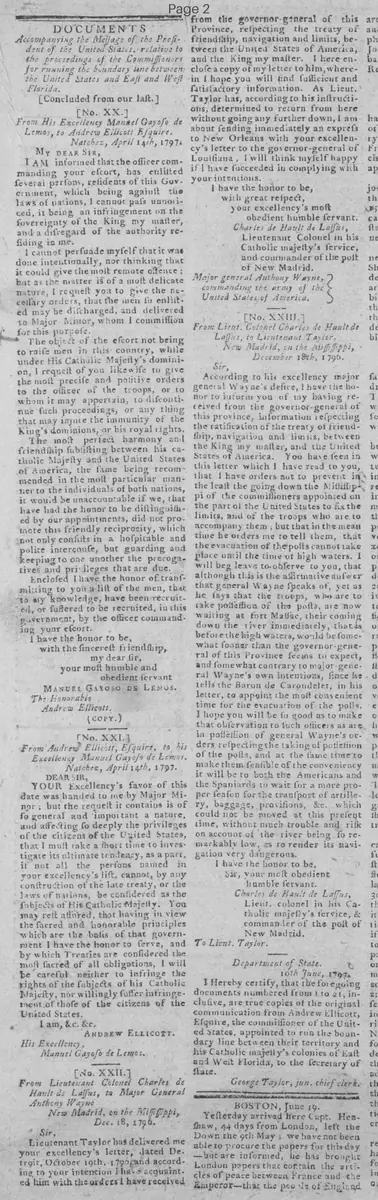
Accompanying the Message of the President of the United States.—relative to the proceedings of the Commissioners for running the boundary line between the United States and East and West Florida.
[Concluded from our last.]
[No. XX.]
From His Excellency Manuel Gayoso de Lemos, to Andrew Ellicott Esquire.
Natchez, April 14th, 1797
My DEAR SIR,
I AM informed that the officer commanding your escort, has enlisted several persons, residents of this Government, which being against the laws of nations, I cannot pass unnoticed, it being an infringement on the sovereignty of the King my master, and a disregard of the authority residing in it.
I cannot persuade myself that it was done intentionally, nor thinking that it could give the most remote offence; but as the matter is of a most delicate nature, I request you to give the necessary orders, that the men so enlisted may be discharged, and delivered to Major Minor, whom I commission for this purpose.
The object of the escort not being to raise men in this country, while under His Catholic Majesty's dominion, I request of you likewise to give the most precise and positive orders to the officer of the troops, or to whom it may appertain, to discontinue such proceedings, or any thing that may injure the immunity of the King's dominions, or his royal rights.
The most perfect harmony and friendship subsisting between his Catholic Majesty and the United States of America, the same being recommended in the most particular manner to the individuals of both nations, it would be unaccountable if we, that have had the honor to be distinguished by our appointments, did not promote this friendly reciprocity, which not only consists in a hospitable and polite intercourse, but guarding and keeping to one another the prerogatives and privileges that are due.
Enclosed I have the honor of transmitting to you a list of the men, that to my knowledge, have been recruited, or suffered to be recruited, in this government, by the officer commanding your escort.
I have the honor to be,
with the sincerest friendship,
my dear sir,
your most humble and
obedient servant
MANUEL GAYOSO DE LEMUS.
To The Honorable
Andrew Ellicott.
(copy.)
[No. XXI.]
From Andrew Ellicott, Esquire, to his Excellency Manuel Gayoso de Lemos.
Natchez, April 14th, 1797.
DEAR SIR,
YOUR Excellency's favor of this date was handed to me by Major Minor; but the request it contains is of so general and important a nature, and affecting so deeply the privileges of the citizens of the United States, that I must take a short time to investigate its ultimate tendency, as a part, if not all the persons named in your excellency's list, cannot, by any construction of the late treaty, or the laws of nations, be considered as the subjects of His Catholic Majesty. You may rest assured, that having in view the sacred and honorable principles which are the basis of that government I have the honor to serve, and by which Treaties are considered the most sacred of all obligations, I will be careful neither to infringe the rights of the subjects of his Catholic Majesty, nor willingly suffer infringement of those of the citizens of the United States.
I am, &c. &c.
Andrew Ellicott.
His Excellency,
Manuel Gayoso de Lemos.
[No. XXII.]
From Lieutenant Colonel Charles de Hault de Lassus, to Major General Anthony Wayne
New Madrid, on the Mississippi,
Dec. 18, 1796.
Sir,
Lieutenant Taylor has delivered me your excellency's letter, dated Detroit, October 19th, 1796, and according to your intention I have acquainted him with the orders I have received
from the governor-general of this Province, respecting the treaty of friendship, navigation and limits, between the United States of America, and the King my master. I here enclose a copy of my letter to him, wherein I hope you will find sufficient and satisfactory information. As Lieut. Taylor has, according to his instructions, determined to return from here without going any further down, I am about sending immediately an express to New Orleans with your excellency's letter to the governor-general of Louisiana, I will think myself happy if I have succeeded in complying with your intentions.
I have the honor to be,
with great respect,
your excellency's most
obedient humble servant.
Charles de Hault de Lassus,
Lieutenant Colonel in his
Catholic majesty's service,
and commander of the post
of New Madrid.
Major general Anthony Wayne,
commanding the army of the
United States of America.
[No. XXIII.]
From Lieut. Colonel Charles de Hault de Lassus, to Lieutenant Taylor.
New Madrid, on the Mississippi,
December 18th, 1796.
Sir,
According to his excellency major general Wayne's desire, I have the honor to inform you of my having received from the governor-general of this province, information respecting the ratification of the treaty of friendship, navigation and limits, between the King my master. and the United States of America. You have seen in this letter which I have read to you, that I have orders not to prevent in the least the going down the Mississippi of the commissioners appointed on the part of the United States to fix the limits, and of the troops who are to accompany them ; but that in the mean time he orders me to tell them, that the evacuation of the posts cannot take place until the time of high waters. I will beg leave to observe to you, that although this is the affirmative answer that general Wayne speaks of, yet as he says that the troops, who are to take possession of those posts, are now waiting at fort Massac, their coming down the river immediately, that is before the high waters, would become somewhat sooner than the governor-general of this Province seems to expect, and somewhat contrary to major-general Wayne's own intentions, since he tells the Baron de Carondelet, in his letter, to appoint the most convenient time for the evacuation of the posts. I hope you will be so good as to make that observation to such officers as are in possession of general Wayne's orders respecting the taking of possession of the posts, and at the same time to make them sensible of the conveniency it will be to both the Americans and the Spaniards to wait for a more proper season for the transport of artillery, baggage, provisions, &c. which could not be moved at this present time, without much trouble and risk on account of the river being so remarkably low, as to render its navigation very dangerous.
I have the honor to be,
Sir, your most obedient
humble servant.
Charles de Hault de Lassus,
Lieut. colonel in his Ca-
tholic majesty's service, &
commander of the post of
New Madrid.
To Lieut. Taylor.
Department of State.
10th June, 1797
I Hereby certify, that the foregoing
documents numbered from I to 21, in-
clusive, are true copies of the original
communication from Andrew Ellicott,
Esquire, the commissioner of the Unit-
ed States, appointed to run the boun-
dary line between their territory and
his Catholic majesty's colonies of East
and West Florida, to the secretary of
state.
George Taylor, jun. chief clerk.
What sub-type of article is it?
What keywords are associated?
What entities or persons were involved?
Where did it happen?
Foreign News Details
Primary Location
Natchez And New Madrid, Mississippi
Event Date
December 18, 1796; April 14, 1797
Key Persons
Outcome
diplomatic requests for discharge of enlisted residents; information on treaty ratification and delayed evacuation of posts until high waters due to low river levels.
Event Details
Correspondence between Spanish Governor Manuel Gayoso de Lemos and U.S. Commissioner Andrew Ellicott at Natchez addresses unauthorized enlistment of local residents by U.S. escort, requesting their discharge to uphold sovereignty and treaty obligations. Separate letters from Lieutenant Colonel Charles de Hault de Lassus at New Madrid to Major General Anthony Wayne and Lieutenant Taylor discuss treaty ratification, permission for U.S. commissioners and troops to proceed down the Mississippi, and the need to delay post evacuation until high waters for safe navigation.