Thank you for visiting SNEWPapers!
Sign up free
The New Hampshire Gazette
Portsmouth, Rockingham County, New Hampshire
What is this article about?
On February 13, 1794, a large town meeting in Boston at Faneuil Hall discussed the vital importance of the U.S. carrying trade, criticized British trade restrictions, and appointed a committee to report on commerce and influence Congress for protective measures. Debate highlighted support for French republicans and neutral rights.
Clipping
OCR Quality
Full Text
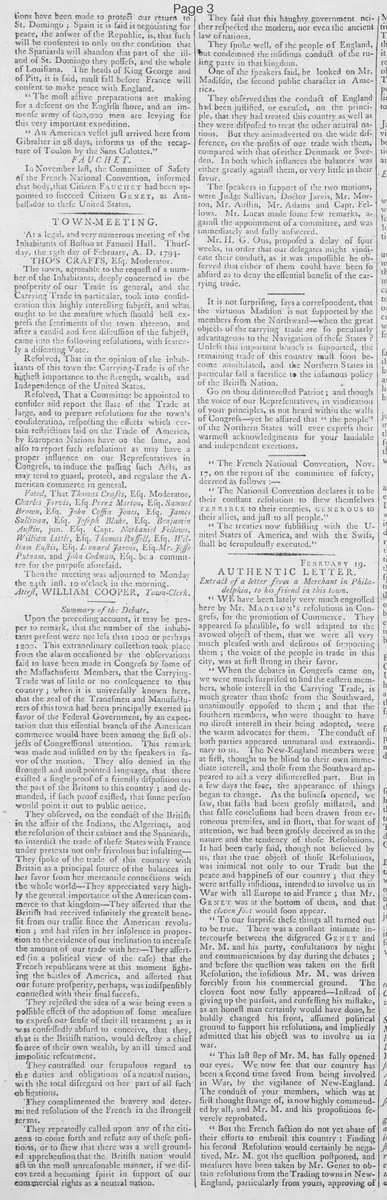
At a legal, and very numerous meeting of the Inhabitants of Boston at Faneuil Hall. Thursday, the 13th day of February, A. D. 1794.
THO'S CRAFTS, Esq. Moderator.
The town, agreeable to the request of a number of the Inhabitants, deeply concerned in the prosperity of our Trade in general, and the Carrying Trade in particular, took into consideration this highly interesting subject, and what ought to be the measure which should best express the sentiments of the town thereon, and after a candid and free discussion of the subject, came into the following resolutions, with scarcely a dissenting Vote.
Resolved, That in the opinion of the inhabitants of this town the Carrying-Trade is of the highest importance to the strength, wealth, and Independence of the United States.
Resolved, That a Committee be appointed to consider and report the state of the Trade at large, and to prepare resolutions for the town's consideration, respecting the effects which certain restrictions laid on the Trade of America, by European Nations have on the same, and also to report such resolutions as may have a proper influence on our Representatives in Congress, to induce the passing such Acts, as may tend to guard, protect, and regulate the American commerce in general.
Voted, That Thomas Crafts, Esq. Moderator, Charles Jarvis, Esq. Perez Morton, Esq. Samuel Brown, Esq. John Coffin Jones, Esq. James Sullivan, Esq. Joseph Blake, Esq. Benjamin Austin, jun. Esq. Capt. Nathaniel Fellows, William Little, Esq. Thomas Russell, Esq. William Eustis, Esq. Leonard Jarvis, Esq. Mr. Jesse Putnam, and John Codman, Esq. be a committee for the purpose aforesaid.
Then the meeting was adjourned to Monday the 24th inst. 10 o'clock in the morning.
Attest, WILLIAM COOPER, Town-Clerk.
Summary of the Debate.
Upon the preceding account, it may be proper to remark, that the number of the inhabitants present were not less than 1000 or perhaps 1200. This extraordinary collection took place from the alarm occasioned by the observations said to have been made in Congress by some of the Massachusetts Members, that the Carrying-Trade was of little or no consequence to this country; when it is universally known here, that the zeal of the Tradesmen and Manufacturers of this town had been principally exerted in favor of the Federal Government, by an expectation that this essential branch of the American commerce would have been among the first objects of Congressional attention. This remark was made and insisted on by the speakers in favor of the motion. They also denied in the strongest and most pointed language, that there existed a single proof of a friendly disposition on the part of the Britons to this country; and demanded, if such proof existed, that some person would point it out to public notice.
They observed, on the conduct of the British in the affair of the Indians, the Algerines, and the resolution of their cabinet and the Spaniards, to interdict the trade of these States with France under pretexts not only frivolous but insulting. They spoke of the trade of this country with Britain as a principal source of the balances in her favor from her mercantile connections with the whole world. They appreciated very highly the general importance of the American commerce to that kingdom. They asserted that the British had received infinitely the greatest benefit from our traffic since the American revolution: and had risen in her insolence in proportion to the evidence of our inclination to increase the amount of our trade with her. They asserted (in a political view of the case) that the French republicans were at this moment fighting the battles of America, and asserted that our future prosperity, perhaps, was indispensibly connected with their final success.
They rejected the idea of a war being even a possible effect of the adoption of some measure to express our sense of their ill treatment; as it was confessedly absurd to conceive, that they, that is the British nation, would destroy a chief source of their own wealth, by an ill timed and impolitic resentment.
They contrasted our scrupulous regard to the duties and obligations of a neutral nation, with the total disregard on her part of all such obligations.
They complimented the bravery and determined resolution of the French in the strongest terms.
They repeatedly called upon any of the citizens to come forth and refute any of these positions, or to shew that there was a well grounded apprehension that the British nation would act in the most unreasonable manner, if we discovered a becoming spirit in support of our commercial rights as a neutral nation.
They said that this haughty government neither respected the modern, nor even the ancient law of nations.
They spoke well, of the people of England, but condemned the insidious conduct of the ruling party in that kingdom.
One of the speakers said, he looked on Mr. Madison, the second public character in America.
They observed that the conduct of England had been justified, or excused. on the principle, that they had treated this country as well as they were disposed to treat the other neutral nations. But they animadverted on the wide difference, on the profits of our trade with them, compared with that of either Denmark or Sweden. In both which instances the balance was either greatly against them, or very little in their favor.
The speakers in support of the two motions, were Judge Sullivan, Doctor Jarvis, Mr. Morton, Mr. Austin, Mr. Adams and Capt. Fellows. Mr. Lucas made some few remarks, against the appointment of a committee, and was immediately and fully answered.
Mr. H. G. Otis, proposed a delay of four weeks, in order that our delegates might vindicate their conduct, as it was impossible he observed that either of them could have been so absurd as to deny the essential benefit of the carrying trade.
What sub-type of article is it?
What themes does it cover?
What keywords are associated?
What entities or persons were involved?
Where did it happen?
Story Details
Key Persons
Location
Boston, Faneuil Hall
Event Date
February 13, 1794
Story Details
Boston inhabitants hold a town meeting to affirm the importance of the carrying trade to U.S. strength and independence, appoint a committee to report on trade restrictions by European nations and influence Congress for protective acts, amid debate criticizing British conduct and supporting French efforts.