Thank you for visiting SNEWPapers!
Sign up free
Editorial
February 21, 1939
Imperial Valley Press
El Centro, Imperial County, California
What is this article about?
Willis Thornton's editorial draws parallels between Henry Adams' 1905 observations of European tensions in Paris and contemporary German expansionism under Hitler, cautioning that history's patterns recur without exact repetition, leading to similar dangers of war.
Clipping
OCR Quality
98%
Excellent
Full Text
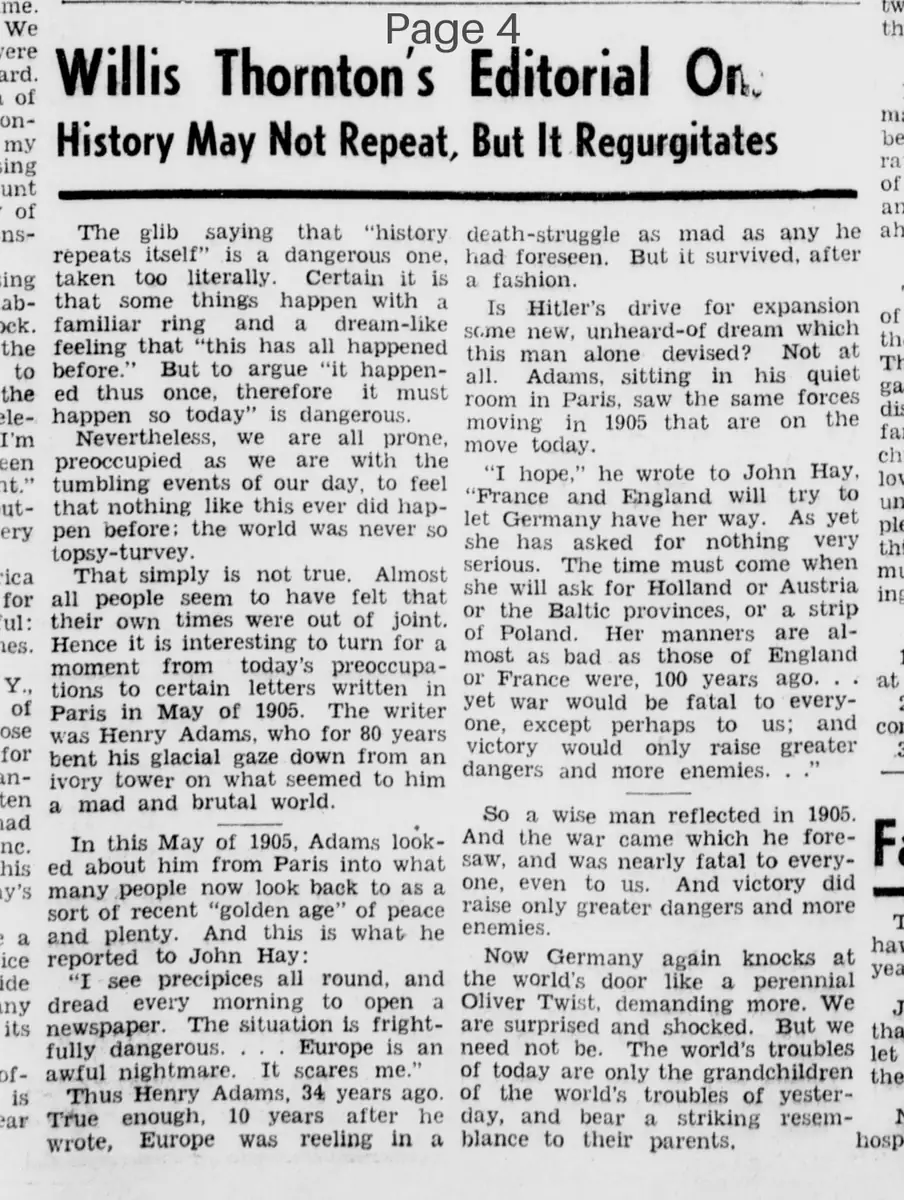
Willis Thornton's
Editorial
On
History
May
Not Repeat,
But It Regurgitates
The glib saying that "history repeats itself" is a dangerous one, taken too literally. Certain it is that some things happen with a familiar ring and a dream-like feeling that "this has all happened before." But to argue "it happened thus once, therefore it must happen so today" is dangerous.
Nevertheless, we are all prone, preoccupied as we are with the tumbling events of our day, to feel that nothing like this ever did happen before; the world was never so topsy-turvy.
That simply is not true. Almost all people seem to have felt that their own times were out of joint. Hence it is interesting to turn for a moment from today's preoccupations to certain letters written in Paris in May of 1905. The writer was Henry Adams, who for 80 years bent his glacial gaze down from an ivory tower on what seemed to him a mad and brutal world.
In this May of 1905, Adams looked about him from Paris into what many people now look back to as a sort of recent "golden age" of peace and plenty. And this is what he reported to John Hay:
"I see precipices all round, and dread every morning to open a newspaper. The situation is frightfully dangerous. . . . Europe is an awful nightmare. It scares me."
Thus Henry Adams, 34 years ago. True enough, 10 years after he wrote, Europe was reeling in a death-struggle as mad as any he had foreseen. But it survived, after a fashion.
Is Hitler's drive for expansion some new, unheard-of dream which this man alone devised? Not at all. Adams, sitting in his quiet room in Paris, saw the same forces moving in 1905 that are on the move today.
"I hope," he wrote to John Hay, "France and England will try to let Germany have her way. As yet she has asked for nothing very serious. The time must come when she will ask for Holland or Austria or the Baltic provinces, or a strip of Poland. Her manners are almost as bad as those of England or France were, 100 years ago. . . yet war would be fatal to everyone, except perhaps to us: and victory would only raise greater dangers and more enemies. . ."
So a wise man reflected in 1905. And the war came which he foresaw, and was nearly fatal to everyone, even to us. And victory did raise only greater dangers and more enemies.
Now Germany again knocks at the world's door like a perennial Oliver Twist, demanding more. We are surprised and shocked. But we need not be. The world's troubles of today are only the grandchildren of the world's troubles of yesterday, and bear a striking resemblance to their parents.
Editorial
On
History
May
Not Repeat,
But It Regurgitates
The glib saying that "history repeats itself" is a dangerous one, taken too literally. Certain it is that some things happen with a familiar ring and a dream-like feeling that "this has all happened before." But to argue "it happened thus once, therefore it must happen so today" is dangerous.
Nevertheless, we are all prone, preoccupied as we are with the tumbling events of our day, to feel that nothing like this ever did happen before; the world was never so topsy-turvy.
That simply is not true. Almost all people seem to have felt that their own times were out of joint. Hence it is interesting to turn for a moment from today's preoccupations to certain letters written in Paris in May of 1905. The writer was Henry Adams, who for 80 years bent his glacial gaze down from an ivory tower on what seemed to him a mad and brutal world.
In this May of 1905, Adams looked about him from Paris into what many people now look back to as a sort of recent "golden age" of peace and plenty. And this is what he reported to John Hay:
"I see precipices all round, and dread every morning to open a newspaper. The situation is frightfully dangerous. . . . Europe is an awful nightmare. It scares me."
Thus Henry Adams, 34 years ago. True enough, 10 years after he wrote, Europe was reeling in a death-struggle as mad as any he had foreseen. But it survived, after a fashion.
Is Hitler's drive for expansion some new, unheard-of dream which this man alone devised? Not at all. Adams, sitting in his quiet room in Paris, saw the same forces moving in 1905 that are on the move today.
"I hope," he wrote to John Hay, "France and England will try to let Germany have her way. As yet she has asked for nothing very serious. The time must come when she will ask for Holland or Austria or the Baltic provinces, or a strip of Poland. Her manners are almost as bad as those of England or France were, 100 years ago. . . yet war would be fatal to everyone, except perhaps to us: and victory would only raise greater dangers and more enemies. . ."
So a wise man reflected in 1905. And the war came which he foresaw, and was nearly fatal to everyone, even to us. And victory did raise only greater dangers and more enemies.
Now Germany again knocks at the world's door like a perennial Oliver Twist, demanding more. We are surprised and shocked. But we need not be. The world's troubles of today are only the grandchildren of the world's troubles of yesterday, and bear a striking resemblance to their parents.
What sub-type of article is it?
War Or Peace
Foreign Affairs
What keywords are associated?
History Repeats
Henry Adams
European Tensions
German Expansion
World War Foreshadowing
Adams Letters
What entities or persons were involved?
Henry Adams
John Hay
Hitler
Germany
France
England
Editorial Details
Primary Topic
Historical Parallels In European Expansionism And War Risks
Stance / Tone
Reflective And Cautionary
Key Figures
Henry Adams
John Hay
Hitler
Germany
France
England
Key Arguments
History Does Not Repeat Exactly But Shows Familiar Patterns
Adams Foresaw European War In 1905 Similar To Today's Tensions
Appeasing Germany's Demands Risks Greater Dangers
World War I Victory Led To More Enemies
Current German Expansion Echoes Past Aggressions