Thank you for visiting SNEWPapers!
Sign up free
The Warner Weekly Sun
Warner, Brown County, South Dakota
What is this article about?
Detailed description of the traditional Virginia method for curing hams, including preparation, dry salting, peppering with molasses or sugar, and smoking with green hickory or oak wood to achieve flavor and color.
Clipping
OCR Quality
Full Text
Country Gentleman
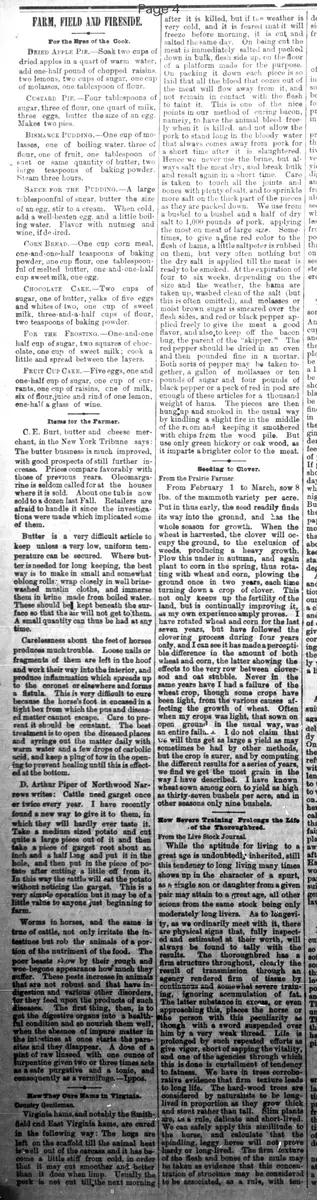
Virginia hams, and notably the Smithfield and East Virginia hams, are cured in the following way: The hogs are left on the scaffold till the animal heat is well out of the carcass and it has become a little stiff from cold, in order that it may cut smoother and better than it does when limp. Usually the pork is not cut till the next morning after it is killed, but if the weather is very cold, and it is feared that it will freeze before morning, it is cut and salted the same day. On being cut the meat is immediately salted and packed down in bulk, flesh side up, on the floor of a platform made for the purpose. On packing it down each piece is so laid that all the blood that oozes out of the meat will flow away from it, and not remain in contact with the flesh to taint it. This is one of the nice points in our method of curing bacon, namely, to have the animal bleed freely when it is killed, and not allow the pork to stand long in the bloody water that always comes away from pork for a short time after it is slaughtered. Hence we never use the brine, but always salt the meat dry, and break bulk and resalting again in a short time. Care is taken to touch all the joints and bones with plenty of salt, and to sprinkle more salt on the thick part of the pieces as they are packed down. We use from a bushel to a bushel and a half of dry salt to 1,000 pounds of pork, applying the most on meat of large size. Sometimes, to give a fine red color to the flesh of hams, a little saltpeter is rubbed on them, but very often nothing but the dry salt is applied till the meat is ready to be smoked. At the expiration of four to six weeks, depending on the size and the weather, the hams are taken up, washed clean of the salt (but this is often omitted), and molasses or moist brown sugar is smeared over the flesh sides, and red or black pepper applied freely to give the meat a good flavor, and also to keep off the bacon bug, the parent of the "skipper." The red pepper should be dried in an oven and then pounded fine in a mortar. Both sorts of pepper may be taken together, a gallon of molasses or ten pounds of sugar and four pounds of black pepper or a peck of red in pod are enough of these articles for a thousand weight of hams. The pieces are then hung up and smoked in the usual way by kindling a slight fire in the middle of the room and keeping it smothered with chips from the wood pile. But use only green hickory or oak wood, as it imparts a brighter color to the meat.
What sub-type of article is it?
What keywords are associated?
Where did it happen?
Domestic News Details
Primary Location
Virginia
Event Details
The hogs are left on the scaffold till the animal heat is well out of the carcass and it has become a little stiff from cold, in order that it may cut smoother and better than it does when limp. Usually the pork is not cut till the next morning after it is killed, but if the weather is very cold, and it is feared that it will freeze before morning, it is cut and salted the same day. On being cut the meat is immediately salted and packed down in bulk, flesh side up, on the floor of a platform made for the purpose. On packing it down each piece is so laid that all the blood that oozes out of the meat will flow away from it, and not remain in contact with the flesh to taint it. This is one of the nice points in our method of curing bacon, namely, to have the animal bleed freely when it is killed, and not allow the pork to stand long in the bloody water that always comes away from pork for a short time after it is slaughtered. Hence we never use the brine, but always salt the meat dry, and break bulk and resalting again in a short time. Care is taken to touch all the joints and bones with plenty of salt, and to sprinkle more salt on the thick part of the pieces as they are packed down. We use from a bushel to a bushel and a half of dry salt to 1,000 pounds of pork, applying the most on meat of large size. Sometimes, to give a fine red color to the flesh of hams, a little saltpeter is rubbed on them, but very often nothing but the dry salt is applied till the meat is ready to be smoked. At the expiration of four to six weeks, depending on the size and the weather, the hams are taken up, washed clean of the salt (but this is often omitted), and molasses or moist brown sugar is smeared over the flesh sides, and red or black pepper applied freely to give the meat a good flavor, and also to keep off the bacon bug, the parent of the "skipper." The red pepper should be dried in an oven and then pounded fine in a mortar. Both sorts of pepper may be taken together, a gallon of molasses or ten pounds of sugar and four pounds of black pepper or a peck of red in pod are enough of these articles for a thousand weight of hams. The pieces are then hung up and smoked in the usual way by kindling a slight fire in the middle of the room and keeping it smothered with chips from the wood pile. But use only green hickory or oak wood, as it imparts a brighter color to the meat.