Thank you for visiting SNEWPapers!
Sign up free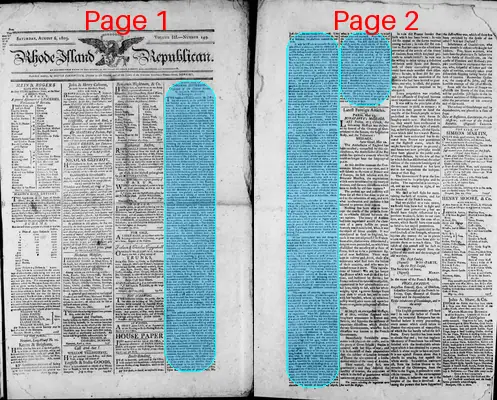
Rhode Island Republican
Newport, Newport County, Rhode Island
What is this article about?
Allan B. Magruder of Lexington, Kentucky, delivers a laudatory biographical sketch of Thomas Jefferson, emphasizing his intellectual virtues, patriotic sacrifices during the American Revolution, sound political principles rooted in nature and reason, diplomatic achievements in France, and suitability as a statesman and U.S. President.
Merged-components note: This is a continuation of the character sketch of Thomas Jefferson across pages, best classified as an editorial opinion piece.
Clippings

1 of 2
OCR Quality
Full Text
THOMAS JEFFERSON.
President of the United States.
By Allan B. Magruder,
Of Lexington, (Ken.)
The superior distinction which Mr. Jefferson
has acquired, in the political world.
was founded upon the alliance of virtue and
fortune. Great events give birth to great talents.
It is not difficult to say, however, that
had the revolution in America never taken
place, he would have arisen to considerable fame,
in the republics of letters and philosophy. The
advantages of an excellent education, habits of
application and study, were circumstances that
gave to his mind an inclination for philosophical
and literary pursuits.—His Notes on the
State of Virginia, a work though incomplete,
and considered merely as bearing the characters
of its style, is however not without considerable
merit.—It discovers a mind at once sagacious
and inquisitive; and capable, by the gradual
means of experiment and rational deduction, of
unfolding the sublimest principles of truth.—
But the same great event which has immortalized the genius of American patriotism, and
drawn from obscurity the most brilliant talents
in the field and the cabinet, paid an equal tribute
to the virtues of Mr. Jefferson, and gave him
distinction in the first rank of statesmen.—At
the first shock of that convulsion, which eventually separated the continent of America from
Great-Britain, the philosophical apparatus fell
from his hand. Governed by that genuine patriotism which sacrifices private interest to public felicity, he exchanged rural ease and retirement for the bustle of active life, the amusements of the laboratory for the more interesting duties of the cabinet.—In this situation,
Mr. Jefferson appears to have been designed by
fortune, and accident, to combine with the holiday the durability of a reputation. His advancement was gradual; and every step of it,
was marked by a display of talents that was
equally honorable to himself and competent to
the difficulties occasioned by—the precipitancy of events. There is a contemptible activity which
sacrifices personal dignity and independence to
the rage of ambition and the desire of fame.
Not contented with the internal consciousness of
deserving applause, and waiting, with composure, for the period which shall bestow it, it
goes in search of unmerited laurels, and courts
the acquisition, -at the expense of every engagement of delicacy and propriety.—This imputation never tarnished the character of Mr. Jefferson. The suffrages of his country were wisely
disposed of. He deserved consideration and he
obtained it. He never followed fame; but
fame appears to have pursued him, through every department, in which fortune or accident
may have placed him. An understanding clear
and sagacious, integrity unpolluted by public
reproach or private malice, and principles whose
soundness and moderation are the best testimonials of their sincerity, were qualifications that
called him to the highest departments of state.
If I may be permitted, to give an opinion
of the political principles of Mr. Jefferson, it will
be drawn from the aggregate qualifications of
his character.—This mode, however, may be a
very fallible one in forming the judgment; because the most manly virtues, and the most brilliant intellects, are, too frequently, in conflict
with the latent feelings of the heart. But it
would be uncharitable, in the present instance,
to conceive of a disparity, which nothing confirms and every thing refutes. It would be
barbarous to violate the Sentiments of benevolence; and to reproach the judgment with a defect, without the evidence of truth and reason.—It is difficult to make the progress of personal interest, in the actions of a man, every part
of whose conduct has been connected together,
by a chain of uniform morality, whose tone is
decisive, whose style and language, clear and
nervous, whose principles convey the reality of
justice and the convictions of experience and reflection.
The political principles of Mr. Jefferson,
are drawn from an expanded intellect, that consults the oracles of nature and reason as its only
guides.—Born at a period when the whole universe was convulsed by the conflicting passions
of mankind; his study is to reconcile the jarring
elements and to extract felicity and order from
misery and confusion. Experience and observation have pointed out to him the wrecks of
ambition, and the despotism of error and prejudice. They have conveyed his mind through
the various regions of society, familiarized it
with the melancholy exhibitions of lost dignity,
of injured innocence, of polluted virtue; and
left it in the awful contemplation of scenes, at
which his humanity shudders.—It is no wonder,
therefore, that his opinions are the pious innovations of the philosopher, who wishes to repair
the injuries which an unjust policy has occasioned in the world; that he cherishes them as a
peculiar tribute to his own feelings, which the
understanding confirms and the heart ratifies.
Upon this moral plan of philanthropy, Mr.
Jefferson is the true citizen of the world. Like Cato he feels an attachment for his country, but like Socrates, his affections embrace the universe.
It will be difficult to reconcile the principles of such a character, with the views and inclinations that govern the parasite of despotism. The first are founded upon a basis whose truth is irresistible; whose origin is nature; whose attributes, morality; whose essence, reason.
The last erect nature at defiance, considers morality as mummery, and reason as a fool. Therefore, Mr. Jefferson dares in opinion with many of his countrymen, it is because he differs in the degree of estimation in which these things are mutually held. He considers nature the source of every human right, morality the basis, and reason the unerring guide of every human action. Of course he perceives no grades in society, no partial distinctions; considers the people as the source of all power, and the peculiar guardians of their own rights. He makes allowances for the particular situation in which he has found mankind. He endeavors to reconcile their different interests by institutions that are calculated to produce the most extensive and complete felicity. Consulting nature, his maxims of government are simple and refined. They do not partake too much of that overstrained energy, which borders on oppression, or of that loose, licentious fanaticism, which is connected with the subversion of all order and security in government. They point eventually to a reform of abuses, which have constituted the greatest share of misery in society; which he considers the excellence of state, and the germ of despotism.
It is said that Mr. Jefferson is a philosopher; that consequently he possesses a peculiar cast of mind, that unfits him for the duties of a statesman. Let this objection rest in the bosom of the illiberal parasite of power, who is at the footstool of despotism, and dreads the influence of a single qualification that might soften the afflictions of a nation. For my part, I perceive not the incompatibility complained of. The philosopher is nothing more than a being, whose morality is elevated; whose opinions are drawn from the convictions of truth & reason: whose expanded intellect disdains the shackles of prejudice, and whose soul looks with complacency upon the errors and fallibilities of mankind.
The reverse of these qualifications, constitutes the features of tyranny, whenever it is blended with extensive power. There is an invisible chain which connects immorality with a contempt for truth, a contempt for truth with the delusions of error, and the delusions of error with the most brutish tyranny. Hence the licentiousness of courts, and the patriotic crimes of an patriot: hence that cold philosophy which chills the warmth of benevolence, and sacrifices, on the polluted altar of despotism, the felicity of millions.
Disdaining the character of the courtier, where pusillanimity and flattery are the steps by which the sycophant rises to fame and distinction, Mr. Jefferson has ascended the highest office of government, by his own intrinsic merit. The simplicity of his manners and the reservedness of his temper, are the characteristics of a vigorous mind, which grasps at higher objects than the mere art of pleasing. Yet there is no man in private life more amiable, none more dignified, and none whose manners possess, in a higher degree, the incomparable felicity of inspiring that combined emotions of attachment and respect.
He has contemplated men and things in the different lights in which they are, and in which they should be. His reflections on this subject are the sources of his humanity and forbearance; qualifications which travel, business and books, have matured into practice, and given to his mind a degree of philosophical tranquility, infinitely superior to most of his contemporaries. Let not this placidity of temper be mistaken for coldness and apprehension. He does not possess an understanding incapable of being inspired with intrepidity, when great objects demand its energy. The American declaration of independence, his negotiations in several of the most subtle cabinets of Europe, and his communications with the intriguing ministers of France and England, while secretary of State, will remain the durable memorial of a great mind, at once capable of combining the various qualifications of energy, deliberate coolness and penetration.
The candor of amicable negotiation, is too frequently the victim of court intrigue and of diplomatic ceremony. There was no cabinet that afforded more pretexts for both, than the court of Louis the 16th. To mislead, to bribe, and to corrupt by all the arts of chicanery and deceit, constituted the peculiar skill of every minister, and were the preliminaries of every negotiation. When Mr. Jefferson went to France, he carried with him the friendly views of a people whose simplicity had not been corrupted, and whose manners, founded upon that candor which flows from an elevated freedom, disarmed the licentiousness of a court, that was calculated to embarrass and betray. Arrived there, it was very reasonable to suppose, that the recent dismemberment of the American colonies from Great Britain, and the natural inveteracy which had for ages, existed between the cabinets of France and England, would have been the means of depreciating the popularity of our negotiator. Mr. Jefferson at, an early period of his residence at the court of the tyrant foresaw, with the intuitive eye of sagacity, what he might reasonably expect from the opposition of the latter. His unshaken integrity, however; his candor and impartiality, were the grounds for fair dealings from all parties. They not only inspired the friendship and confidence of the Count de Montmorin, the venal minister of a corrupted court, but of that party, who from sentiment, felt favorably disposed towards the American revolution. This could only be the result of a principle, which with courts as well as with individuals gives to character the impulse of involuntary respect, when it is found to be invulnerable to unjust calumniation and reproach. Were those views of the French cabinet disclosed? Mr. Jefferson studied them. The first cause and the probable effect, were the direct objects of investigation. Were they hid from his immediate inspection? He assumed the powers & the language of prophecy: predicted with the sagacity of an ingenious mind, and unfolded, so far as the comprehension of and the nature of things would permit. Accustomed to judge of men, more by their actions than their professions, and constantly in the habit of regulating himself by the former, the courtly language of dissimulation, made no impression on him. It was by a display of those qualifications, so little looked for, in the ambassador of a rustic people, that he preserved his own, and the dignity of the nation he represented. Recalled to fill the department of State, he left France, after having rendered to his country as much service by his abilities, as he had bestowed honor on himself, by the combination of the various qualities of integrity, sagacity, and prudence. He quit it, leaving on the mind of the nation, those sentiments of veneration and respect which have not been erased by the recent convulsions of state.
[To be concluded in our next.]
What sub-type of article is it?
What keywords are associated?
What entities or persons were involved?
Editorial Details
Primary Topic
Character And Political Principles Of Thomas Jefferson
Stance / Tone
Admiring Praise Of Jefferson's Virtues, Intellect, And Statesmanship
Key Figures
Key Arguments