Thank you for visiting SNEWPapers!
Sign up free
Story
December 24, 1893
The Morning News
Savannah, Chatham County, Georgia
What is this article about?
The article compares sizes of modern large animals to their extinct counterparts, noting most are smaller, but exceptions like whales, rhinos, and especially giraffes exist. Giraffes are deemed the tallest living mammals and possibly all quadrupedal animals ever, with males reaching up to 18 feet.
Clipping
OCR Quality
98%
Excellent
Full Text
The Tallest Extant Animal.
From Knowledge.
Compared with their extinct allies of earlier periods of the earth's history, it may be laid down as a general rule that the large animals of the present day are decidedly inferior in point of size. During the latter portion of the tertiary period, for instance, before the incoming of the glacial epoch, when mammals appear to have attained their maximum development, there lived elephants alongside of which ordinary individuals of the existing species would have looked almost dwarfs, while the cave bear and the cave hyena attained considerably larger dimensions than their living representatives, and some of the sable-toothed tigers must have been considerably larger than the biggest African lion or Bengal lion.
Again, the remains of red deer, bison, and wild oxen disinterred from the caverns and other surficial deposits of this country indicate animals far superior in size to their degenerate descendants of the present day, while some of the extinct pigs from the Siwalik hills of Northern India might be compared in stature to a tapir rather than an ordinary wild boar. The same story is told of reptiles, the giant tortoise of the Siwalik hills, in spite of the dimensions having been considerably exaggerated, greatly exceeding in size the largest living giant tortoises of either the Mascarene or the Galapagos Islands. The latter have also yielded the remains of a long-snouted crocodile, allied to the gavial of the Ganges, which probably measures from fifty to sixty feet in length, whereas it is very doubtful if any existing member of the order exceeds half the smaller of these dimensions. If, moreover, we took into account totally extinct types, such as the megatheres and mylodons of South America, and contrasting them with their nearest living allies—in this instance the sloths and anteaters—the discrepancy in size would be still more marked, but such a comparison would scarcely be analogous to the above.
To every rule there is, however, an exception, and there are a few groups of living large mammals whose existing members appear never to have been surpassed in size by their fossil relatives. Foremost among these are the whales, which now appear to include the largest members of the order which have ever existed. The so called white, or square-mouthed rhinoceros, of South Africa, seems also to be fully equal in size to any of its extinct ancestors; and the same is certainly true of the giraffe, which may even exceed all its predecessors in this respect. Whether, however, the fossil giraffes, of which more anon, were or were not the equals in height of the largest individuals of the living species, there is no question but that the latter is by far the tallest of all living mammals, and that it was only rivalled in this respect among extinct forms by its aforesaid ancestors. Moreover, if we include creatures like some of the gigantic dinosaurian reptiles of the secondary epoch, which, so to speak, gained an unfair advantage as regards height by sitting on their hind legs in a kangaroo-like manner, and limit our comparison to such as walk on all four feet in the good-old-fashioned way, we shall find that giraffes are not only the tallest mammals, but likewise the tallest of all animals that have ever existed.
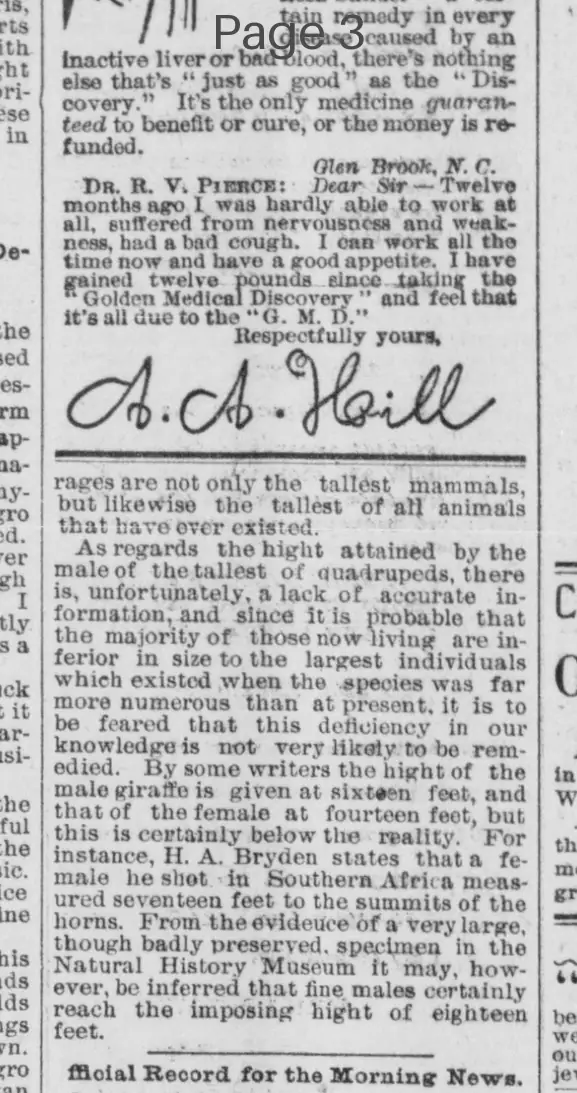
As regards the height attained by the male of the tallest of quadrupeds, there is, unfortunately, a lack of accurate information, and since it is probable that the majority of those now living are inferior in size to the largest individuals which existed when the species was far more numerous than at present, it is to be feared that this deficiency in our knowledge is not very likely to be remedied. By some writers the height of the male giraffe is given at sixteen feet, and that of the female at fourteen feet, but this is certainly below the reality. For instance, H. A. Bryden states that a female he shot in Southern Africa measured seventeen feet to the summits of the horns. From the evidence of a very large, though badly preserved, specimen in the Natural History Museum it may, however, be inferred that fine males certainly reach the imposing height of eighteen feet.
From Knowledge.
Compared with their extinct allies of earlier periods of the earth's history, it may be laid down as a general rule that the large animals of the present day are decidedly inferior in point of size. During the latter portion of the tertiary period, for instance, before the incoming of the glacial epoch, when mammals appear to have attained their maximum development, there lived elephants alongside of which ordinary individuals of the existing species would have looked almost dwarfs, while the cave bear and the cave hyena attained considerably larger dimensions than their living representatives, and some of the sable-toothed tigers must have been considerably larger than the biggest African lion or Bengal lion.
Again, the remains of red deer, bison, and wild oxen disinterred from the caverns and other surficial deposits of this country indicate animals far superior in size to their degenerate descendants of the present day, while some of the extinct pigs from the Siwalik hills of Northern India might be compared in stature to a tapir rather than an ordinary wild boar. The same story is told of reptiles, the giant tortoise of the Siwalik hills, in spite of the dimensions having been considerably exaggerated, greatly exceeding in size the largest living giant tortoises of either the Mascarene or the Galapagos Islands. The latter have also yielded the remains of a long-snouted crocodile, allied to the gavial of the Ganges, which probably measures from fifty to sixty feet in length, whereas it is very doubtful if any existing member of the order exceeds half the smaller of these dimensions. If, moreover, we took into account totally extinct types, such as the megatheres and mylodons of South America, and contrasting them with their nearest living allies—in this instance the sloths and anteaters—the discrepancy in size would be still more marked, but such a comparison would scarcely be analogous to the above.
To every rule there is, however, an exception, and there are a few groups of living large mammals whose existing members appear never to have been surpassed in size by their fossil relatives. Foremost among these are the whales, which now appear to include the largest members of the order which have ever existed. The so called white, or square-mouthed rhinoceros, of South Africa, seems also to be fully equal in size to any of its extinct ancestors; and the same is certainly true of the giraffe, which may even exceed all its predecessors in this respect. Whether, however, the fossil giraffes, of which more anon, were or were not the equals in height of the largest individuals of the living species, there is no question but that the latter is by far the tallest of all living mammals, and that it was only rivalled in this respect among extinct forms by its aforesaid ancestors. Moreover, if we include creatures like some of the gigantic dinosaurian reptiles of the secondary epoch, which, so to speak, gained an unfair advantage as regards height by sitting on their hind legs in a kangaroo-like manner, and limit our comparison to such as walk on all four feet in the good-old-fashioned way, we shall find that giraffes are not only the tallest mammals, but likewise the tallest of all animals that have ever existed.
As regards the height attained by the male of the tallest of quadrupeds, there is, unfortunately, a lack of accurate information, and since it is probable that the majority of those now living are inferior in size to the largest individuals which existed when the species was far more numerous than at present, it is to be feared that this deficiency in our knowledge is not very likely to be remedied. By some writers the height of the male giraffe is given at sixteen feet, and that of the female at fourteen feet, but this is certainly below the reality. For instance, H. A. Bryden states that a female he shot in Southern Africa measured seventeen feet to the summits of the horns. From the evidence of a very large, though badly preserved, specimen in the Natural History Museum it may, however, be inferred that fine males certainly reach the imposing height of eighteen feet.
What sub-type of article is it?
Curiosity
Historical Event
What themes does it cover?
Nature
What keywords are associated?
Extinct Animals
Giraffe Height
Paleontology
Animal Sizes
Tertiary Period
Fossil Comparisons
What entities or persons were involved?
H. A. Bryden
Where did it happen?
South Africa, Siwalik Hills Of Northern India, Mascarene Islands, Galapagos Islands, South America, Ganges
Story Details
Key Persons
H. A. Bryden
Location
South Africa, Siwalik Hills Of Northern India, Mascarene Islands, Galapagos Islands, South America, Ganges
Event Date
Tertiary Period, Glacial Epoch, Secondary Epoch
Story Details
Modern large animals are generally smaller than extinct relatives, but giraffes are the tallest extant quadrupeds, reaching up to 18 feet, surpassing most predecessors.