Thank you for visiting SNEWPapers!
Sign up free
The Virginia Gazette
Williamsburg, Virginia
What is this article about?
A letter to the Boston Gazette printers requests publication of a 1768 circular letter from Massachusetts town committees to Dennis de Berdt in London, defending their convention's loyalty amid grievances over British revenue acts and military enforcement, countering misrepresentations of riots, and enclosing a petition to the King. It includes a postscript on troop encampments and full council proceedings advising on quartering soldiers while urging their removal.
Clipping
OCR Quality
Full Text
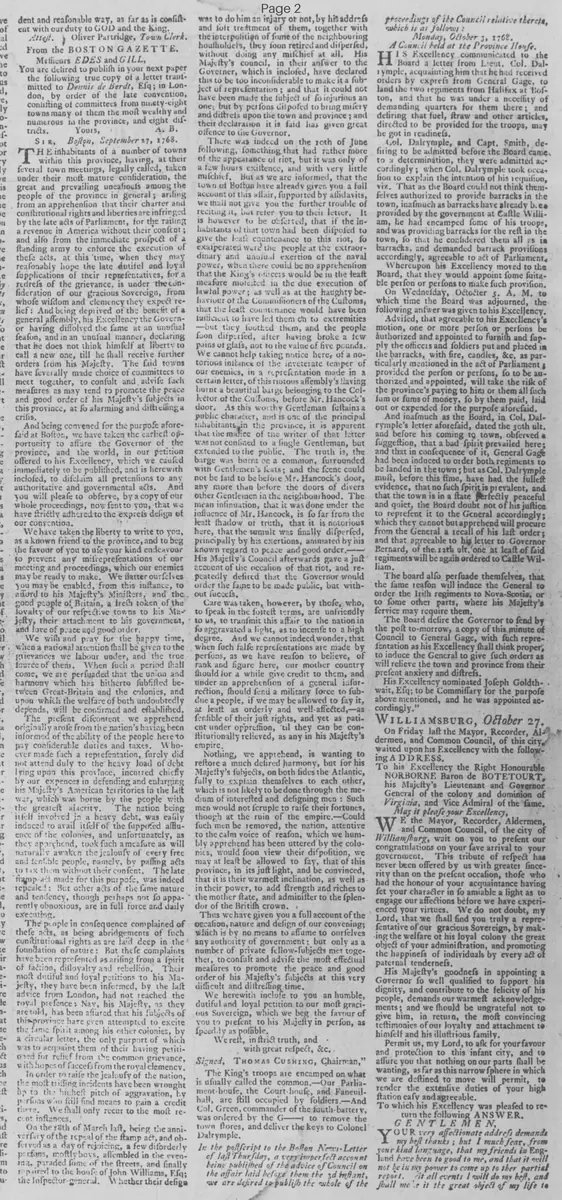
Messieurs EDES and GILL,
You are desired to publish in your next paper the following true copy of a letter transmitted to Dennis de Berdt, Esq: in London, by order of the late convention, consisting of committees from ninety-eight towns many of them the most wealthy and numerous in the province, and eight districts.
Yours,
A. B.
SIR, Boston, September 27, 1768.
THE inhabitants of a number of towns having, several town meetings, legally called, taken under their most mature consideration, the great and prevailing uneasiness among the people of the province in general; arising from an apprehension that their charter and constitutional rights and liberties are infringed by the late acts of Parliament, for raising a revenue in America without their consent; and also from the immediate prospect of a standing army to enforce the execution of these acts. at this time, when they may reasonably hope the late dutiful and loyal applications of their representatives, for a redress of the grievance, is under the consideration of our gracious Sovereign, from whose wisdom and clemency they expect relief : And being deprived of the benefit of a general assembly, his Excellency the Governor having dissolved the same at an unusual season, and in an unusual manner, declaring that he does not think himself at liberty to call a new one, till he shall receive further orders from his Majesty. The said towns have severally made choice of committees to meet together, to consult and advise such measures as may tend to promote the peace and good order of his Majesty's subjects in this province, at so alarming and distressing a crisis.
And being convened for the purpose aforesaid at Boston, we have taken the earliest opportunity to assure the Governor of the province, and the world, in our petition offered to his Excellency. which we caused immediately to be published, and is herewith enclosed, to disclaim all pretensions to any authoritative and governmental acts. And you will please to observe, by a copy of our whole proceedings, now sent to you, that we have strictly adhered to the express design of our convention.
We have taken the liberty to write to you, as a known friend to the province, and to beg the favour of you to use your kind endeavour to prevent any misrepresentations of our meeting and proceedings, which our enemies may be ready to make. We assure ourselves you may be enabled, from this instance, to afford to his Majesty's Ministers, and the good people of Britain, a fresh token of the loyalty of our respective towns to his Majesty, their attachment to his government, and love of peace and good order.
We wish and pray for the happy time, when a national attention shall be given to the grievances we labour under, and the true source of them. When such a period shall come, we are persuaded that the union and harmony which has hitherto subsisted between Great-Britain and the colonies. and upon which the welfare of both undoubtedly depends, will be confirmed and established.
The present discontent we apprehend originally arose from the nation's having been informed of the ability of the people here to pay considerable duties and taxes. Whoever made such a representation, surely did not attend duly to the heavy load of debt lying upon this province, incurred chiefly by our expenses in defending and enlarging his Majesty's American territories in the last war, which was borne by the people with the greatest alacrity. The nation being itself involved in a heavy debt, was easily induced to avail itself of the supposed affluence of the colonies, and unfortunately, as they apprehend, took such a measure as will naturally awaken the jealousy of every free and sensible people, namely, by passing acts to tax them without their consent. The late stamp act made for this purpose. was indeed repealed: But other acts of the same nature and tendency, though perhaps not so apparently obnoxious, are in full force and daily executing.
The people in consequence complained of these acts, as being abridgements of such constitutional rights as are laid deep in the foundation of nature: But these complaints have been represented as arising from a spirit of faction, disloyalty and rebellion. Their most dutiful and loyal petitions to his Majesty, they have been informed, by the last advice from London, had not reached the royal presence: Nay, his Majesty, as they are told, has been assured that his subjects of this province have even attempted to excite the same spirit among his other colonies, by a circular letter, the only purport of which was to acquaint them of their having petitioned for relief from the common grievance, with hopes of success from the royal clemency.
In order to raise the jealousy of the nation, the most trifling incidents have been wrought up to the highest pitch of aggravation, by persons who still find means to gain a credit there. We shall only recur to the most recent instances.
On the 18th of March last. being the anniversary of the repeal of the stamp act, and observed as a day of rejoicing, a few disorderly persons, mostly boys. assembled in the evening, paraded some of the streets, and finally repaired to the house of John Williams, Esq: the Inspector-general. Whether their design was to do him an injury or not. by his address and soft treatment of them, together with the interposition of some of the neighbouring householders, they soon retired and dispersed, without doing any mischief at all. His Majesty's council, in their answer to the Governor, which is enclosed, have declared this to be too inconsiderable to make it a subject of representation : and that it could not have been made the subject of so injurious an one but by persons disposed to bring misery and distress upon the town and province ; and their declaration it is said has given great offence to the Governor.
There was indeed on the 10th of June following, something that had rather more of the appearance of riot, but it was only of a few hours existence, and with very little mischief. But as we are informed, that the town of Boston have already given you a full account of this affair, supported by affidavits, we shall not give you the further trouble of reciting it, but refer you to their letter. It is however to be observed, that if the inhabitants of that town had been disposed to give the least countenance to this riot, so exasperated were the people at the extraordinary and unusual exertion of the naval power, when there could be no apprehension that the King's officers would be in the least measure molested in the due execution of legal power; as well as at the haughty behaviour of the Commissioners of the Customs, that the least countenance would have been sufficient to have led them on to extremities —but they soothed them, and the people soon dispersed, after having broke a few panes of glass, not to the value of five pounds.
We cannot help taking notice here, of a notorious instance of the inveterate temper of our enemies, in a representation made in a certain letter, of this riotous assembly's having burnt a beautiful barge belonging to the Collector of the Customs, before Mr. Hancock's door. As this worthy Gentleman sustains a public character, and is one of the principal inhabitants in the province, it is apparent that the malice of the writer of that letter was not confined to a single Gentleman, but extended to the public. The truth is, the barge was burnt on a common, surrounded with Gentlemen's seats: and the scene could not be said to be before Mr. Hancock's door, any more than before the doors of divers other Gentlemen in the neighbourhood. The mean insinuation. that it was done under the influence of Mr. Hancock. is so far from the least shadow of truth, that it is notorious here, that the tumult was finally dispersed, principally by his exertions, animated by his known regard to peace and good order.
His Majesty's Council afterwards gave a just account of the occasion of that riot, and repeatedly desired that the Governor would order the same to be made public, but without success.
Care was taken, however, by those, who, to speak in the softest terms, are unfriendly to us. to transmit this affair to the nation in so aggravated a light, as to incense to a high degree. And we cannot indeed wonder, that when such false representations are made by persons, as we have reason to believe, of rank and figure here, our mother country should for a while give credit to them, and under an apprehension of a general insurrection, should send a military force to subdue a people, if we may be allowed to say it, at least as orderly and well-affected,-as sensible of their just rights, and yet as patient under oppression, 'til they can be constitutionally relieved, as any in his Majesty's empire.
Nothing, we apprehend, is wanting to restore a much desired harmony, but for his Majesty's subjects, on both sides the Atlantic, fully to explain themselves to each other, which is not likely to be done through the medium of interested and designing men : Such men would not scruple to raise their fortunes, though at the ruin of the empire. Could such men be removed, the nation, attentive to the calm voice of reason, which we humbly apprehend has been uttered by the colonies, would soon view their disposition, we may at least be allowed to say, that of this province, in its just light, and be convinced. that it is their warmest inclination, as well as in their power, to add strength and riches to the mother state, and administer to the splendour of the British crown.
Thus we have given you a full account of the occasion, nature and design of our convention; which is by no means to assume to ourselves any authority of government: but only as a number of private fellow-subjects met together, to consult and advise the most effectual measures to promote the peace and good order of his Majesty's subjects at this very difficult and distressing time.
We herewith enclose to you an humble. dutiful and loyal petition to our most gracious Sovereign, which we beg the favour of you to present to his Majesty in person, as speedily as possible.
We rest, in strict truth, and with great respect, &c.
Signed, Thomas Cushing, Chairman.
The King's troops are encamped on what is usually called the common. Our Parliament-house, the Court-house, and Faneuil-hall, are still occupied by soldiers. And Col. Green, commander of the south battery. was ordered by the G—i to remove the town stores, and deliver the keys to Colonel Dalrymple.
In the postscript to the Boston News-Letter of last Thursday, a very imperfect account being published of the advice of Council on the affair laid before them the 3d instant, we are desired to publish the whole of the proceedings of the Council relative thereto. which is as follows :
Monday, October 3, 1768.
A Council held at the Province House.
HIS Excellency communicated to the Board a letter from Lieut. Col. Dalrymple, acquainting him that he had received orders by express from General Gage, to land the two regiments from Halifax at Boston, and that he was under a necessity of demanding quarters for them there: and desiring that fuel, straw and other articles, directed to be provided for the troops, may be got in readiness.
Col. Dalrymple, and Capt. Smith, desiring to be admitted before the Board came to a determination, they were admitted accordingly; when Col. Dalrymple took occasion to explain the intention of his requisition, viz. That as the Board could not think themselves authorized to provide barracks in the town, inasmuch as barracks have already been provided by the government at Castle William, he had encamped some of his troops, and was providing barracks for the rest in the town, so that he considered them all as in barracks, and demanded barrack provisions accordingly, agreeable to act of Parliament.
Whereupon his Excellency moved to the Board, that they would appoint some suitable person or persons to make such provision.
On Wednesday, October 5. A. M. to which time the Board was adjourned, the following answer was given to his Excellency.
Advised, that agreeable to his Excellency's motion, one or more person or persons be authorized and appointed to furnish and supply the officers and soldiers put and placed in the barracks, with fire, candles, &c. as particularly mentioned in the act of Parliament provided the person or persons, so to be authorized and appointed, will take the risk of the province's paying to him or them all such sum or sums of money. so by them paid, laid out or expended for the purpose aforesaid.
And inasmuch as the Board. in Col. Dalrymple's letter aforesaid, dated the 30th ult. and before his coming to town, observed a suggestion, that a bad spirit prevailed here; and that in consequence of it, General Gage had been induced to order both regiments to be landed in the town; but as Col. Dalrymple must, before this time, have had the fullest evidence, that no such spirit is prevalent, and that the town is in a state perfectly peaceful and quiet, the Board doubt not of his justice to represent it to the General accordingly; which they cannot but apprehend will procure from the General a recall of his last order; and that agreeable to his letter to Governor Bernard, of the 1st ult. one at least of said regiments will be again ordered to Castle William.
The board also persuade themselves, that the same reason will induce the General to order the British regiments to Nova-Scotia, or to some other parts, where his Majesty's service may require them.
The Board desire the Governor to send by the post to-morrow, a copy of this minute of Council to General Gage, with such representation as his Excellency shall think proper to induce the General to give such orders as will relieve the town and province from their present anxiety and distress.
His Excellency nominated Joseph Goldthwait, Esq: to be Commissary for the purpose above mentioned, and he was appointed accordingly.
What sub-type of article is it?
What themes does it cover?
What keywords are associated?
What entities or persons were involved?
Letter to Editor Details
Author
Thomas Cushing, Chairman
Recipient
Dennis De Berdt, Esq
Main Argument
the massachusetts convention asserts loyalty to the king while protesting parliament's revenue acts as violations of constitutional rights without consent, counters misrepresentations of local disorders as riots, and seeks to prevent further military escalation by explaining the province's peaceful disposition and heavy war debts.
Notable Details
- references to march 18, 1768 gathering at john williams' house
- june 10, 1768 riot involving customs barge
- enclosure of petition to the king
- council advice on quartering troops dated october 3-5, 1768