Thank you for visiting SNEWPapers!
Sign up free
The Sidney Herald
Sidney, Richland County, Montana
What is this article about?
Article advises Montana farmers to monitor stored grain for hot spots caused by temperature differences and moisture condensation, especially after rapid cold spells. Recommends frequent checks and turning the top layer to prevent insect issues. Notes recent research on temperature-moisture relationships in grain storage.
Clipping
OCR Quality
Full Text
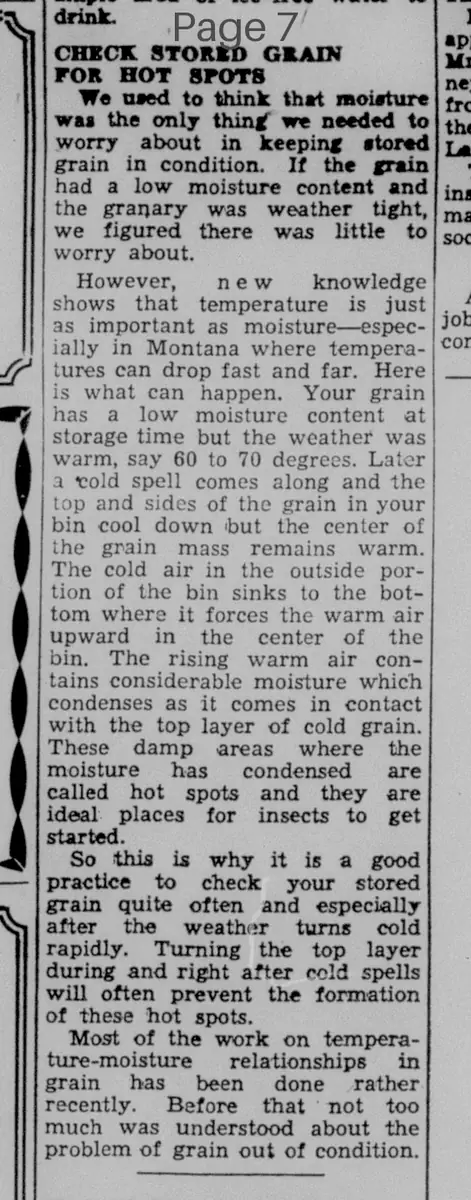
We used to think that moisture was the only thing we needed to worry about in keeping stored grain in condition. If the grain had a low moisture content and the granary was weather tight, we figured there was little to worry about.
However, new knowledge shows that temperature is just as important as moisture—especially in Montana where temperatures can drop fast and far. Here is what can happen. Your grain has a low moisture content at storage time but the weather was warm, say 60 to 70 degrees. Later a cold spell comes along and the top and sides of the grain in your bin cool down but the center of the grain mass remains warm. The cold air in the outside portion of the bin sinks to the bottom where it forces the warm air upward in the center of the bin. The rising warm air contains considerable moisture which condenses as it comes in contact with the top layer of cold grain. These damp areas where the moisture has condensed are called hot spots and they are ideal places for insects to get started.
So this is why it is a good practice to check your stored grain quite often and especially after the weather turns cold rapidly. Turning the top layer during and right after cold spells will often prevent the formation of these hot spots.
Most of the work on temperature-moisture relationships in grain has been done rather recently. Before that not too much was understood about the problem of grain out of condition.
What sub-type of article is it?
What keywords are associated?
Where did it happen?
Domestic News Details
Primary Location
Montana
Event Details
New knowledge emphasizes temperature's role alongside moisture in stored grain condition, particularly in Montana's variable weather. Warm-stored grain cools unevenly during cold spells, causing moisture condensation and hot spots that attract insects. Recommend frequent checks and turning top layer after cold weather to prevent issues. Recent research has clarified these temperature-moisture relationships.