Thank you for visiting SNEWPapers!
Sign up free
Story
September 16, 1897
Hutchinson Gazette
Hutchinson, Reno County, Kansas
What is this article about?
Article contrasts Japan's fair transition to gold standard, preserving debtor options for silver payments, with the US's 1873-1893 shifts that doubled debts via silver demonetization and mint closures, labeled as robbery by Denver Times-Sun.
Clipping
OCR Quality
95%
Excellent
Full Text
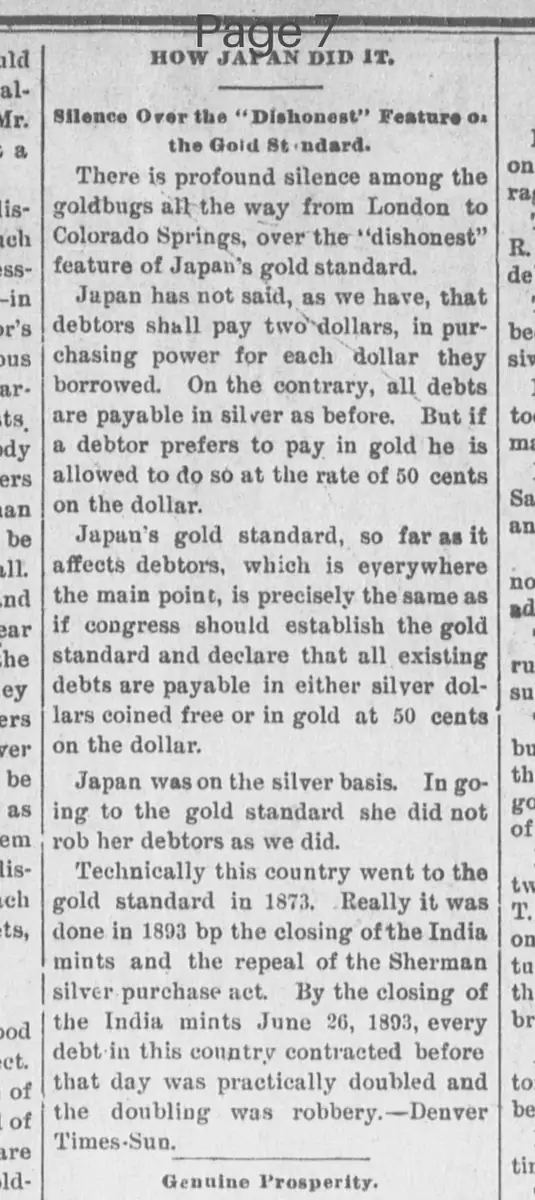
HOW JAPAN DID IT
Silence Over the "Dishonest" Feature Of the Gold Standard.
There is profound silence among the goldbugs all the way from London to Colorado Springs, over the "dishonest" feature of Japan's gold standard.
Japan has not said, as we have, that debtors shall pay two dollars, in purchasing power for each dollar they borrowed. On the contrary, all debts are payable in silver as before. But if a debtor prefers to pay in gold he is allowed to do so at the rate of 50 cents on the dollar.
Japan's gold standard, so far as it affects debtors, which is everywhere the main point, is precisely the same as if congress should establish the gold standard and declare that all existing debts are payable in either silver dollars coined free or in gold at 50 cents on the dollar.
Japan was on the silver basis. In going to the gold standard she did not rob her debtors as we did.
Technically this country went to the gold standard in 1873. Really it was done in 1893 by the closing of the India mints and the repeal of the Sherman silver purchase act. By the closing of the India mints June 26, 1893, every debt in this country contracted before that day was practically doubled and the doubling was robbery.—Denver Times-Sun.
Silence Over the "Dishonest" Feature Of the Gold Standard.
There is profound silence among the goldbugs all the way from London to Colorado Springs, over the "dishonest" feature of Japan's gold standard.
Japan has not said, as we have, that debtors shall pay two dollars, in purchasing power for each dollar they borrowed. On the contrary, all debts are payable in silver as before. But if a debtor prefers to pay in gold he is allowed to do so at the rate of 50 cents on the dollar.
Japan's gold standard, so far as it affects debtors, which is everywhere the main point, is precisely the same as if congress should establish the gold standard and declare that all existing debts are payable in either silver dollars coined free or in gold at 50 cents on the dollar.
Japan was on the silver basis. In going to the gold standard she did not rob her debtors as we did.
Technically this country went to the gold standard in 1873. Really it was done in 1893 by the closing of the India mints and the repeal of the Sherman silver purchase act. By the closing of the India mints June 26, 1893, every debt in this country contracted before that day was practically doubled and the doubling was robbery.—Denver Times-Sun.
What sub-type of article is it?
Historical Event
Curiosity
What themes does it cover?
Deception
Misfortune
Justice
What keywords are associated?
Gold Standard
Japan Currency
Debtor Payments
Us Silver Act
India Mints
Sherman Act Repeal
Where did it happen?
Japan, United States, London To Colorado Springs, India
Story Details
Location
Japan, United States, London To Colorado Springs, India
Event Date
1873; June 26, 1893
Story Details
Japan adopted the gold standard without increasing debtors' burdens by allowing payments in silver or gold at 50 cents on the dollar, unlike the US which effectively doubled debts through actions in 1873 and 1893, described as robbery.