Thank you for visiting SNEWPapers!
Sign up free
Daily State Sentinel
Indianapolis, Marion County, Indiana
What is this article about?
Proceedings of the Indiana State Legislature on March 2, 1863. Senate debated prison transfers, election laws, soldier voting, and negro exclusion bill. House faced quorum crisis due to absent Democratic members, leading to heated partisan debates on arrests, war policy, and Governor Morton amid Civil War tensions.
Merged-components note: These two sequential components continue the reporting on the Indiana Legislature proceedings without interruption in topic, forming a single article on Senate and House sessions.
Clippings
1 of 2
OCR Quality
Full Text
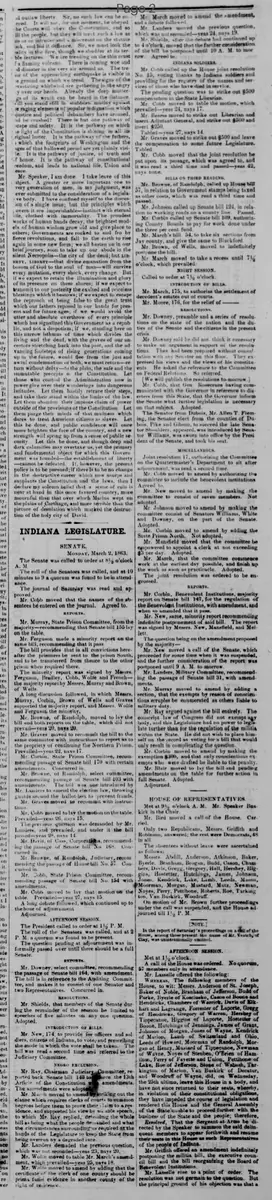
SENATE.
Monday, March 2, 1863.
The Senate was called to order at 8½ o'clock A. M.
The roll of the Senators was called, and at 10 minutes to 9 a quorum was found to be in attendance.
The journal of Saturday was read and approved.
Mr. Cobb moved that the names of the absentees be entered on the journal. Agreed to.
REPORTS.
Mr. Murray, State Prison Committee, from the majority—recommending that Senate bill 155 lay on the table.
Mr. Ferguson made a minority report on the same bill, recommending that it pass.
The bill provides that in all convictions hereafter the prisoners be sent to the prison South, and to be transferred from thence to the other prison when required there.
The minority report was signed by Messrs. Ferguson, Bradley, Cobb, Wolfe and French—the majority report by Messrs. Murray and Brown, of Wells.
A long discussion followed, in which Messrs. Murray, Corbin, Brown of Wells and Graves supported the majority report, and Messrs. Wolfe and Ferguson the minority.
Mr. Browne, of Randolph, moved to lay the bill and both reports on the table, which did not prevail—yeas 20, nays 20.
Mr. Graves moved to recommit the bill to the same committee with instructions to report as to the propriety of continuing the Northern Prison. Prevailed—yeas 22, nays 17.
Mr. Corbin, State Prison Committee, recommending passage of Senate bill 170 with certain amendments. Concurred in.
Mr. Browne, of Randolph, select committee, recommending passage of Senate bill 103 with amendments. The bill was one introduced by Mr. Landers to amend the election law, throwing guards around the ballot box to prevent frauds.
Mr. Graves moved to recommit with instructions.
Mr. Cobb moved to lay the motion on the table. Prevailed—yeas 26, nays 15.
The previous question was demanded by Mr. Landers, and prevailed, and under it the bill passed—yeas 25, nays 14.
Mr. Davis, of Cass, Corporations, recommending the passage of Senate bill No 168. Concurred in.
Mr. Browne, of Randolph, Judiciary, recommending the passage of House bill No. 5. Concurred in.
Mr. Cobb, State Prison Committee, recommending passage of Senate bill No. 154 with amendments.
Mr. Cobb moved to lay that motion on the table. Prevailed—yeas 27, nays 15.
A long debate followed, which continued up to the hour of adjournment.
Adjourned.
AFTERNOON SESSION.
The President called to order at 2½ P. M.
The roll of the Senators was called, and at 2 P. M. a quorum was found to be present.
The question pending at adjournment was informally passed over until there should be a full Senate.
REPORTS.
Mr. Downey, select committee, recommending the passage of Senate bill 164, with amendment. The bill is in reference to the Auditing Committee, and makes it to consist of one Senator and two Representatives. Concurred in.
RESOLUTIONS.
Mr. Shields, that members of the Senate during the remainder of the session be limited to speeches of five minutes on any one question. Adopted.
INTRODUCTION OF BILLS.
Mr. New, 174, to provide for officers and soldiers, citizens of Indiana, to vote, and prescribing the mode in which the vote shall be taken. The bill was read a second time and referred to the Judiciary Committee.
NEGRO EXCLUSION.
Mr. Ray, Chairman Judiciary Committee, reported back Senate bill 140 to enforce the 13th Article of the Constitution with amendments.
The amendments were adopted.
Mr. March moved to amend by striking out the clause which requires clerks of courts to summon negroes before them to prove their claim to a residence, and supported his view by an able speech, to which Mr. Ray replied, defending the whole bill as being what the people demanded and what the circumstances surrounding us required at the hands of the Legislature to keep the State from being overrun by a degraded race.
Mr. Landers demanded the previous question, which was not seconded—yeas 23, nays 20.
Mr. Wolfe moved to table Mr. March's amendment, which prevailed—yeas 25, nays 18.
Mr. Wolfe moved to amend by adding that the certificate of the clerk of one county should be prima facie evidence in another county of the right of residence.
Mr. March moved to amend the amendment, and a debate followed.
Mr. Landers moved the previous question, which was not seconded—yeas 24, nays 19.
Mr. Shields, after the debate had continued up to 4 o'clock, moved that the further consideration of the bill be postponed until 10 A. M. to-morrow.
Agreed to.
INDIANA SOLDIERS.
Mr. Cobb called up the House joint resolution No. 15, voting thanks to Indiana soldiers and providing for the registry of the names and services of those who have died in service.
The pending question was to strike out $500 compensation to the State Librarian.
Mr. Cobb moved to table the motion, which prevailed—yeas 24, nays 17.
Mr. Bearss moved to strike out Librarian and insert Adjutant General, and strike out $500 and insert $250.
Tabled—yeas 27, nays 14.
Mr. Graves moved to strike out $500 and leave the compensation to some future Legislature.
Tabled.
Mr. Cobb moved that the joint resolution be put upon its passage, which was agreed to, and it was read a third time and passed—yeas 42, nays none.
BILLS ON THIRD READING.
Mr. Browne, of Randolph, called up House bill 57, in relation to Government stamps being taxed as other costs, which was read a third time and passed.
Mr. Johnson called up Senate bill 124, in relation to working roads on a county line. Passed.
Mr. Corbin called up Senate bill 109, authorizing County Boards to pay for work done under the three per cent fund.
Mr. March's bill 54, to take six sections from Jay county, and give the same to Blackford.
Mr. Brown, of Wells, moved to indefinitely postpone the bill.
Mr. March moved to take a recess until 7 o'clock, which prevailed.
NIGHT SESSION.
Called to order at 7½ o'clock.
INTRODUCTION OF BILLS.
Mr. March, 175, to authorize the settlement of decedent's estates out of courts.
Mr. Moore, 176, for the relief of—
RESOLUTIONS,
Mr. Downey, preamble and a series of resolutions on the state of the nation and the duties of the Senate and the citizens in the present crisis.
Mr. Downey said he did not think it necessary to make an argument in support of the resolutions. They had been prepared without consultation with any Senator on this floor. They expressed his views and the views of his constituents. He asked the reference to the Committee on Federal Relations. So referred.
[We will publish the resolutions to-morrow.]
Mr. Cobb, that Gen. Rosecrans having communicated with the Governor in reference to deserters from this State, that the Governor inform the Senate what further legislation is necessary on that subject. Adopted.
The Senator from Dubois, Mr. Allen T. Fleming, the Senator elect from the counties of Dubois, Pike and Gibson, to succeed the late Senator Shoulders, appeared, was introduced by Senator Williams, was sworn into office by the President of the Senate, and took his seat.
MISCELLANEOUS.
Joint resolution 17, authorizing the Committee on the Quartermaster's Department to sit after adjournment, was read a second time.
Mr. Cobb moved to amend by authorizing the committee to include the benevolent institutions. Agreed to.
Mr. New moved to amend by making the committee to consist of seven members. Not adopted.
Mr. Johnson moved to amend by making the committee consist of Senators Williams, White and Downey, on the part of the Senate. Adopted.
Mr. Corbin moved to amend by adding the State Prison North. Not adopted.
Mr. Mansfield moved that the committee be empowered to appoint a clerk at not exceeding $3 per day. Adopted.
Mr. March, that the committee commence work at the earliest day possible, and finish up the work as soon as practicable. Adopted.
The joint resolution was ordered to be engrossed.
REPORTS.
Mr. Corbin, Benevolent Institutions, majority report on Senate bill 147, for the regulation of the Benevolent Institutions, with amendment, and when so amended that it pass.
Mr. New, same, minority report recommending indefinite postponement of said bill. The report was signed by Messrs. New, Mansfield, and Mellett.
The question being on the amendment proposed by the majority.
Mr. New moved a call of the Senate, which proceeded for some time when it was suspended, and the further consideration of the report was postponed until 9 A. M. to-morrow.
Mr. Landers, Military Committee, recommending the passage of Senate bill 31, with amendments.
Mr. Murray moved to amend by adding a section, that the exempts by reason of conscientious scruples be enumerated as others liable to military duty.
Mr. Ray argued against the bill entirely. The conscript law of Congress did not exempt any body, and this Legislature had no power to legislate further than for the regulation of the militia within the State. He did not wish to place himself on the record as voting for a bill that would only result in complicating the question.
Mr. Corbin moved to amend by making the exemption $300, and that only conscientious exempts who were drafted be liable to the penalty.
Mr. Blair moved to lay the bill and pending amendments on the table for further action in full Senate. Adopted.
Adjourned.
HOUSE OF REPRESENTATIVES.
Met at 9½ o'clock A. M. Mr. Speaker Buskirk in the Chair.
Mr. Bird moved a call of the House. Carried.
Only two Republicans, Messrs. Griffith and Robinson, present were Democrats—48 in all.
The absentees without leave were ascertained as follows:
Messrs. Abdill, Anderson, Atkinson, Baker, Byerle, Branham, Brogan, Budd, Cason, Chambers, Davis, Gregg, Gregory, Hall, Hershey, Higgins, Hostetter, Hutchings, James, Johnson, Jones, Kendrick, Lake, Lamb, Leeds, Mason, Moorman, Morgan, Mustard, Mutz, Newman, Noyes, Perry, Pettibone, Roberts, Roe, Tarkington, Van Buskirk, Woodruff.
On motion of Mr. Brown further proceedings under the call was suspended, and the House adjourned till 2 P. M.
[NOTE]
In the report of Saturday's proceedings on a call of the House, among those present the name of Mr. Veatch, of Clay, was unintentionally omitted.
AFTERNOON SESSION.
Met at 2 o'clock.
Call of the House was ordered. No quorum—57 members only in attendance.
Mr. Lasselle offered the following:
Whereas, The following members of the House, to wit: Messrs. Anderson of St. Joseph, Baker of Noble, Branham of Jefferson, Budd of Parke, Byerle of Kosciusko, Cason of Boone and Hendricks, Chambers of Warrick, Davis of Elkhart and Lagrange, Forrester of Laporte, Gregg of Hendricks, Gregory of Warren, Hershey of Tippecanoe, Higgins of Laporte, Hostetter of Boone, Hutchings of Jennings, James of Grant, Johnson of Morgan, Jones of Wayne, Kendrick of Marion, Lamb of Switzerland and Ohio, Leeds of Howard, Moorman of Randolph, Morgan of Henry, Mustard of Tippecanoe, Newman of Wayne, Noyes of Steuben, O'Brien of Hamilton, Perry of Fayette and Union, Pettibone of Lake, Roe of Jefferson, Stone of Wabash, Tarkington of Marion, Van Buskirk of Decatur, and Woodruff of Wayne, did, on Wednesday, the 25th ultimo, leave this House in a body, and have not since returned to their seats, whereby, in violation of their constitutional obligations, they have impeded the course of legislation and rendered this House and the General Assembly of the State unable to proceed further with the business of the State and the people; therefore,
Resolved, That the Sergeant-at-Arms be directed by the Speaker to summon the said delinquent members to appear forthwith and resume their seat in this House as such Representatives of the people of Indiana. Ordered.
Mr. Griffith offered an amendment indefinitely postponing the militia bill, the executive council bill and the bill reorganizing the Board of Benevolent Institutions.
Mr. Lasselle rose to a point of order. The resolution was not germane to the question. But the principal ground of his objection was that a—
call of the House just being had, and a quorum not ascertained to be present, we could do nothing further than take measures to compel the attendance of absentees, and adjourn from day to day to that end.
Mr. Wolfe offered a resolution declaring that the fears of the minority that the majority proposed to trample on the rights of any officer under the Constitution, or of any portion of the people of the State, were groundless; and that secession was not peculiar to Southern citizens, but was a growth in the North, as exemplified by the action of the minority in this House.
The Speaker pronounced the amendment of Mr. Griffith and the resolution of Mr. Wolfe out of order. The House could do no business, acting under a call of the House, except action pertaining to the quorum.
Mr. Hanna hoped that the resolution of the gentleman from Cass [Mr. Lasselle] would not pass, inasmuch as the gentleman from Jefferson [Mr. Branham] had said that he would not be brought back here unless he came to hang Democrats. Democrat, did not wish just now to be hung, promising with traitors or secessionists, North or South. He was opposed to compromising with traitors or secessionists. North or South. He was for fighting according to law first, and otherwise if it became necessary.
He therefore moved that the Sergeant at Arms be sent at once after the delinquents.
Mr. Lasselle defended his resolution. He thought that first the Sergeant-at-Arms should be requested to notify them, and then if they refused to obey they might be compelled.
Mr. Priest opposed the resolution. Those men who were seceding were making a record for themselves. Let us deal mildly but firmly with them. Let us meet here from day to day, and if the sixty one days under the Constitution expired without requisite legislation, theirs would be the responsibility. He feared if the Sergeant-at-Arms was sent after these recusants blood-shed would be precipitated.
Mr. Kilgore: Many members upon this floor did not in their canvass take the position in regard to the war that they here have taken. If they had, they would have been defeated. The gentleman from Jackson did not dare in his canvass to take the position he assumes here.
Mr. Brown: When I was a candidate for the position I now occupy the Hon. John F. Carr was my competitor, and, to say the least about him, you must admit he is a politician of large experience. In the canvass I asked Mr. Carr whether he indorsed the Crittenden compromise; whether he indorsed the abolition of slavery in the District of Columbia; whether he indorsed the confiscation act; and, as soon as the President issued his emancipation proclamation, I took issue upon that and denounced it. I indorsed the Crittenden proposition and opposed the others, and directly said that I would not support the Administration in the prosecution of the war for the Abolition purpose for which the Administration was prosecuting it.
Mr. Kilgore: Your people must not be very patriotic or honest in purpose.
Mr. Brown: Does the gentleman question the honesty or integrity of the people I represent?
Mr. Kilgore: I must question their intelligence.
Mr. Brown: If the gentleman questions the intelligence of the noble people whom I have the honor to represent, and makes himself the exclusive judge as to their intelligence, I will make no objection. But if he calls in question their honesty or integrity, I will hold him to the strictest accountability for it.
Mr. Puett: I will say to the gentleman from Delaware [Mr. Kilgore] that if Governor Morton will resign, and appeal again to the people, every one of the majority on this floor will do likewise. His Excellency will then quickly see how the matter stands between the people and himself and the people and ourselves.
Mr. Kilgore: Before Governor Morton could resign and go before the people on ten days notice, Indiana would be made the tail end of the Southern Confederacy. He proceeded, arguing against Hanna's militia bill, and in vindication of Governor Morton's policy. Whenever you attempt to paralyze the arm of the Governor of Indiana, whenever you say to Abraham Lincoln that because of his infamous proclamation you would not support the war, you were doing all you could to defeat the crushing of this rebellion. Before we would be brought back here to support such measures and such resolutions we would wade in blood up to our knees.
Voices: Ah! ah! ah! Does your party own all the gunpowder?
Mr. Hanna: Does not the Constitution authorize the arrest of the delinquents?
Mr. Kilgore: It does.
Mr. Hanna: Did you not swear to support that Constitution?
Mr. Kilgore: So did you, but your measure proposes to subvert that Constitution.
Mr. Hanna: I have sworn to support that Constitution and I will do it. I will do it.
Mr. Kilgore continued, assailing Judge Perkins especially, and the Democratic party generally, with intense bitterness. It was upon the military bill that his party friends had bolted. And to defeat that bill we would continue to bolt until we were brought in here and the doors bolted. You have not passed that bill, and you never shall. We have been sitting here day after day listening to the propositions and measures of gentlemen until we had become convinced that their sole object was to assist the Southern Rebels to overthrow this Government. If he had been President of the United States he would not have issued the proclamation of emancipation, because the leaders of the Democratic party stood ready to go before the country and misrepresent it, and because the grand Army of the Union were doing their work without it. But since the proclamation had been issued he indorsed it. Yes, sir, yes, sir.
Mr. Hanna made a point of order. The President's proclamation was not legitimately under debate.
After a statement by Mr. Speaker, Mr. Kilgore was allowed to proceed. He gave his reasons at length for supporting the proclamation.
Mr. Packard opposed the resolution. Any efforts under it would be futile. The State of Indiana would never send up another such a set of men to break a quorum and defeat necessary legislation. In reply to Mr. Kilgore, Mr. Packard said that he had told his constituents that whenever the President turned the war into an abolition raid, he would oppose it.
Mr. Packard went on, showing in a masterly manner the inconsistencies of the minority, who, by unconstitutional and revolutionary means, would defeat the will of the majority. He [Mr. Packard] defended at length the measures proposed by the majority, and objected to by the minority. The gentleman desired to know what Governor Morton had done that we should seek to throw guards around his power? One thing Governor Morton was doing was the placing of arms in the hands of secret political societies, to overthrow the liberties of the people. He has seen citizens of this State seized and dragged out of it without lifting a finger in their behalf. A beautiful Executive he is! He has used members of the army to overawe the people in fair elections; he has seen printing offices mobbed; he has seen private residences invaded; he has seen women insulted. He, the excellent Governor, had seen all this, and had not bestirred himself in respect of the rights and liberties of the citizen. He had, too, used the money appropriated by the Democrats of the last Legislature, and used it all for his own glory. It was for these things that the Democracy wished to bring this Governor down to his proper level. The people had pronounced against Governor Morton. He wished the plan of the gentleman from Putnam could be carried out, that the Governor would resign with the rest of us. The people would send us and a Democratic Governor back in less than two weeks by a majority of 100,000. He would tell the gentleman from Delaware that he might just as well leave his seat at once if he supposed the measures he opposed could not be carried and other legislation be done.
The minority of this House had sought by all means of intimidation to overawe the majority. But we were not to be terrified. We were not to be bullied. They send up their resolutions here from the army. He knew how it was done. They were sent up by shoulder straps. We would demand from Governor Morton and his Abolition minions the full and free expression of our rights as representatives of the people.
From the commencement of the session revolution had been inaugurated by the minority. They had finally lost their seats. Let them go. They were off to Madison on a big drunk, he understood. The Sergeant-at-Arms could not find them if he was sent after them. We shall do nothing, if the gentleman from Delaware speaks by authority, for we will press these measures. We will press them—and if rightful legislation is defeated we will go back to our people, and appealing to them, they will teach this Executive, and the minority on this floor doing now his bidding what their duties were.
Mr. Buskirk (Mr. Holcomb in the chair) argued in favor of the power to arrest absentees, but was opposed in this juncture to the exercise of it.
Mr. Brown spoke in favor of the resolution. He said that these men, in violation of their oath of office, of their duty to their constituents and themselves, have, without just cause, seceded from this body. We have the constitutional right and power to compel their attendance, and let us at least attempt to do so. It is a duty we owe to ourselves and our constituents. Gentlemen say, let us consult policy. Principle and not policy is what is right, and actuates the true man. He who consults policy without reference to principle will never arrive at very great prominence. The gentleman from Delaware has told us that any attempt to bring back the minority to this House would end in insurrection. He tells us that were he with the seceders, and an attempt was made to compel him to return to this House and submit to the majority passing what he calls unconstitutional and unjust measures, he would wade in blood to his knees before he would submit. Bold, heroic man!—We have been told that we dare not attempt to compel their attendance. Shall we bow down and submit to their mighty boasts? Our constituents demand that we shall protect their rights and sustain our own characters. An Abolition meeting has been held here to overawe and terrify this body, and do we submit in silence?
Sir, the present Administration by its acts shows that its policy is not indorsed by the people, and it now attempts by vile despotic and arbitrary measures to compel the people to an indorsement of it. In kingdoms where the people are raised in ignorance and taught to believe that their rulers are by divine inspiration endowed with power to rule them and pronounce laws for them, such a procedure might succeed, but not in this country. Here the people are sovereigns and not subjects.
We are told that insurrection and civil war will take place. I trust and believe not. I cannot think that the minority will so far forget themselves as to attempt to resist the rightful officer of this body in the exercise of his sworn and constitutional duties. But if civil war, anarchy and desolation are to come; if the spirit of mobocracy is to be invoked; if a military despotism is to be established instead of a free-government and a Constitution guaranteeing liberty to the citizen, the sooner the people know it the better. Let the issue be made. But woe upon him who attempts to override the Constitution and enslave the people. When such a system is about to be inaugurated the people of the country (not your towns and cities) will rise and speak in thunder tones, and when they speak they will speak the law.
A fearful and dreadful crisis is upon us. I trust peace and order may be maintained. It is the duty of all good citizens to enjoin upon their neighbors a strict observance of the Constitution and the laws, and to obey the Constitution and the laws themselves. But it is the slave and coward who bows down with passive submission to a party in power, when that party is endeavoring to take from him his constitutional rights, and place him in a state of subjection. Let the resolution be passed. Let the Sergeant-at-Arms apprehend these secessionists, and bring them before the bar of this House and show them that we know our rights, and that their cowardly threats are of no avail.
Mr. Wolfe pursued the argument against the resolution. He feared there was no remedy for our National or State evils.
Mr. Puett opposed the resolution. The minority had done just as the Southern Senators. He avowed in his place in the presence of the citizens here and the few members who heard him, that no man could bolt without violating the oath he had taken, and contributing to tear down our Government. The minority might use every parliamentary rule to defeat, but if they bolted, they were just as much secessionists as any member of Jeff. Davis's Government. He [Mr. Puett] should remain in and about the city until this Legislature expired by constitutional limit, ready to transact the people's business. Let us stay here, standing by the Constitution and the laws, doing our duty.
Mr. Burton opposed the resolution. We could accomplish nothing under it. If we must use force, every purpose of a Legislature of a free people would be defeated. A Legislature held together by the bayonet would be no Legislature of the people of Indiana.
In reply to Mr. Kilgore, he declared himself opposed to voting another man or dollar for the prosecution of the war under the President's emancipation proclamation. He had told the people so. He told this Legislature so now. If the people are tired of this war; if they wished to hold a peace convention, in God's name let them hold it. They carried on the war: they furnished the men and means, not Abraham Lincoln. And when they said the war must stop, stop it would. And the people were with him in the sentiment that the war must stop. As to bolting, the people know that the majority were here ready to pass the measures they demanded.
Mr. Niblack was for sending for the bolters by the Sergeant-at-Arms, with the proper writ to arrest them. We had just as well know now as not whether these gentlemen intended to precipitate the State into revolution on an issue so trivial as this. He was, for the purpose of treating the threats of the minority with defiance, for the adoption of strenuous measures.
The day of compromise had passed with him. If we do anything, let us do it like men, coming square up to the work. These men knew that it was their duty to be in their seats. We had no proposition to make to them. This was a contest for power in this Legislature. They (the minority) were endeavoring to undo the work the people did at the ballot-box. We will send writs for these gentlemen and arrest them by due process of law.
Mr. Howk moved to lay the resolution and pending amendments on the table.
Mr. Brown and Mr. Griffith demanded the yeas and nays.
Yeas 35, nays 17.
Resolution and amendments laid on the table.
Adjourned until 9 A. M. to-morrow.
What sub-type of article is it?
What keywords are associated?
What entities or persons were involved?
Where did it happen?
Domestic News Details
Primary Location
Indiana
Event Date
Monday, March 2, 1863
Key Persons
Outcome
multiple bills passed or recommitted in senate; house quorum not achieved due to absent democratic members; resolution to summon absentees tabled (yeas 35, nays 17); intense partisan debates on war policy, emancipation, and arrests.
Event Details
The Indiana Senate convened with quorum, approved journal, debated and acted on bills related to state prisons, election laws, soldier voting, negro exclusion under the 13th Article of the Constitution, and resolutions thanking soldiers. New senator Allen T. Fleming sworn in. The House faced repeated calls revealing only 48-57 members present, mostly Democrats, with many Republicans absent since February 25, impeding legislation. Debates ensued on summoning absentees, accusations of secession, support for war and Governor Morton, opposition to emancipation proclamation, and threats of violence.